Wize University Physics Textbook (Master) > Fluid Mechanics
Pascal's Principle
Popular Courses
MCAT
General Course
Intro to Physics
University Study Guides
Physics
General Course
PHYSICS 1A03
McMaster University
PHYS 115
Queen's University
PHYS 211
University of Calgary
PHYS 131
University of British Columbia
Intro to Physics
University Study Guides
PHYS*1080
University of Guelph
PHYS 223
University of Calgary
PHY 1321
University of Ottawa
PHYS 102A
University of Victoria
PHYS 221
University of Calgary
PHYS-1400
University of Windsor
PHY 1331
University of Ottawa
PHY 1122
University of Ottawa
PHYS 142
McGill University
PHYC 1190
Dalhousie University
ENGG 212
University of Calgary
ENGG 212
University of Calgary
0:00 / 0:00
Pascal's Principle
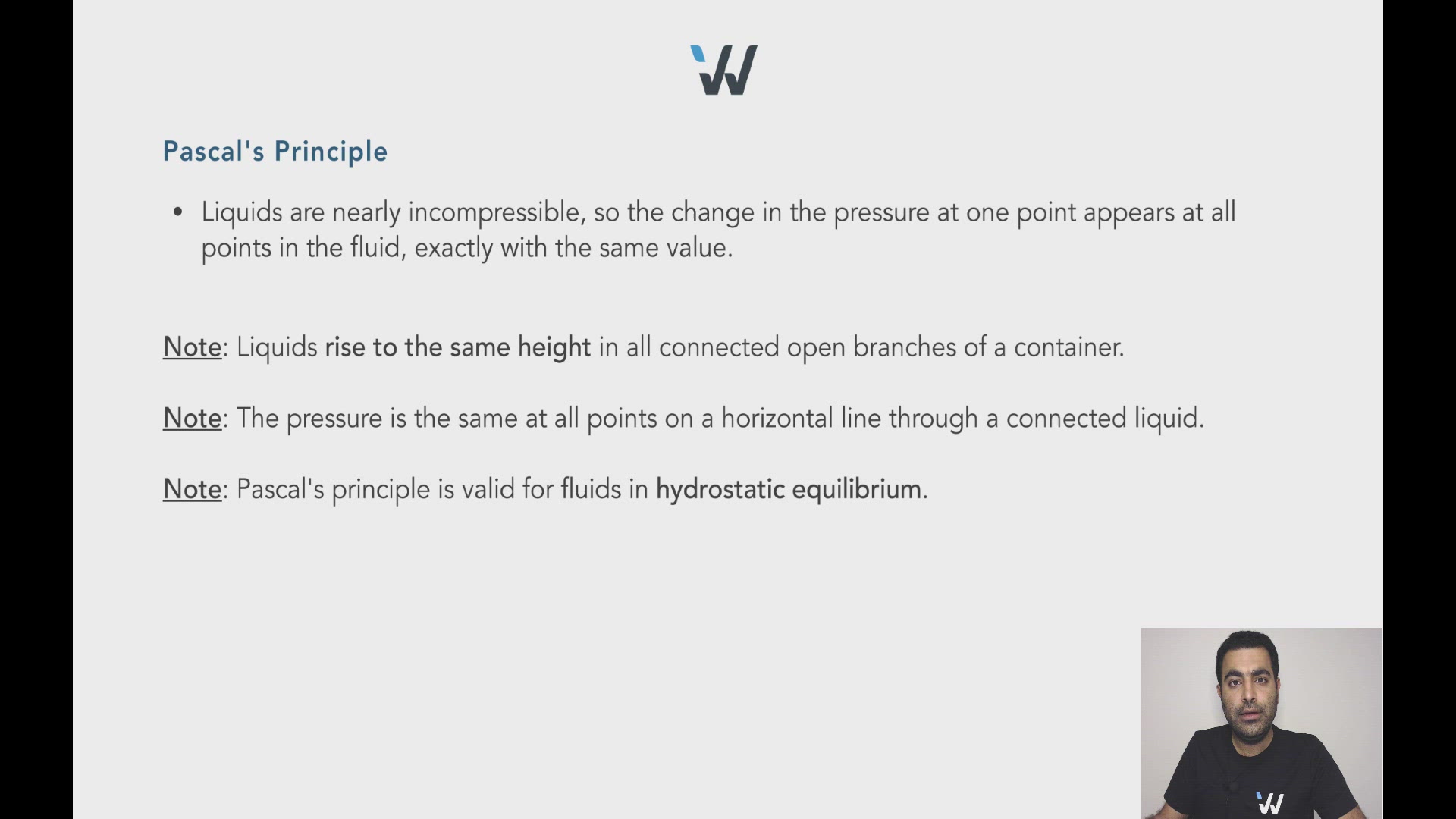
Liquids are nearly incompressible, so the change in the pressure at one point appears at all points in the fluid, exactly with the same value. This is known as Pascal's principle.
Wize Concept
Pascal's Principle tells us that:
- Liquids rise to the same height in all connected open branches of a container.
- The pressure is the same at all points on a horizontal line through a connected liquid.
Watch Out!
Pascal's principle is valid for fluids in hydrostatic equilibrium when the fluid is not flowing around and moving.
Exam Tip
To use Pascal's principle for static fluid, draw a horizontal line passing through the fluid and set the pressure of different points on this line equal to each other.
Example: Pouring Oil in a U-Tube Filled with Water
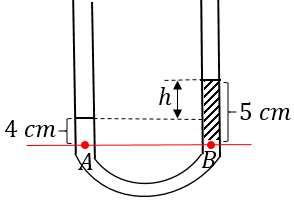
In a U-tube filled with some water, we slowly pour vegetable oil in one arm.
a) Find the density of the oil if cm (the density of water is kg/m3).
b) What is the difference in the water levels in the right arm, before and after pouring the oil ?
Part a)
Since we have a static fluid and points A and B are on a horizontal line (at the same level), they have equal pressures by Pascal's principle.
Part b)
The difference in the water level in the right arm, before and after pouring the oil, is the same as the average between the water levels now: that is, the current difference between the water levels in the left and right arms divided by .
m
Practice: U-Tube Filled with Multiple Fluids
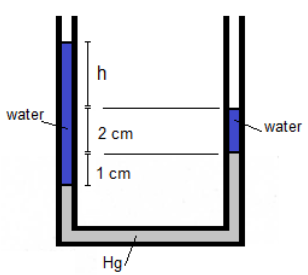
A U-tube of uniform cross-sectional area and open to the atmosphere is partially filled with mercury (). Water is then poured into both arms. The equilibrium configuration of the tube is shown in the figure.
a) Find the value of .
b) How would the value of change if, instead of water we had a liquid with density , and instead of mercury we had a liquid with density ?