Popular Courses
MCAT
General Course
Intro to Physics
University Study Guides
Physics
General Course
PHYSICS 1A03
McMaster University
PHYS 115
Queen's University
PHYS 115
Queen's University
PHYS 211
University of Calgary
PHYS 131
University of British Columbia
Intro to Physics
University Study Guides
PHYS 223
University of Calgary
PHYS*1080
University of Guelph
PHY 1321
University of Ottawa
PHYS 102A
University of Victoria
PHYS 221
University of Calgary
PHYS-1400
University of Windsor
PHY 1331
University of Ottawa
PHY 1122
University of Ottawa
PHYS 142
McGill University
PHYC 1190
Dalhousie University
ENGG 212
University of Calgary
0:00 / 0:00
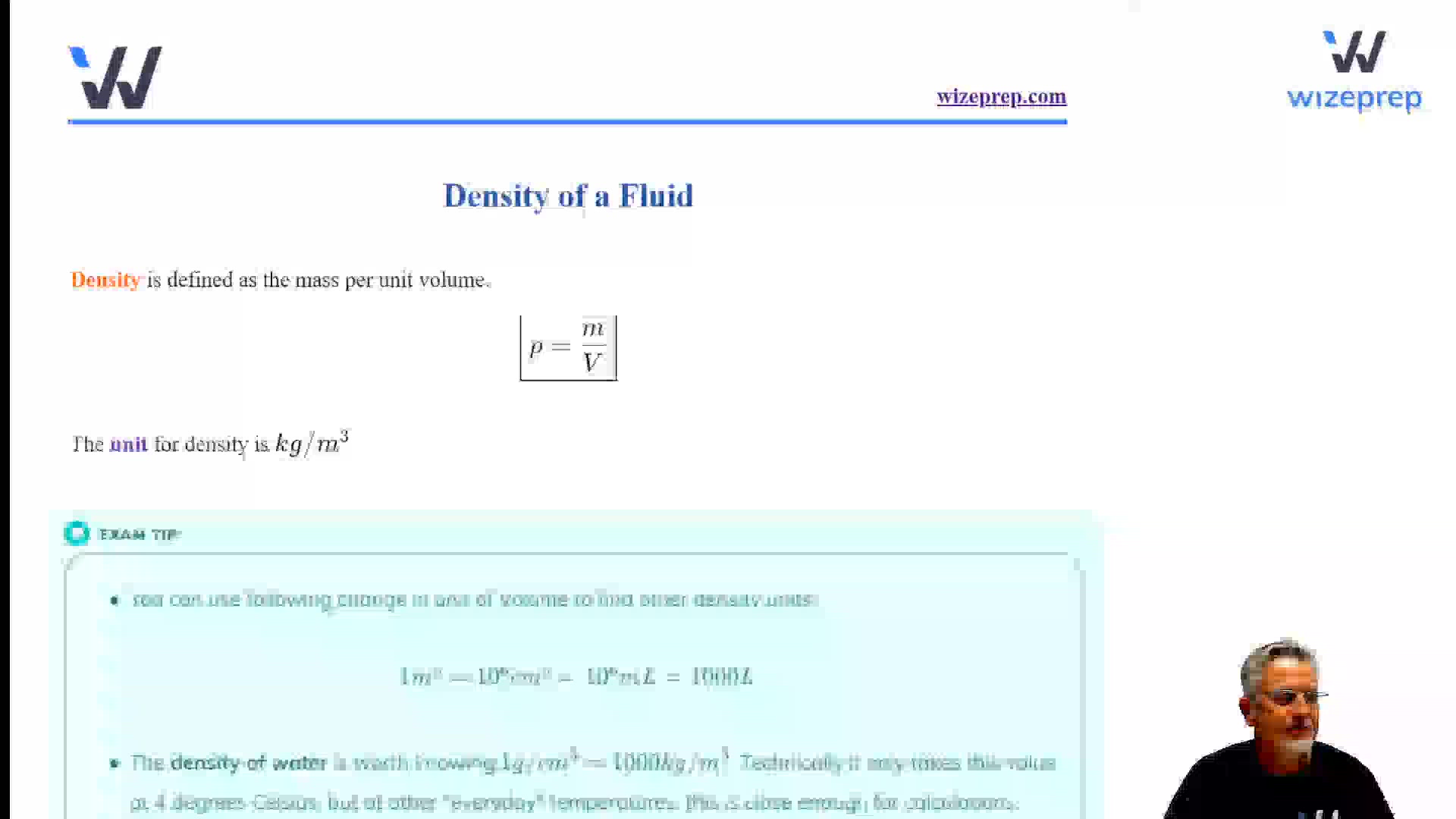
Density of a Fluid
Density is defined as the mass per unit volume.
The unit for density is
Exam Tip
- You can use following change in unit of Volume to find other density units:
- The density of water is worth knowing:. Technically it only takes this value at 4 degrees Celsius, but at other "everyday" temperatures, this is close enough for calculations.
Wize Concept
The specific gravity of an object is its density divided by the density of water (1000 kg/m3).
0:00 / 0:00
Mass and Density
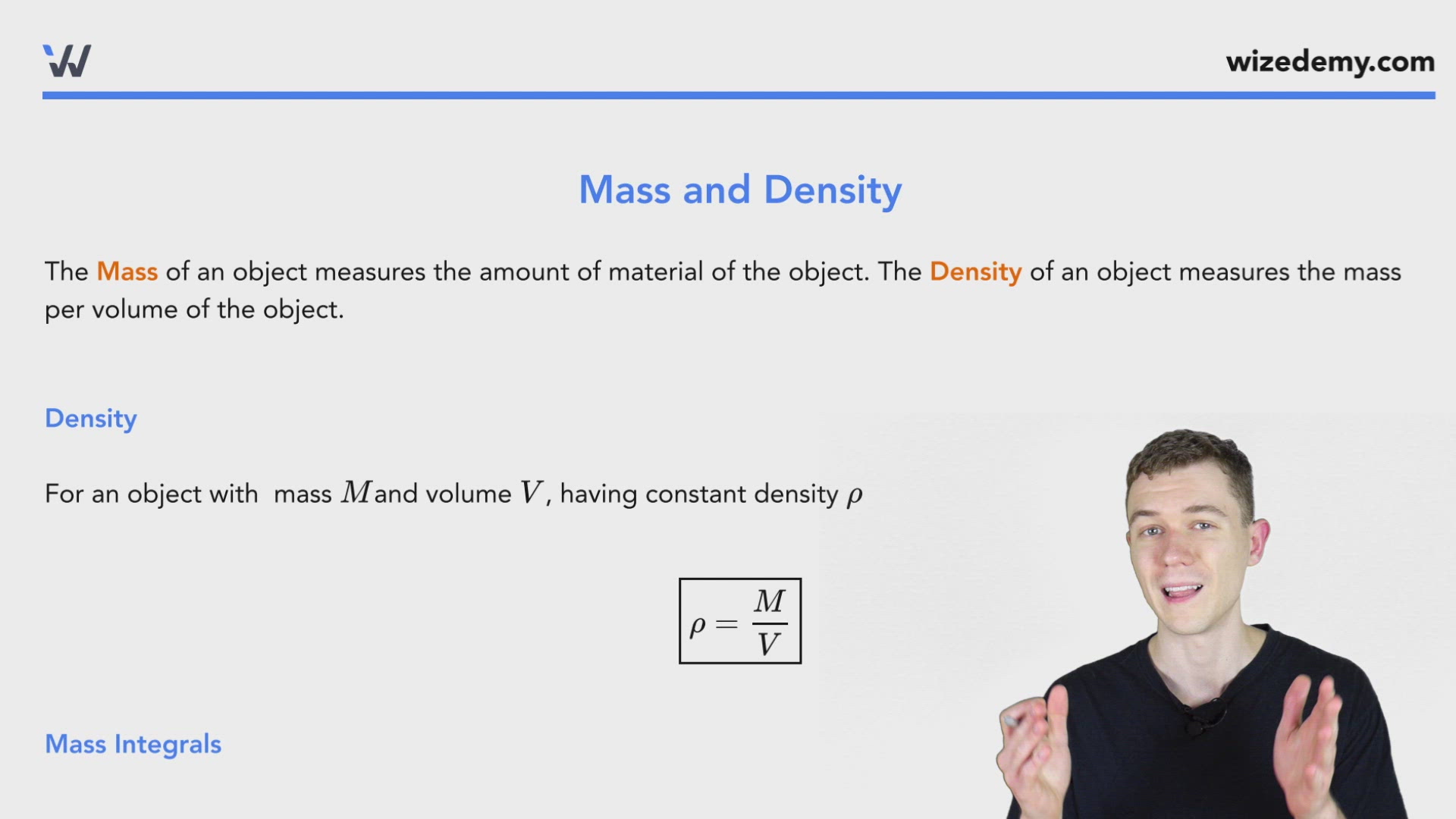
The Mass of an object measures the amount of material of the object. The Density of an object measures the mass per volume of the object.
Density
For an object with mass and volume , having constant density
Mass Integrals
For an object with cross-sectional area and density on the interval , the mass is
Wize Concept
For 3-D solids, can be determined using the methods of volume of revolution by cross sections.
0:00 / 0:00
Pressure
Pressure is defined as the normal force per unit of area of surface:
Pressure is a scalar quantity. It involves the molecules or atoms of the fluid striking the container walls.
The SI unit of pressure is the Pascal:
Hydrostatic Pressure
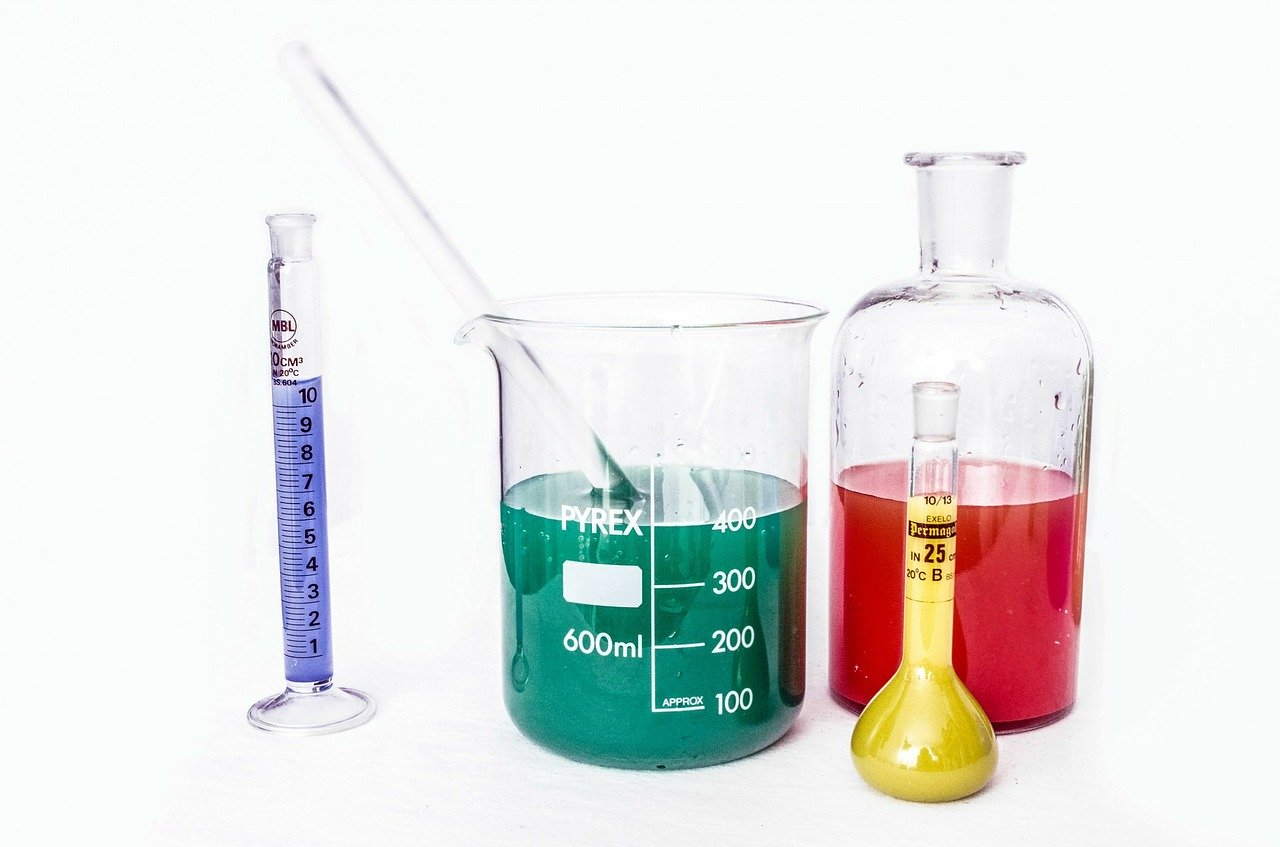
Hydrostatic pressure is due to the weight of a column of fluid in stationary fluids:
where is the cross sectional area of the column, is the height of column and is the density of the fluid.
Wize Concept
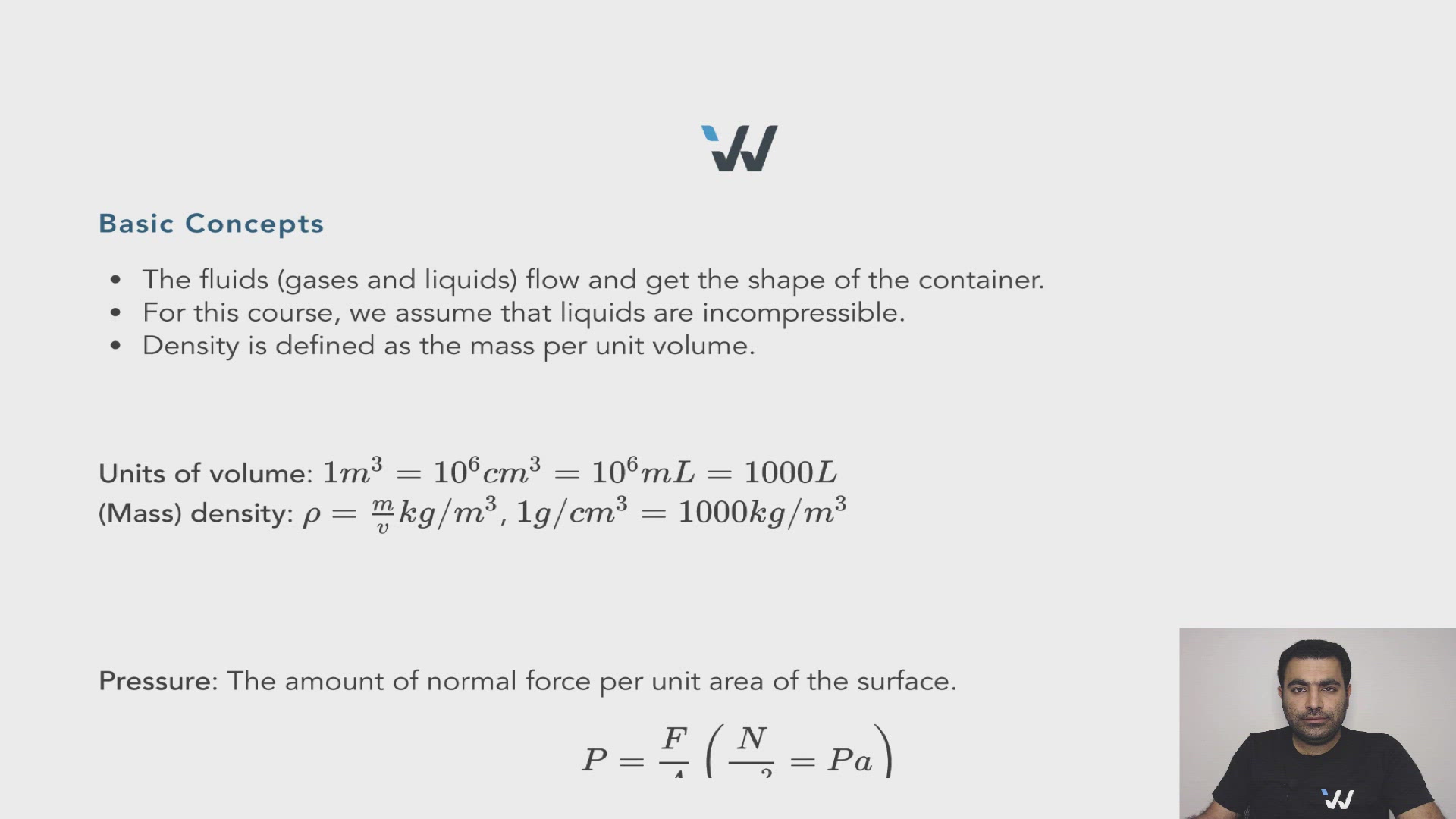
- Fluids (gases and liquids) assume the shape of their containers.
- For this course, we assume that liquids are incompressible (I.e. their density does not depend on pressure).
The variation of pressure with depth for an incompressible liquid is given by:
- is the pressure at the surface.
- is the depth of the liquid column between and .
Air Pressure
Air pressure on the surface of the earth is assumed to be constant and is defined to be equal to one atmosphere, (defined at sea level):
Exam Tip
For many exam problems it is enough to consider to be .
Gauge pressure is defined as the absolute pressure subtracted by the air pressure.
Example: Gauge Pressure
At depth within a saltwater solution, the gauge pressure is times the atmospheric pressure. At what depth will the total pressure be times the atmospheric pressure?
At depth , we have:
Therefore the atmospheric pressure can be expressed in terms of the depth as follows:
At the unknown depth , we have:
Therefore, the new depth has to be of the original depth.
Practice: Vacuum Lifter
A vacuum lifter consists of five suction pads that are attached to a frame and a vacuum pump that keeps the pressure under each pad at atm. The diameter of each pad is cm. What is the heaviest piece of glass that can be lifted using this vacuum lifter?