Wize University Physics Textbook (Master) > Equilibrium & Elasticity
Stability and Balance
Popular Courses
MCAT
General Course
PHYSICS 1201A/B
Western University
Intro to Physics
University Study Guides
Physics
General Course
PHYS 211
University of Calgary
PCS 211
Toronto Metropolitan University
PHYS 204
Concordia University
Intro to Physics
University Study Guides
APSC 111
Queen's University
PHYS 102A
University of Victoria
PHYS 205
Concordia University
PHYS 221
University of Calgary
PCS 120
Toronto Metropolitan University
PHYS 110
University of Victoria
LE/PHYS 1800 3.00
York University
PHYS-1400
University of Windsor
PHYS 142
McGill University
PHYC 1190
Dalhousie University
ENGG 212
University of Calgary
PHY132H1
University of Toronto
Stability
Stability:
- a measure of how likely an object is to topple over when pushed or moved
- how well a body or system maintains its equilibrium
- Stable objects are difficult to topple over, while unstable objects topple easily.
- An object's stability is directly related to its center of gravity and the base it rests on. In other words, it depends on the location of the object's center of mass with respect to the pivot or tipping point
Static Equilibrium:
- a physical state where an object, body or system is at rest and all opposing forces and torques are balanced.
- In this state, the object does not accelerate, tilt, or rotate, and the net force and net torque acting on it is zero.
An object is in Static Equilibrium if two conditions are satisfied:
1. Sum F's = 0 (all forces cancel or balance in the x, y, and z directions)
2. Sum T's = 0 (all torques cancel or balance about the x, y, and z axes)
There are 3 TYPES of EQUILIBRIUM:
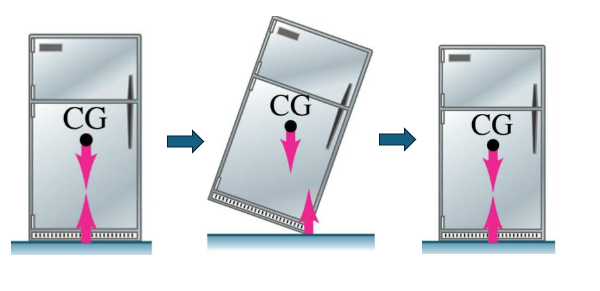
- Stable: when displaced from equilibrium, the object will return to its original starting position, due to a net force or torque acting in a direction opposite to the direction of displacement. Requires that the object is not displaced beyond the 'tipping' point (eg. where the center of mass moves beyond the tipping point
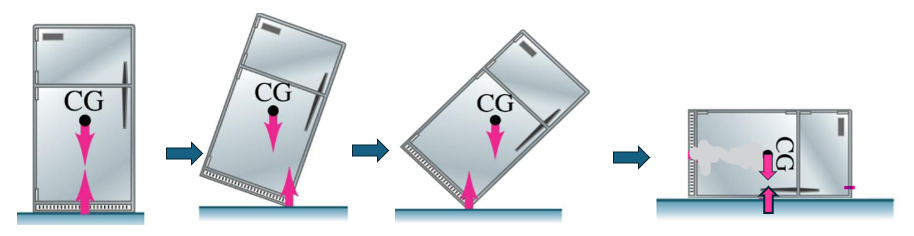
2. Unstable: when displaced from equilibrium, the object will tip or fall over in the direction of the displacement, due to a net force or torque acting in the same direction as the displacement.
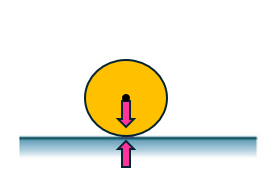
3. Neutral: if the object's equilibrium position is independent of displacements from its original position. An example would be a 'ball' - it will remain in equilibrium even if it is rolled forward or backward.