Popular Courses
MCAT
General Course
Intro to Physics
University Study Guides
Physics
General Course
PHYS 115
Queen's University
PHYS 211
University of Calgary
PHYS 131
University of British Columbia
Intro to Physics
University Study Guides
PHYS*1080
University of Guelph
PHY 1321
University of Ottawa
PHYS 102A
University of Victoria
PHYS 221
University of Calgary
PHYS-1400
University of Windsor
PHY 1331
University of Ottawa
PHY 1122
University of Ottawa
PHYS 142
McGill University
PHYC 1190
Dalhousie University
ENGG 212
University of Calgary
ENGG 212
University of Calgary
PHYS 1050
University of Manitoba
PHYS 101
Simon Fraser University
0:00 / 0:00
Bernoulli's Principle
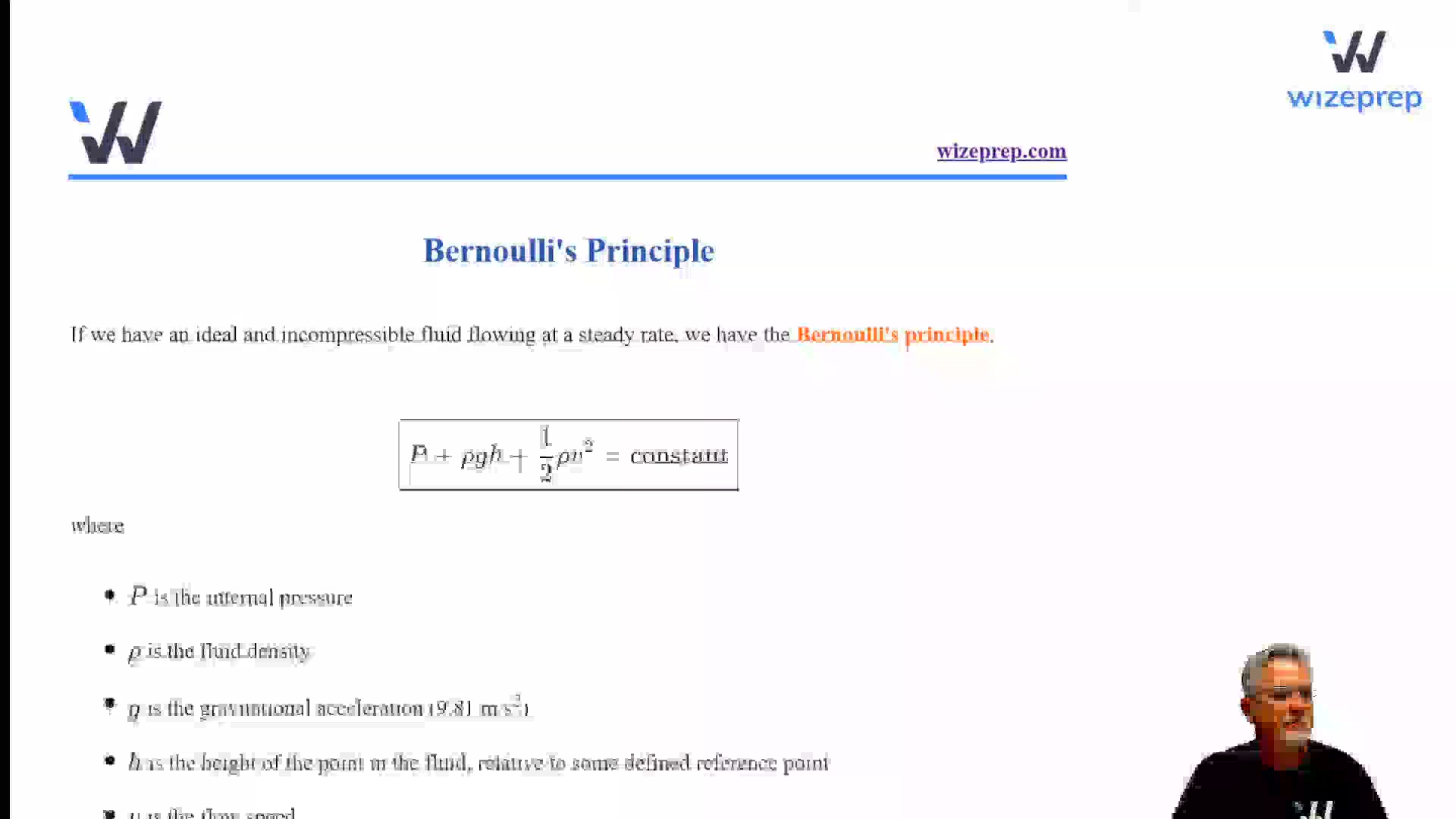
If we have an ideal and incompressible fluid flowing at a steady rate, we have the Bernoulli's principle.
where
- is the internal pressure
- is the fluid density
- is the gravitational acceleration (9.81 m/s2)
- is the height of the point in the fluid, relative to some defined reference point
- is the flow speed
So for any two points inside of our flow, we have:

Wize Tip
You can think of the Bernoulli's principle as a form of energy conservation. The three terms corresponds to the internal energy (), the fluid potential energy (), and the fluid kinetic energy ().
Exam Tip
By picking two point inside of the flow and write down Bernoulli's equation for them, we can find missing information about one point by knowing those information about another point.
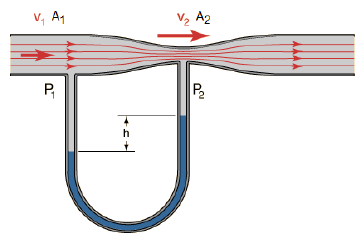
Now let's look at two points in the flow at the same height but with different cross sectional area (Points 1 an 2 in the upper pipe)
Wize Tip
Pressure is lower in the section of the tube in which the fluid moves faster!
Flow Rates and Continuity
To talk about moving fluids, we are going to define some flow rates, which will tell us how much fluid is moving per unit time.
Flow rate is usually defined as the rate of change in volume and it is shown by :
where is the volume of fluid.
If we assume that we have a steady flow and incompressible fluid, flow rate is constant and could be written in the following form:
where is the cross-sectional area of the fluid (perpendicular to the flow direction), and is the flow speed.

Now by comparing any two points in the flow and putting their flow rates equal to each other we can find continuity equation:
Wize Concept
All that the continuity equation is telling us is that the amount of fluid in must be the same as the fluid out. You can think of this like fluid conservation, just like how we have energy and momentum conservation.
Wize Tip
A wider pipe will have slower flow, and a thinner pipe will have faster flow.
Think about a garden hose with water coming out. If you put your thumb on half the opening of the pipe (thinning the cross-sectional area of the flow), the water will shoot out FASTER.
Exam Tip
If the cross sectional area of a pipe at one point is so much bigger than the cross sectional area of the rest of the pipe, we can assume that the velocity of the fluid in that point is approximately zero (for example the velocity of water in a huge tank!).
Example: Venturi System
A Venturi flow-meter for a tube of water is shown below. There is stationary mercury in the U-tube, shown by the blue color, with density kg/m3 , and flowing water on the top pipe with density kg/m3 . We know that and m/s. What is the difference in the height of mercury in the U-tube?
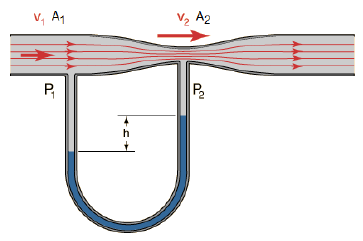
Note that because has pushed down the mercury more compared to .
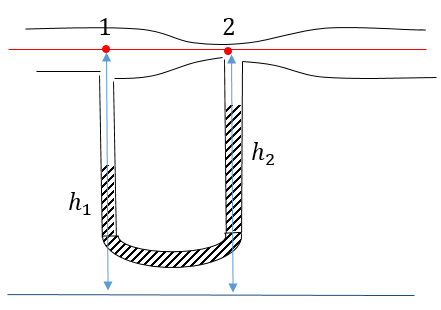
Here we have a static fluid (mercury) and a flowing fluid (water).
So, we can use Pascal's principle for Mercury and Bernoulli's equation for water.
Write Bernoulli's Equation for the flow of water at points #1 and #2.
Here no matter where the reference height is (it could be the bottom of the picture, or the line passing through these points, or any other horizontal line).
Then the difference in pressures is given by:
Let's use the continuity equation to sub in and get:
Write Pascal's principle for the stationary mercury: at point A at the surface of the lower branch on the left, and point B at the same level on the right branch.
where we have ignored the columns of water above the surface of the higher branch, since they're the same for both branches and so the pressure from them cancels out.
The difference in pressures is then:
Let's equate the two expressions we have for the pressure difference:
Isolate the height:
Put the numbers in:
(m)
Practice: Leaking Tank
A large cylindrical container is filled with water to a height and it is open to air on top. The density of the liquid is .
1) Find the velocity of the emerging fluid from the hole at the base of the container. (Assume that the cross sectional area of the container is much larger compared to the size of the hole)