Double-Slit Interference
The principle of double-slit interference is similar to the interference of sound waves from two speakers.

Bright fringes on the screen correspond to constructive interference. The path difference is given by:
- is the distance between the two slits
- is the angle that the rays make with the horizontal
Dark fringes on the screen correspond to destructive interference. The path difference is given by:
An equivalent way of writing this would be:
Let's define the following quantities:
- is the distance on the screen between the point of interference and the central bright spot
- is the distance between the slits and the screen
Then we have a triangle in which:
Example: Number of Fringes
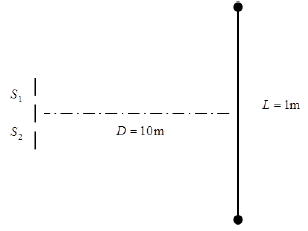
A double-slit configuration is shown below, with mm. Light with a wavelength of nm is used.
a) How many (bright) fringes are displayed on the screen?
b) How many (bright) fringes would be displayed on the screen if we double its length (m)?
c) What if the length of the screen is unlimited?
Part a)
For bright fringes we have constructive interference, so we use:
Since we can use the small angle approximation: to get:
The maximum distance on the screen is half the length of the screen, so we'll use to find the maximum that can be:
But this means we have fringes on either side, and we also have to add the central bright fringe (corresponding to ), so we have a total of:
bright fringes
Part b)
If the length of the screen doubles, the doubles, and the we solved for also doubles (because they are directly proportional in the equation), so we get .
Again, we have bright fringes on either side, and if we also count the central bright fringe, the total is:
bright fringes
Part c)
When the length of the screen is infinite, we could have a maximum angle of , and . Therefore our equation becomes:
And we get:
We have bright fringes on either side, so the total is:
bright fringes
Double-Slit Interference
Bright fringes on the screen correspond to constructive interference.
- is the distance between the two slits
- is the angle that the rays make with the horizontal
Dark fringes on the screen correspond to destructive interference. The path difference is given by:
Let's define the following quantities:
- is the distance on the screen between the point of interference and the central bright spot
- is the distance between the slits and the screen
Then we have a triangle in which:
A diffraction grating has multiple slits located the same distance apart. But same principle and same formulas work as of the double-slit.
If you're given number of lines per unit length () , the distance between each two slits could be found from: