Create a free account to get started

Unlock full course notes by signing up

  • Video lessons taught by top educators
  • Practice questions with guided solutions
  • Written review notes for reference
  • Expert answers anytime from course tutors

Viscosity


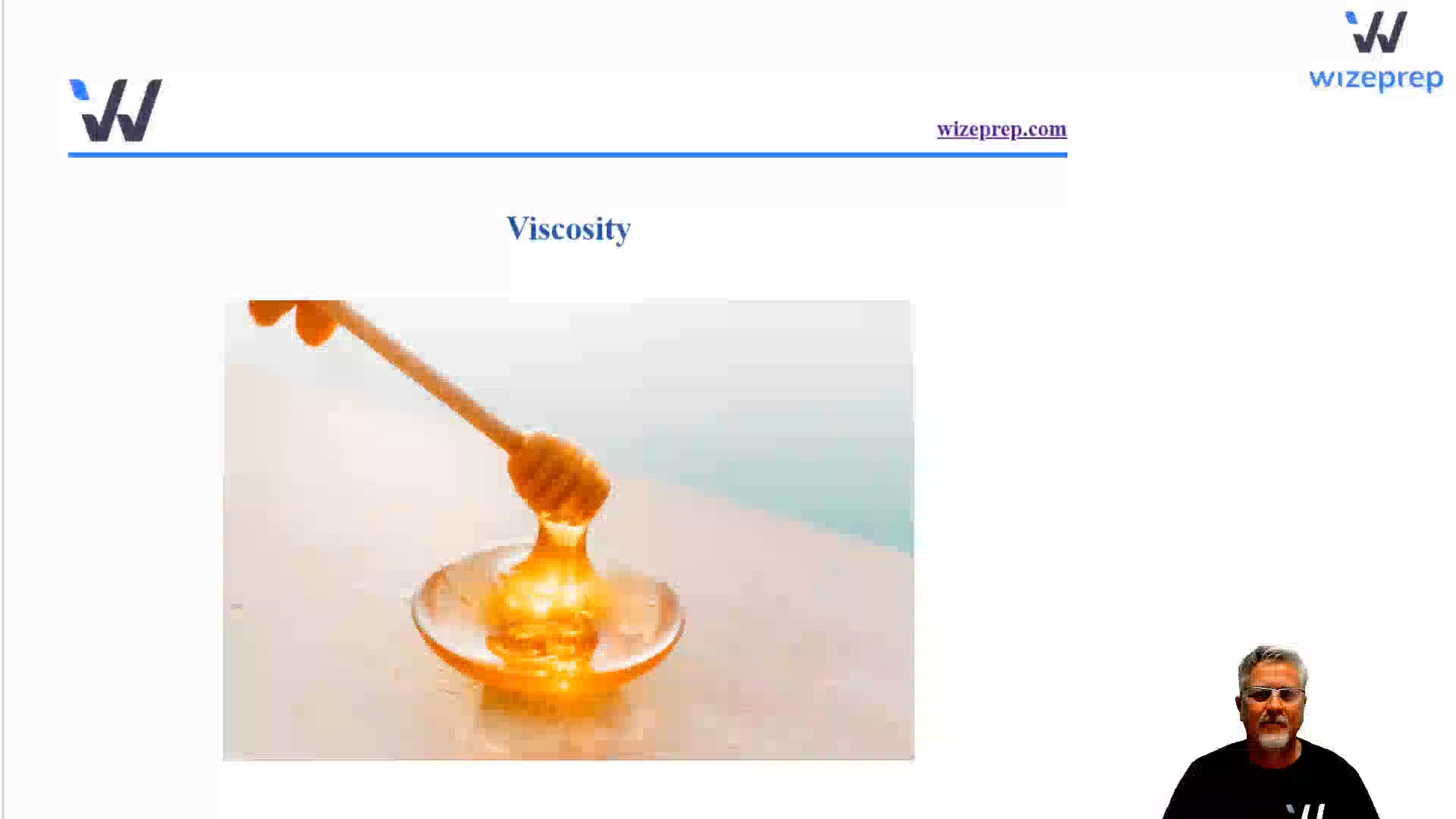
Image illustrating Viscosity


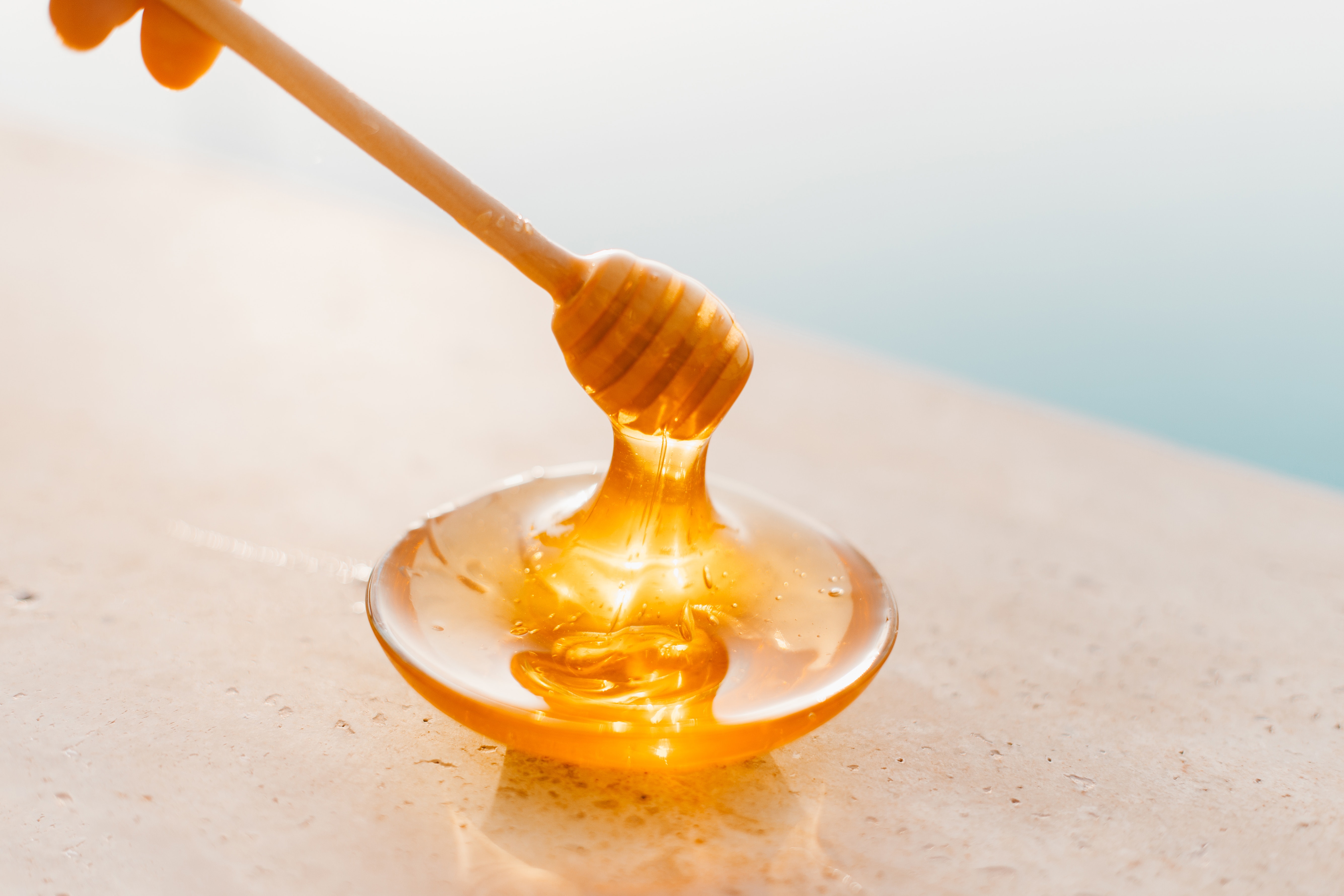
Viscosity is the internal friction and resistance of a fluid to flow. This comes from the attractive forces (cohesive) between molecules in our fluid. The more viscous, the thicker the fluid, and the more it clings to itself and the surfaces it is flowing on.
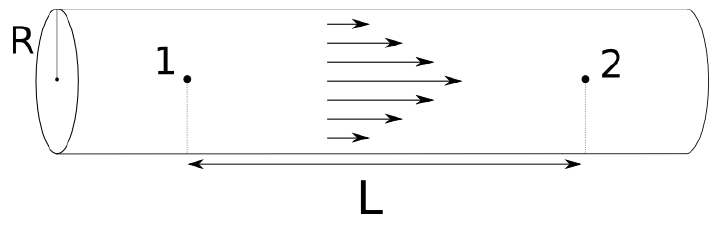


Image illustrating Viscosity


Flow of a viscous fluid in a horizontal cylindrical pipe:

A pressure gradient is required to overcome the friction.


Poiseuille's Law says that the flow rate QQ of a fluid with viscosity constant η\eta from a pipe of length LL and radius RR is related to the pressure gradient between two ends of the pipe as:


 P1−P2=8η LQπR4 \boxed{ \ P_1-P_2=8\eta \ \frac{LQ}{\pi R^4} \ }


Rearranging for the flow rate we have:


 Q=πR2ΔP8ηL \boxed{ \ Q=\dfrac{\pi R^2\Delta P}{8\eta L} \ }


Here:

  • η\eta is the viscosity constant, and its units are Pa⋅s=kg⋅m−1⋅s−1Pa\cdot s=kg\cdot m^{-1}\cdot s^{-1}
  • RR is the radius of the pipe
  • QQ is the flow rate


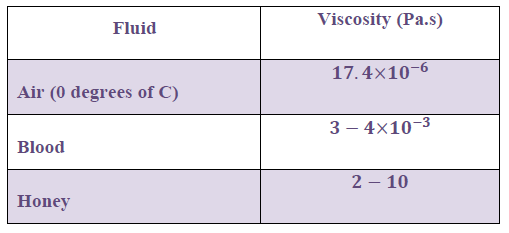
Below we have the viscosity constant of a few fluids in Pa⋅sPa\cdot s:


Image illustrating Viscosity


Practice: Viscosity


A tube of radius 0.1500.150 mm and length 2.502.50 cm has a viscous fluid flowing through it at the rate of 0.1200.120 cm3/s . The viscosity is 1.00×10⁻³\ 1.00\times10^{-3} Pa s. What is the gauge pressure needed at one end to push the fluid out of the other end?

Choose an answer

Create a free account to get started

Unlock full course notes by signing up

  • Video lessons taught by top educators
  • Practice questions with guided solutions
  • Written review notes for reference
  • Expert answers anytime from course tutors