PV Diagrams & Thermodynamic Processes
- The system is taken from some initial state to some final state.
- Every line in a PV-diagram is a thermodynamic process.
- There are four well known thermodynamic processes

- The adiabatic line is always steeper than the isothermal line because:
- In an isothermal process:
- In an adiabatic process:
Work done on an ideal gas
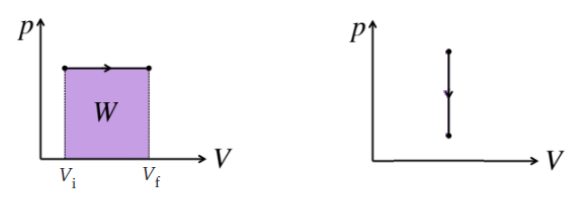
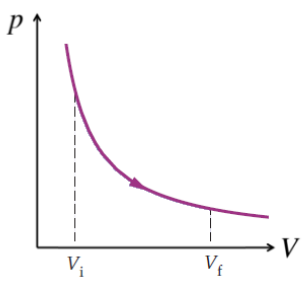
Work done on the gas during a thermodynamic process is the area under the PV curve, from initial state (i) to final state (f).
EXPANSION of the gas COMPRESSION of the gas
A Carnot engine is operated between ��H and ��C according to the PV – Diagram given below where the processes 𝑎 → 𝑏 and 𝑐 → 𝑑 are isothermal and the processes 𝑏 → 𝑐 and 𝑑 → 𝑎 are adiabatic.
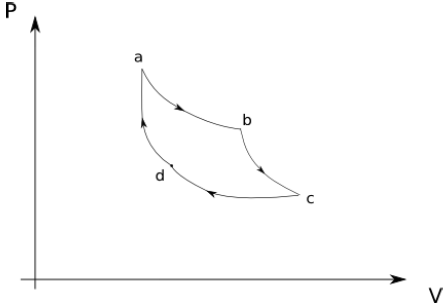
a) Find the efficiency of this engine as a function of ��C and ��H
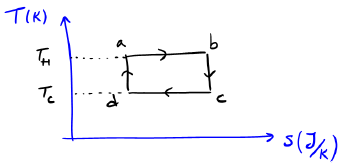
b) Show Carnot Cycle in TS –diagram
Solution:
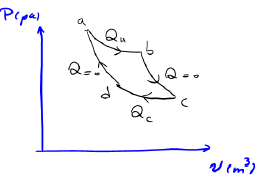
a)
for adiabatic processes
for
for
plug into efficiency equation
b)