Ampere's Law
Finding the magnetic field due to a current distribution can be very tedious. Ampere's Law gives a much easier way of finding magnetic fields if the current distribution has a high degree of symmetry.
- To use Ampere's Law, we first need to draw an Amperian loop.
- The magnetic field at all points on the Amperian Loop should be equal.
- Once an Amperian loop is defined, Ampere's Law is written as follows:

Example: Ampere's Law for a Straight Wire
Using Ampere’s law, find the magnetic field around a long straight wire with current .
If we pick any circular path that is centered on the wire, the magnetic field will be constant at all points on the circle. Therefore, our Amperian loop will be a circle of radius centered on the wire.

The current enclosed is simply the current of the wire, .
At all points on our Amperian loop, the magnetic field points in the same direction as our loop, so the dot product will reduce to a simple multiplication. Because the magnetic field is constant at all points, we can pull it out of the integral.
This gives the same formula that we took for granted before.
Example: Ampere's Law for a Solenoid
Find the magnetic field inside an infinite solenoid carrying a current of I.
Hint: Define the enclosed current by using the number density of loops () instead of trying to use the absolute number of wire segments (). Because the solenoid is infinite, this would be tricky to define!
We need to draw a cross-section of a solenoid - see below. In our drawing, the top part of the solenoid has current pointing into the page, and the bottom part of the solenoid has current that points out of the page. Note that inside the solenoid, the magnetic field is uniform and points to the left.
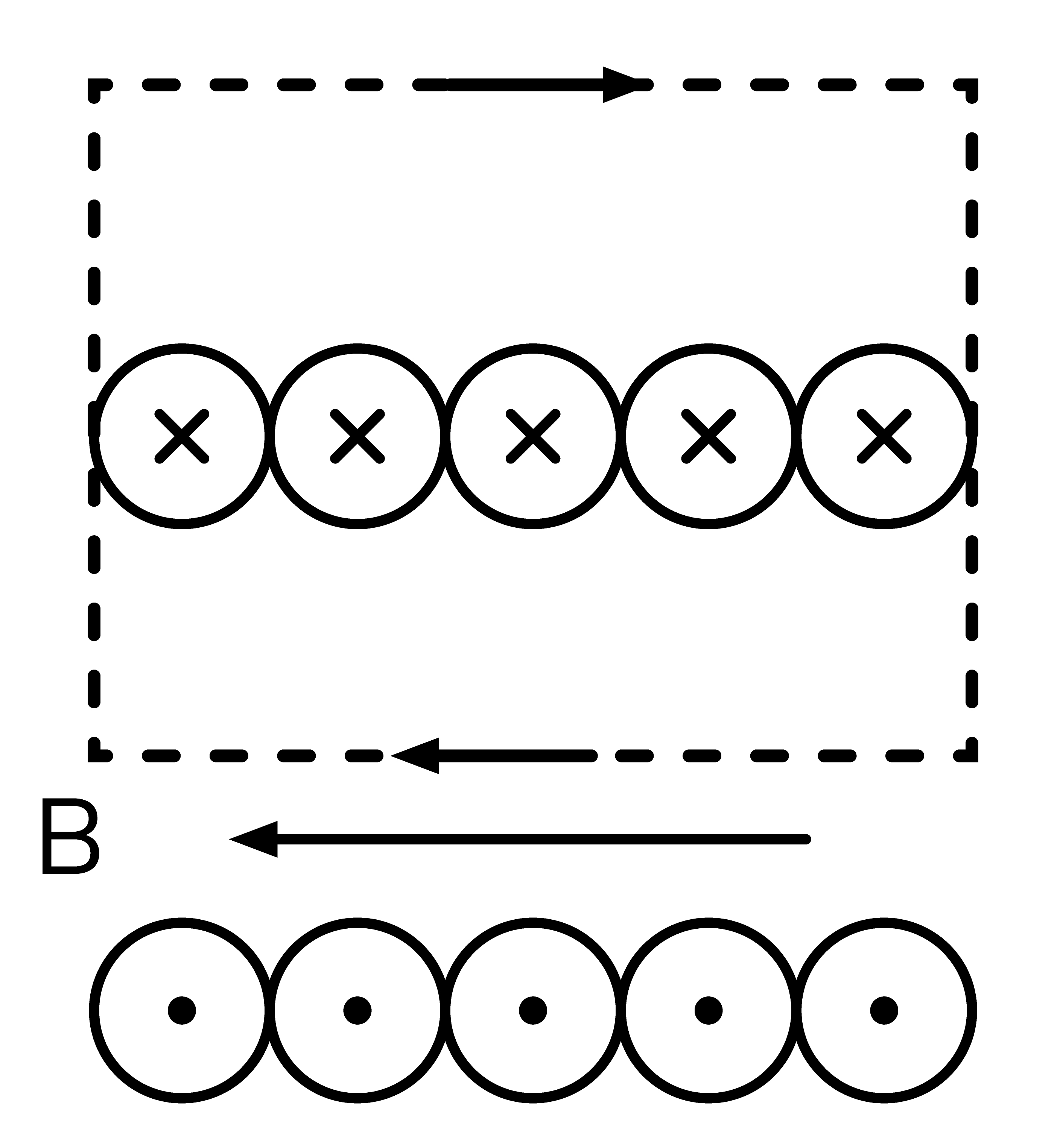
The Amperian loop is going to be a rectangle that spans the interior and exterior of the solenoid. The sides that "cut through" the solenoid have zero magnetic field contribution because the loop and field lines are perpendicular, so .
The parallel piece of the Amperian loop is far away from the solenoid, so the magnetic field contributions are negligible. (This is why we consider the solenoid to be "infinite").
Inside the solenoid, we are just left with one piece of the loop of length L that is in the same direction as the magnetic field, so the dot product inside the Ampere's Law integral reduces to a simple multiplication.
Note, it's a good thing that there is no "L" in our final answer. The length of our Amperian loop is a variable that we introduced into the problem, so it should not make an impact on our final result!