Electric Fields of Special Charge Distributions
There are certain charge configurations that appear more often than others, both for exam settings and real-life applications, that are worth mentioning.
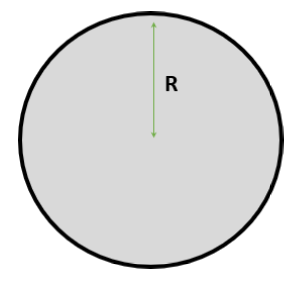
- Conducting charged sphere: This charge distribution has the same formula as the electric field for a point charge, but the electric field is zero inside the conductor.
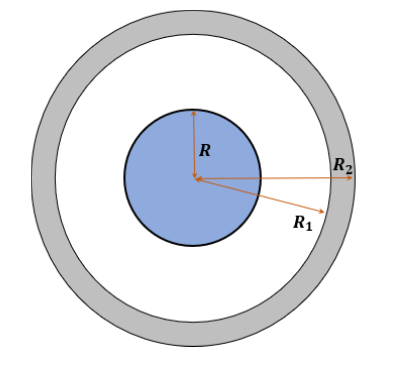
- Conducting charged spherical shell:
- For the space between the shells, the electric field depends only on the interior charge and uses the same formula as above.
- For the space outside the shells, the electric field depends on the total charge on all of the shells.
- Inside the conductors, the field is zero.
- Infinite line of charge or infinite conducting charged cylinder: The formula for this electric field distribution is given below. For the cylindrical case, the field is zero inside the conductor, but otherwise uses the same formula.

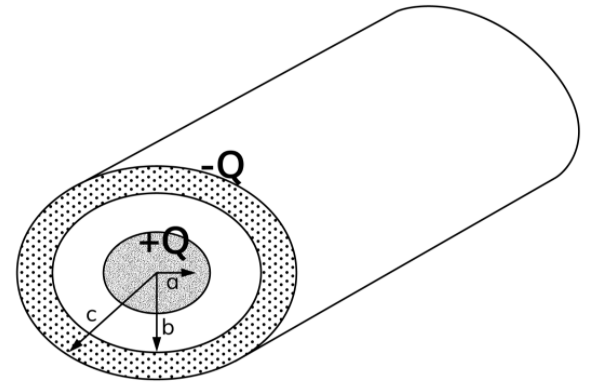
- Infinite conducting cylindrical shell:
- For the space between the shells, the formula used is the same as above, but only relies on the linear charge density of the interior line of charge (or cylinder).
- For the space outside the shells, the formula depends on the total linear charge density on all of the shells.
- Inside the conductors, the field is zero.
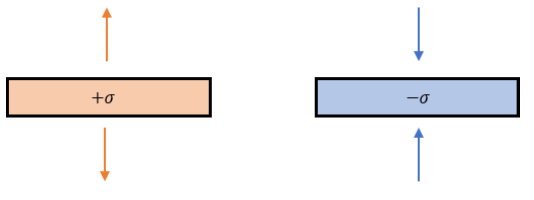
- Infinite thin plate: The electric field is constant for this geometry and depends only on the charge density of the plate.
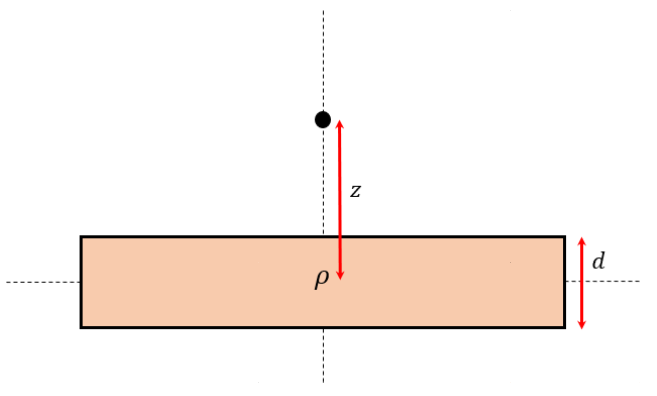
- Infinite thick insulating plate: For this geometry, the electric field is constant outside of the plate, but it varies linearly inside the plate (equations shown below).