Create a free account to get started

Unlock full course notes by signing up

  • Video lessons taught by top educators
  • Practice questions with guided solutions
  • Written review notes for reference
  • Expert answers anytime from course tutors

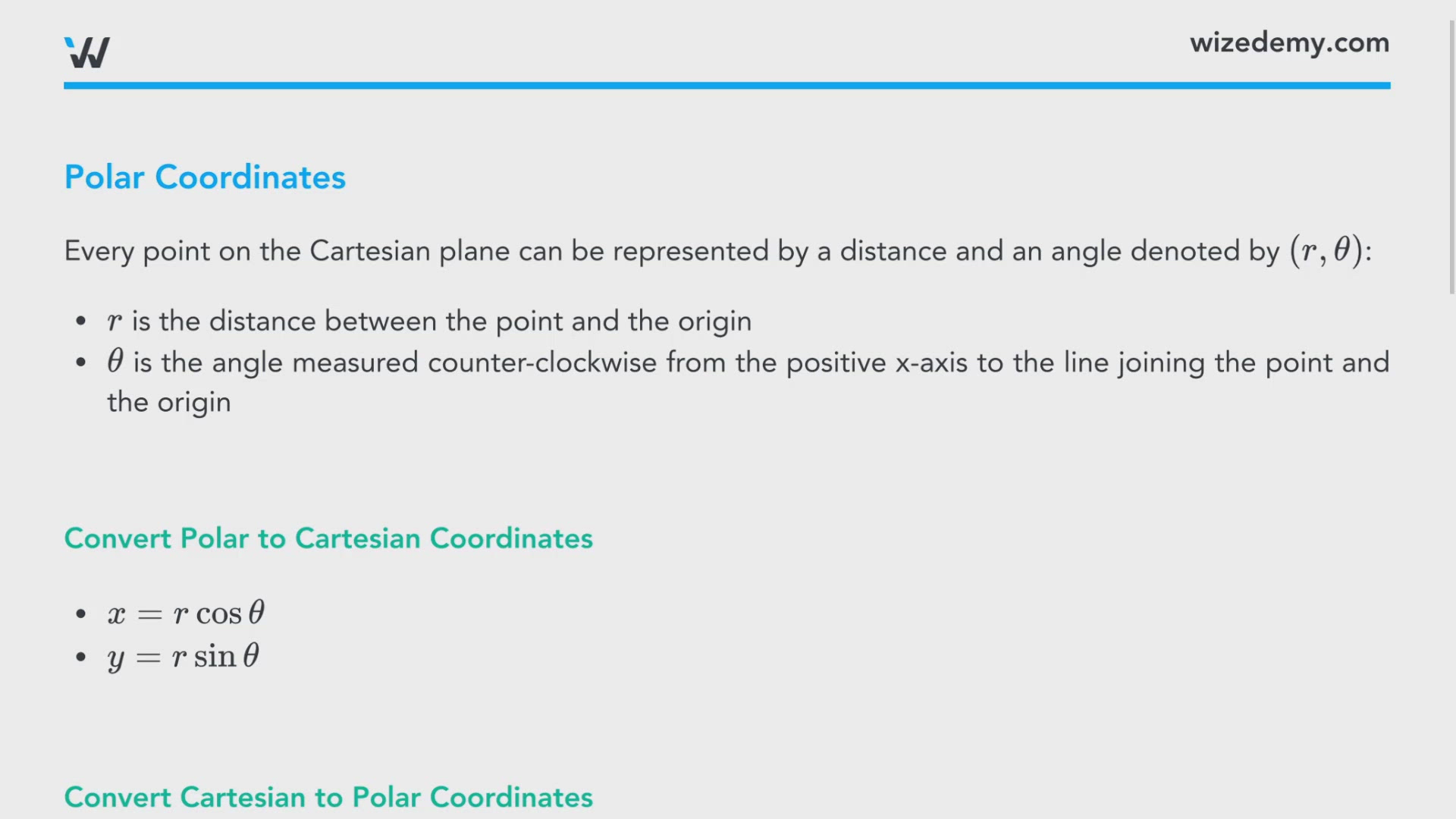
Polar Coordinates

Every point on the Cartesian plane can be represented by a distance and an angle denoted by (r,θ)\left(r,\theta\right):

  • rr is the distance between the point and the origin
  • θ\theta is the angle measured counter-clockwise from the positive x-axis to the line joining the point and the origin


Convert Polar to Cartesian Coordinates

  • x=rcos⁡θx=r\cos\theta
  • y=rsin⁡θy=r\sin\theta


Convert Cartesian to Polar Coordinates

  • r=x2+y2r=\sqrt{x^2+y^2}
  • θ=arctan⁡(yx)\theta=\arctan\left(\frac{y}{x}\right)


Polar Curves

We can graph curves of the form r(θ)=...θ...r\left(\theta\right)=...\theta... when the interval for θ\theta is given.

Example: Converting Coordinates

a.) Plot the polar points (2,π3)\left(2,\frac{\pi}{3}\right), (−2, 4π3)\left(-2,\ \frac{4\pi}{3}\right), and (2, 7π3)\left(2,\ \frac{7\pi}{3}\right)on the Cartesian plane. Then convert them to Cartesian coordinates.

In Cartesian coordinates, we have (x,y)=(rcos⁡(θ),rsin⁡(θ))(x,y)=(r\cos(\theta),r\sin(\theta))..

  • (2,π3)  →  (2cos⁡(π/3),2sin⁡(π/3))=(212,232)=(1,3).\left(2,\frac{\pi}{3}\right)\ \ \to\ \ (2\cos(\pi/3),2\sin(\pi/3))=(2\frac{1}{2},2\frac{\sqrt{3}}{2})=(1,\sqrt{3}).
  • (−2,4π3)  →  (−2cos⁡(4π3),−2sin⁡(4π3))=(1,3)\left(-2,\frac{4\pi}{3}\right)\ \ \to\ \ \left(-2\cos\left(\frac{4\pi}{3}\right),-2\sin\left(\frac{4\pi}{3}\right)\right)=\left(1,\sqrt{3}\right)
  • (2, 7π3)  →  (2cos⁡(7π3), 2sin⁡(7π3))=(1,3)\left(2,\ \frac{7\pi}{3}\right)\ \ \to\ \ \left(2\cos\left(\frac{7\pi}{3}\right),\ 2\sin\left(\frac{7\pi}{3}\right)\right)=\left(1,\sqrt{3}\right)

Therefore, the cartesian coordinates are all (1,3)\left(1,\sqrt{3}\right).


b.) Convert the Cartesian point (−5, 12)\left(-5,\ 12\right) to Polar Coordinates.

In Polar Coordinates r=x2+y2=(−5)2+122=13r=\sqrt{x^2+y^2}=\sqrt{\left(-5\right)^2+12^2}=13 and θ=arctan⁡(yx)=arctan⁡(−125)\theta=\arctan\left(\frac{y}{x}\right)=\arctan\left(-\frac{12}{5}\right).

Therefore, the polar coordinates are (r, θ)=(13, arctan⁡(−125))\left(r,\ \theta\right)=\left(13,\ \arctan\left(-\frac{12}{5}\right)\right).

Create a free account to get started

Unlock full course notes by signing up

  • Video lessons taught by top educators
  • Practice questions with guided solutions
  • Written review notes for reference
  • Expert answers anytime from course tutors

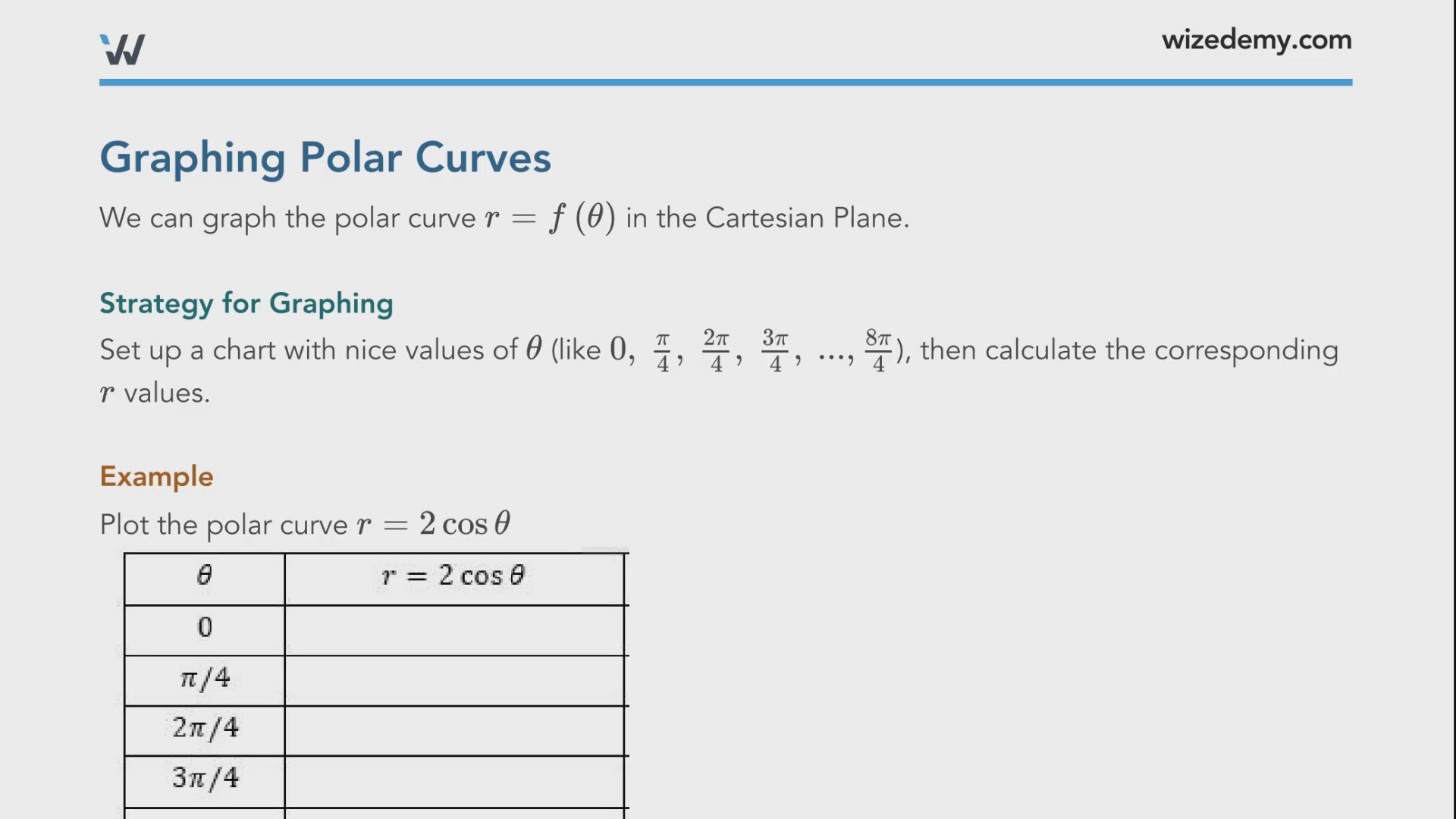
Graphing Polar Curves

We can graph the polar curve r=f(θ)r=f\left(\theta\right) in the Cartesian Plane.


Strategy for Graphing

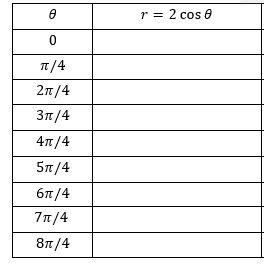
Set up a chart with nice values of θ\theta (like 0, π4, 2π4, 3π4, ...,8π40,\ \frac{\pi}{4},\ \frac{2\pi}{4},\ \frac{3\pi}{4},\ ...,\frac{8\pi}{4}), then calculate the corresponding rr values.


Example

Plot the polar curve r=2cos⁡θr=2\cos\theta

Image illustrating Graphing Polar Curves


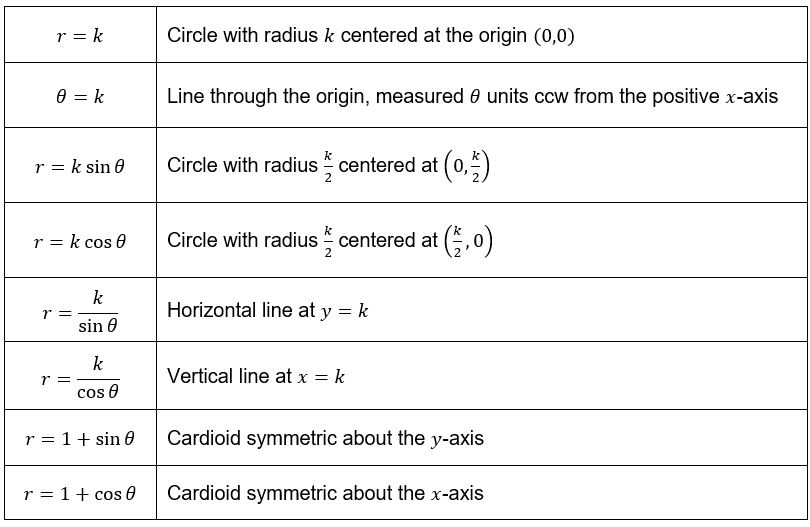
Some Common Polar Curves

Image illustrating Graphing Polar Curves


Practice Question

Plot the polar curves r=1+sin⁡θr=1+\sin\theta and r=1+sin⁡2θr=1+\sin2\theta.


Choose an answer

Create a free account to get started

Unlock full course notes by signing up

  • Video lessons taught by top educators
  • Practice questions with guided solutions
  • Written review notes for reference
  • Expert answers anytime from course tutors

Practice Question

Convert the equation of the curve x2+y2=3x2+y2−4xx^2 + y^2 = 3\sqrt{x^2 + y^2}- 4x to polar coordinates.

Choose an answer

Create a free account to get started

Unlock full course notes by signing up

  • Video lessons taught by top educators
  • Practice questions with guided solutions
  • Written review notes for reference
  • Expert answers anytime from course tutors

Practice Question

Match the following graphs with its corresponding polar curve equation.

Illustration for practice question: Practice Question


a.) r=sin⁡3θr=\sin3\theta

b.) r=2sin⁡2θr=2\sin^2\theta

c.) r=12θr=\frac{1}{2}\theta

d.) r=1−2cos⁡θr=1-2\cos\theta


Match each term
A.

r=1−2cos⁡θr=1-2\cos\theta

B.

r=12θr=\frac{1}{2}\theta

C.

r=2sin⁡2θr=2\sin^2\theta

D.

r=sin⁡3θr=\sin3\theta

ii.

iv.

i.

iii.

Create a free account to get started

Unlock full course notes by signing up

  • Video lessons taught by top educators
  • Practice questions with guided solutions
  • Written review notes for reference
  • Expert answers anytime from course tutors