Create a free account to get started

Unlock full course notes by signing up

  • Video lessons taught by top educators
  • Practice questions with guided solutions
  • Written review notes for reference
  • Expert answers anytime from course tutors

Radical Functions

A radical function is defined as:

y=  nf(x)\boxed{y=~~^n\sqrt {f(x)}}

where f(x)f(x) is a function and n∈Wn\in\mathbb{W}.


Square-Root Functions

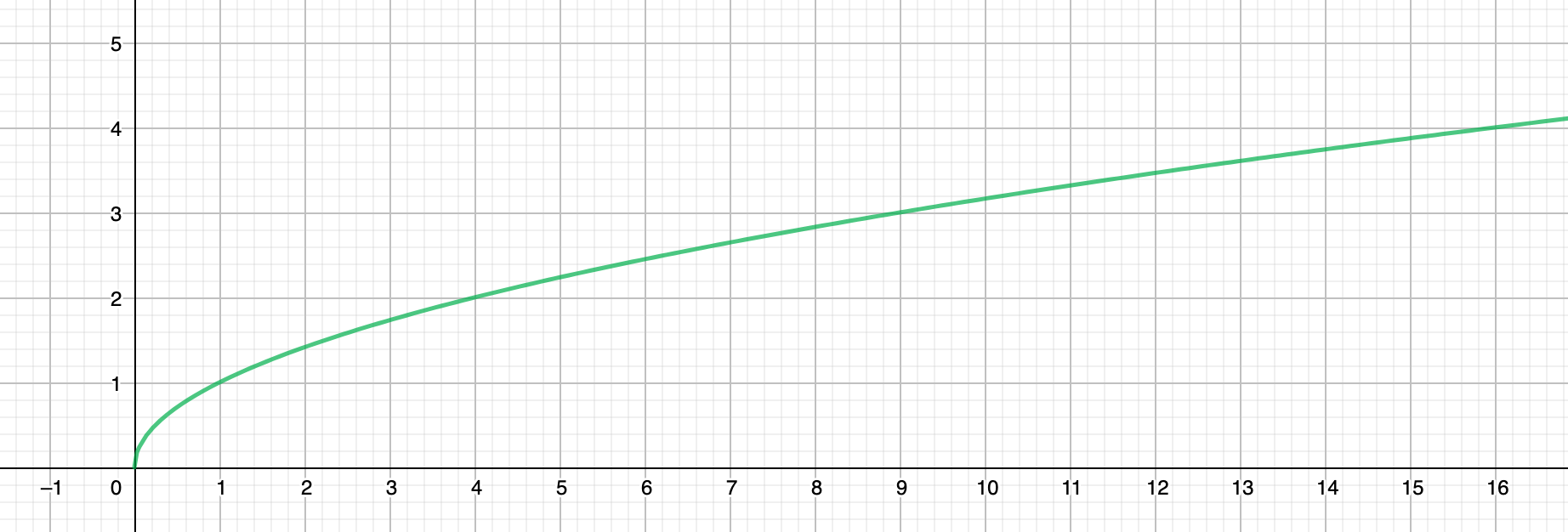
y=xy=\sqrt{x}


Image illustrating Radical Functions xy00114293164\begin{array}{|c|c|}\hline x&y\\\hline 0&0\\\hline 1&1\\\hline 4&2\\\hline 9&3\\\hline 16&4\\\hline \end{array}


xx-Intercept: (0,0)(0,0)

yy-Intercept: (0,0)(0,0)

Domain: [0,∞)[0,\infin)

Range: [0,∞)[0,\infin)

Create a free account to get started

Unlock full course notes by signing up

  • Video lessons taught by top educators
  • Practice questions with guided solutions
  • Written review notes for reference
  • Expert answers anytime from course tutors

Solving Radical Equations

A radical equation is

f(x)=g(x)\boxed{\sqrt{f(x)}=g(x)}

where f(x) & g(x) f(x)~\&~g(x)~ are continuous polynomial functions.


Solutions to Radical Equations

Solve 2x+1=32\sqrt{x}+1=3. State the restrictions for 'x'.


Let f(x)=2x+1f(x)=2\sqrt{x}+1 and let g(x)=3g(x)=3.


Restrictions: x≥0x\geq0


2x+1=32\sqrt{x}+1=3

  ⟹  2x=2\implies 2\sqrt{x}=2

  ⟹  x=1\implies \sqrt{x}=1

  ⟹  x=1\implies x=1


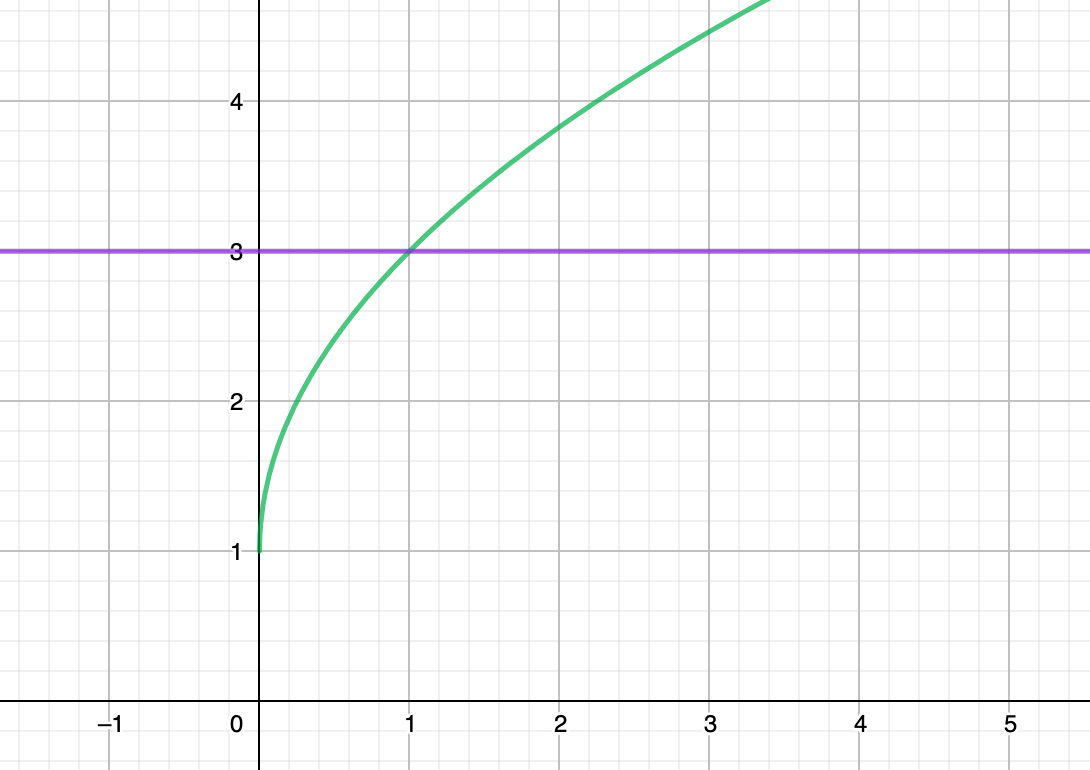
Graph f(x) f(x)~ and g(x)g(x):


Image illustrating Solving Radical Equations


f(x) & g(x) f(x)~\&~g(x)~ intersect at (1, 3).


Let's verify the answer:

2x+1=321+1=33=3✓\begin{array}{cccc} 2\sqrt{x}+1&=&3\\\\ 2\sqrt{1}+1&=&3\\\\ 3&=&3&\checkmark \end{array}

Therefore, (1, 3) is the solution.

Algebraic Solutions to Radical Equations

Solve 5x+6−2=x\sqrt{5x+6}-2=x. State the domain and range


Isolate for 'x'


Restriction: Since the argument of a square root must be 0 or larger, 5x+6≥05x+6\ge0 which means that our domain can be given by x≥−65x\ge-\frac65, or [−65,∞)[-\frac65,\infin) in interval notation. The range can be found be recognizing that the square root has an output of 0 or higher, and so subtracting 2 from this will give us a possible range of [−2,∞)[-2,\infin).


5x+6−2=x(5x+6)2=(x+2)25x+6=x2+4x+40=x2−x−20=(x−2)(x+1)∴  x=−1,2\begin{array}{ccc} \sqrt{5x+6}-2&=&x\\\\ (\sqrt{5x+6})^2&=&(x+2)^2\\\\ 5x+6&=&x^2+4x+4\\\\ 0&=&x^2-x-2\\\\ 0&=&(x-2)(x+1)\\\\ \therefore~~x&=&-1, 2 \end{array}

Verify:

5(−1)+6−2=−1−5+6−2=−11−2=−1−1==−1✓                     5(2)+6−2=210+6−2=216−2=22=2✓\begin{array}{rccc} \sqrt{5(-1)+6}-2&=&-1\\\\ \sqrt{-5+6}-2&=&-1\\\\ \sqrt{1}-2&=&-1\\\\ -1&=&=-1&\checkmark \end{array} ~~~~~~~~~~~~~~~~~~~~~ \begin{array}{rccc} \sqrt{5(2)+6}-2&=&2\\\\ \sqrt{10+6}-2&=&2\\\\ \sqrt{16}-2&=&2\\\\ 2&=&2&\checkmark \end{array}


Create a free account to get started

Unlock full course notes by signing up

  • Video lessons taught by top educators
  • Practice questions with guided solutions
  • Written review notes for reference
  • Expert answers anytime from course tutors

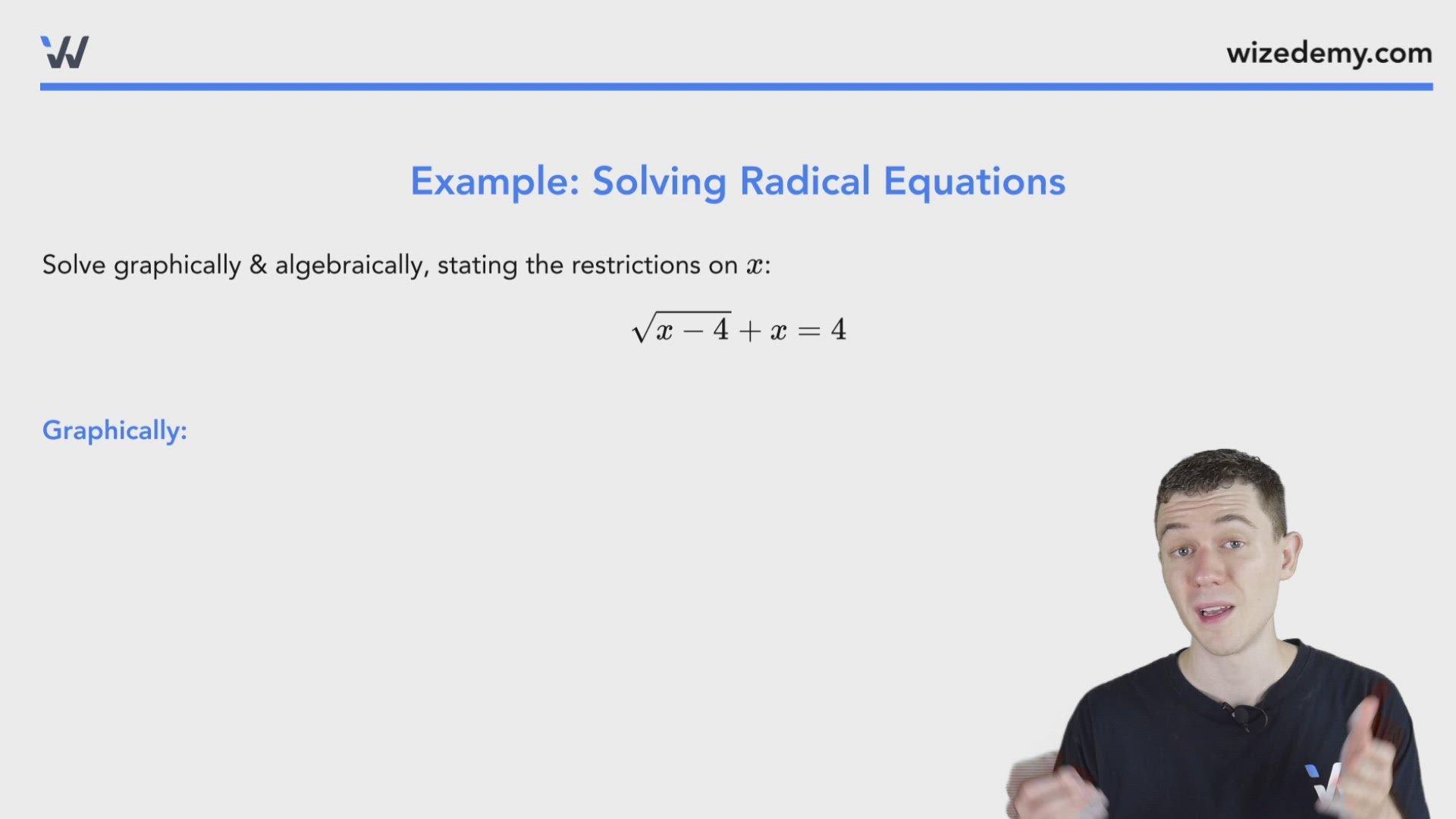
Example: Solving Radical Equations

Solve graphically & algebraically, stating the restrictions on xx:

x−4+x=4\sqrt{x-4}+x=4

Graphically:

Let f(x)=x−4+xf(x)=\sqrt{x-4}+x and g(x)=4g(x)=4. Then,


Image illustrating Example


The solution is (4, 4)


Restrictions on 'x': x≥4x\geq4


Algebraically:

x−4+x=4\sqrt{x-4}+x=4

(x−4)2=(−x+4)2x−4=x2−8x+160=x2−9x+200=(x−5)(x−4)∴  x=4,5\begin{array}{rcl} (\sqrt{x-4})^2&=&(-x+4)^2\\\\ x-4&=&x^2-8x+16\\\\ 0&=&x^2-9x+20\\\\ 0&=&(x-5)(x-4)\\\\ \therefore~~x&=&4, 5 \end{array}

Verify:

x−4+x=44−4+4=44=4✓                  5−4+5=45−4+5=46≠4   Extraneous Solution\begin{array}{rcl} \sqrt{x-4}+x&=&4\\\\ \sqrt{4-4}+4&=&4\\\\ 4&=&4&\checkmark \end{array} ~~~~~~~~~~~~~~~~~~ \begin{array}{rcl} \sqrt{5-4}+5&=&4\\\\ \sqrt{5-4}+5&=&4\\\\ 6&\neq&4&&~~~\footnotesize{\text{Extraneous Solution}} \end{array}


Therefore, only x = 4 is a solution.

Solve algebraically, stating any restrictions:

x+7+2=3−x\sqrt{x+7}+2=\sqrt{3-x}


Choose an answer

Create a free account to get started

Unlock full course notes by signing up

  • Video lessons taught by top educators
  • Practice questions with guided solutions
  • Written review notes for reference
  • Expert answers anytime from course tutors

Extra Practice