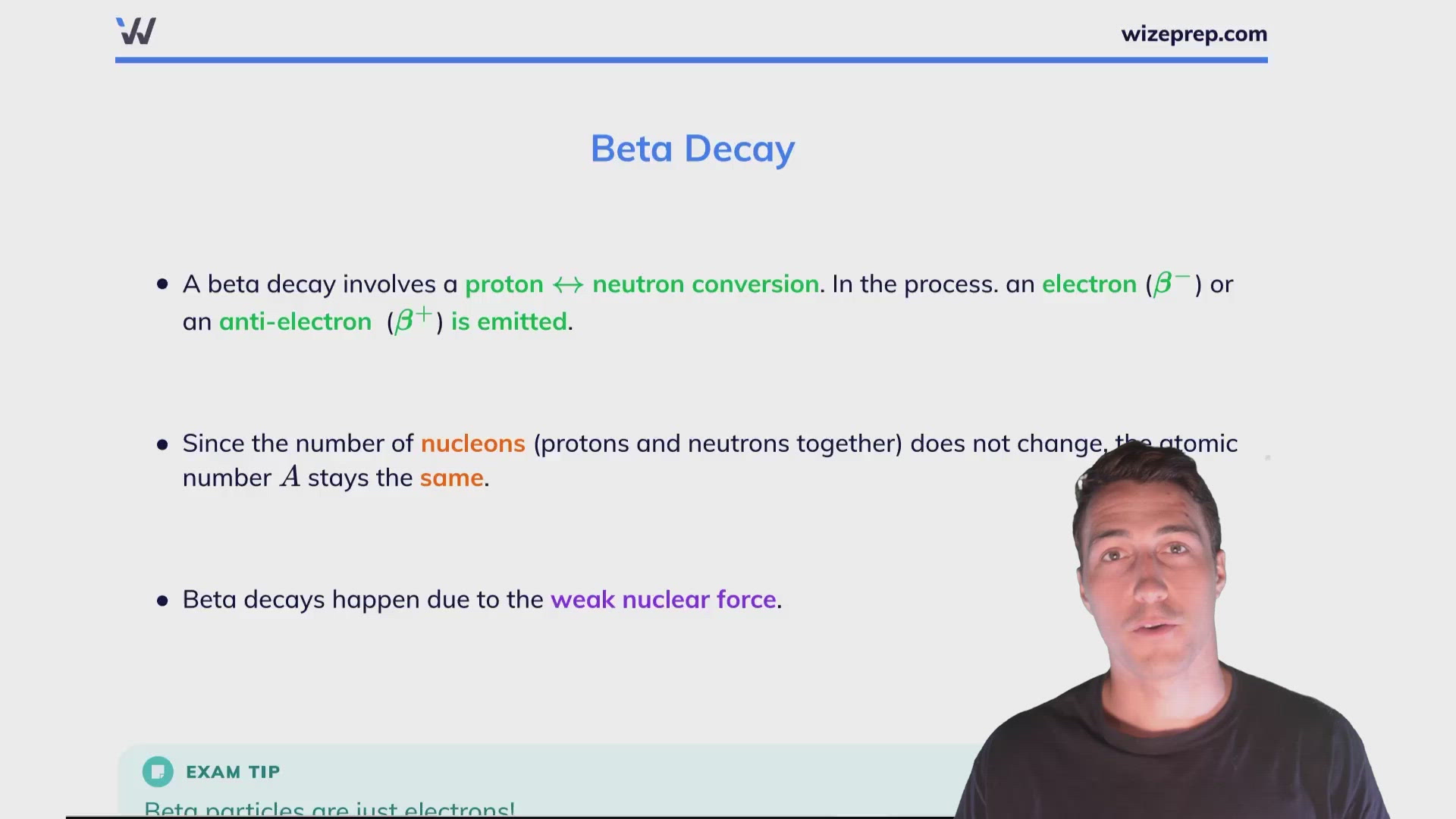
Beta Decay
- A beta decay involves a proton neutron conversion. In the process. an electron () or an anti-electron () is emitted.
- Since the number of nucleons (protons and neutrons together) does not change, the atomic number stays the same.
- Beta decays happen due to the weak nuclear force.

Beta Negative Decay

In a beta negative decay, a neutron turns into a proton to reduce the energy of the nucleus, and an electron is created:
- is the neutron
- is the proton
- is the electron
- is an anti-neutrino , which is the anti-matter version of a neutrino
The mass number doesn't change, but the atomic number goes up by one:
The decay equation is:
The energy released can be found using the mass defect:
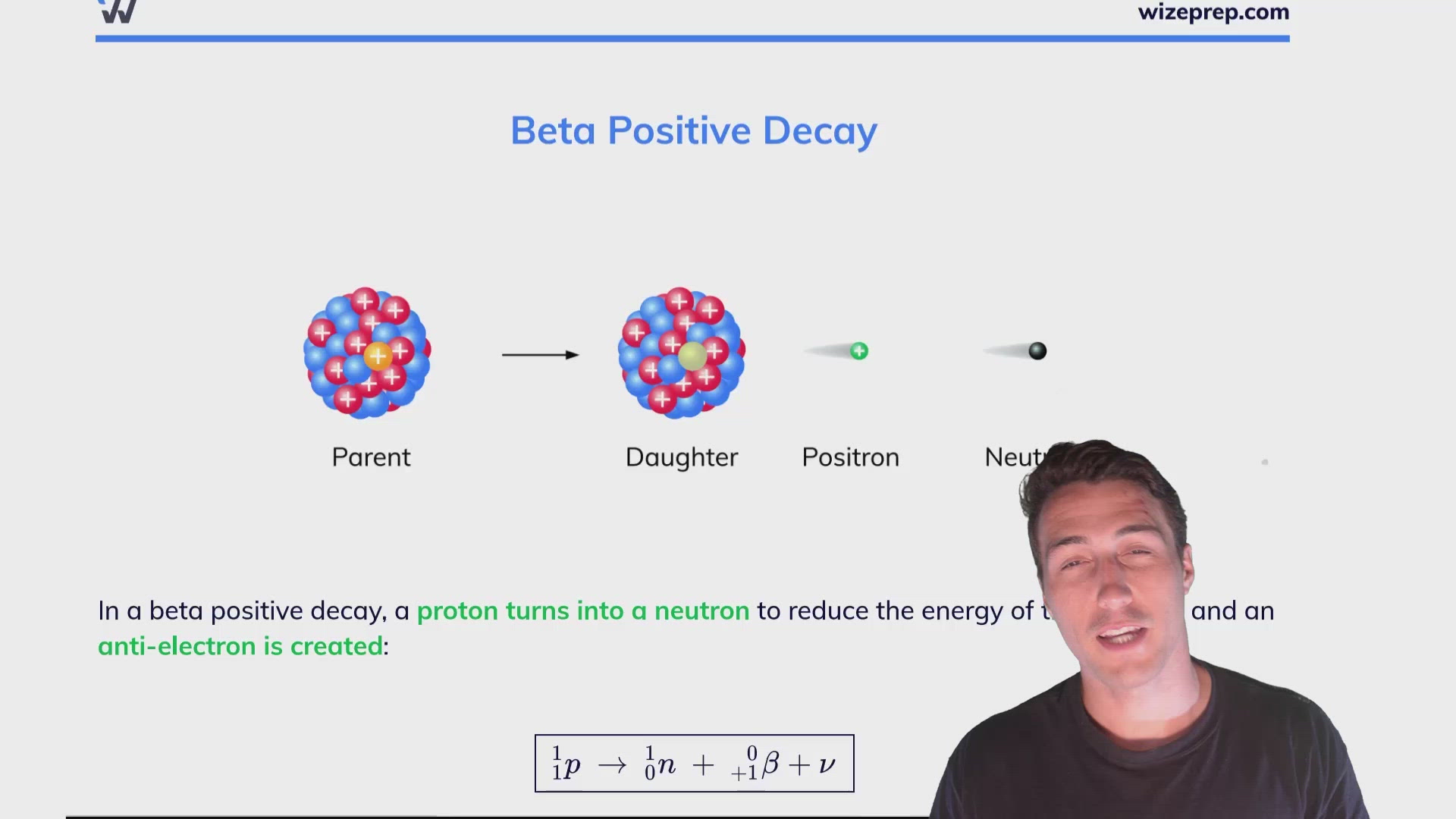
Beta Positive Decay

In a beta positive decay, a proton turns into a neutron to reduce the energy of the nucleus, and an anti-electron is created:
- is the neutron
- is the proton
- is the anti-electron or positron
- is the neutrino
The mass number doesn't change, but the atomic number goes down by one:
The decay equation is:
The energy released can be found using the mass defect:
NOTE: We have one extra electron at the end because the daughter nucleus has one less electron than the parent. Another extra electron is created in the decay process. This means we have a total of extra electrons whose mass has to be subtracted form the initial mass.
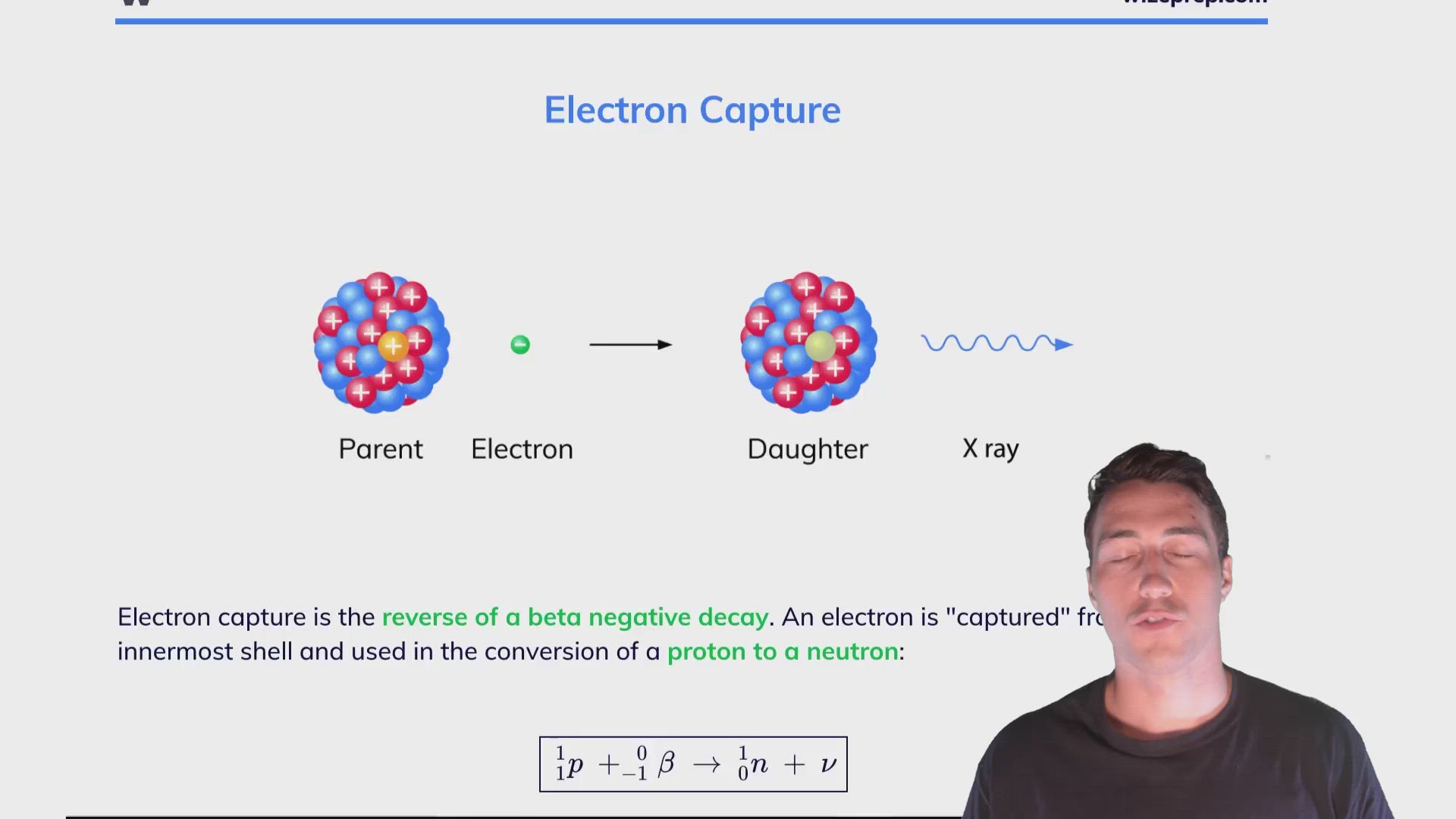
Electron Capture

Electron capture is the reverse of a beta negative decay. An electron is "captured" from the innermost shell and used in the conversion of a proton to a neutron:
- is the neutron
- is the proton
- is the electron
- is the neutrino
The mass number doesn't change, but the atomic number goes down by one:
The decay equation is:
The energy released can be found using the mass defect:

Example: Multiple Decays
Plutonium-244 undergoes a chain of decays: alpha, alpha, beta negative, beta negative, and alpha decay.
a) Without writing the decay equations, find the resulting element.
b) Write all decay equations.
Note: you don't have to know the names of the resulting elements unless you're given the periodic table.
Part a)
We begin with . There are alpha decays and beta negative decays.
Each alpha decay decreases the atomic number by , and each beta negative increases it by . Therefore the new atomic number is:
Each alpha decay decreases the mass number by , but each beta negative leaves it unchanged. Therefore the new mass number is:
The resulting element is:
Part b)
1) alpha decay:
2) alpha decay:
3) beta negative decay:
4) beta negative decay:
5) alpha decay: