Popular Courses
MCAT
General Course
Grade 12 Physics
Ontario High School
Grade 12 Physics
Canada High School
PHYS*1300
University of Guelph
Physics 30
Alberta High School
Physics 12
British Columbia High School
ENGG 212
University of Calgary
PHY132H1
University of Toronto
PHY132H1
University of Toronto
PHYS 111
University of Victoria
PHYS-1300
University of Windsor
PHY 1121
University of Ottawa
PHY 1124
University of Ottawa
PHYS 121
University of Waterloo
PHYSICS 1102A/B
Western University
PHYS 227
University of Calgary
SC/PHYS 2020 3.00
York University
PHYSICS 1AA3
McMaster University
PHY 9B
University of California - Davis
PHY 131
Arizona State University - Tempe

0:00 / 0:00
Gamma Decay

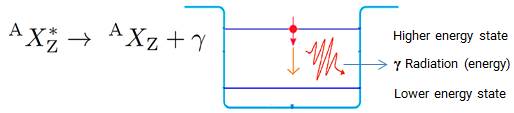
In a gamma decay, an excited nucleus comes down to a less excited (lower energy, more stable) state by emitting a gamma ray.
Wize Tip
This is very similar to photon emission of the atomic orbitals.
Since the basic structure of the nucleus does not change, the element stays the same. Therefore both the atomic number and the mass number are the same.exciting
The decay equation is:
Wize Concept
- After a nucleus has undergone alpha or beta decay, it can still be excited, and it will emit gamma photons to return to the ground state.
- The nucleus can get excited by being bombarded with photons, or at high temperatures.
Exam Tip
Remember that gamma rays aren't particles but waves, so they have no mass or charge. They are the kind of electromagnetic radiation with the highest energy, and move at the speed of light.
Wize Concept
Since gamma rays have no mass, they have the highest energy of the different types of decay.
A few inches of lead or a meter of concrete will be needed to stop most gamma rays!