Popular Courses
MCAT
General Course
Grade 12 Physics
Ontario High School
Grade 12 Physics
Canada High School
PHYS*1300
University of Guelph
Physics 30
Alberta High School
Physics 12
British Columbia High School
ENGG 212
University of Calgary
PHY132H1
University of Toronto
PHY132H1
University of Toronto
PHYS 111
University of Victoria
PHYS-1300
University of Windsor
PHY 1121
University of Ottawa
PHY 1124
University of Ottawa
PHYS 121
University of Waterloo
PHYSICS 1102A/B
Western University
PHYS 227
University of Calgary
SC/PHYS 2020 3.00
York University
PHYSICS 1AA3
McMaster University
PHY 9B
University of California - Davis
PHY 131
Arizona State University - Tempe
0:00 / 0:00
Beta Decay
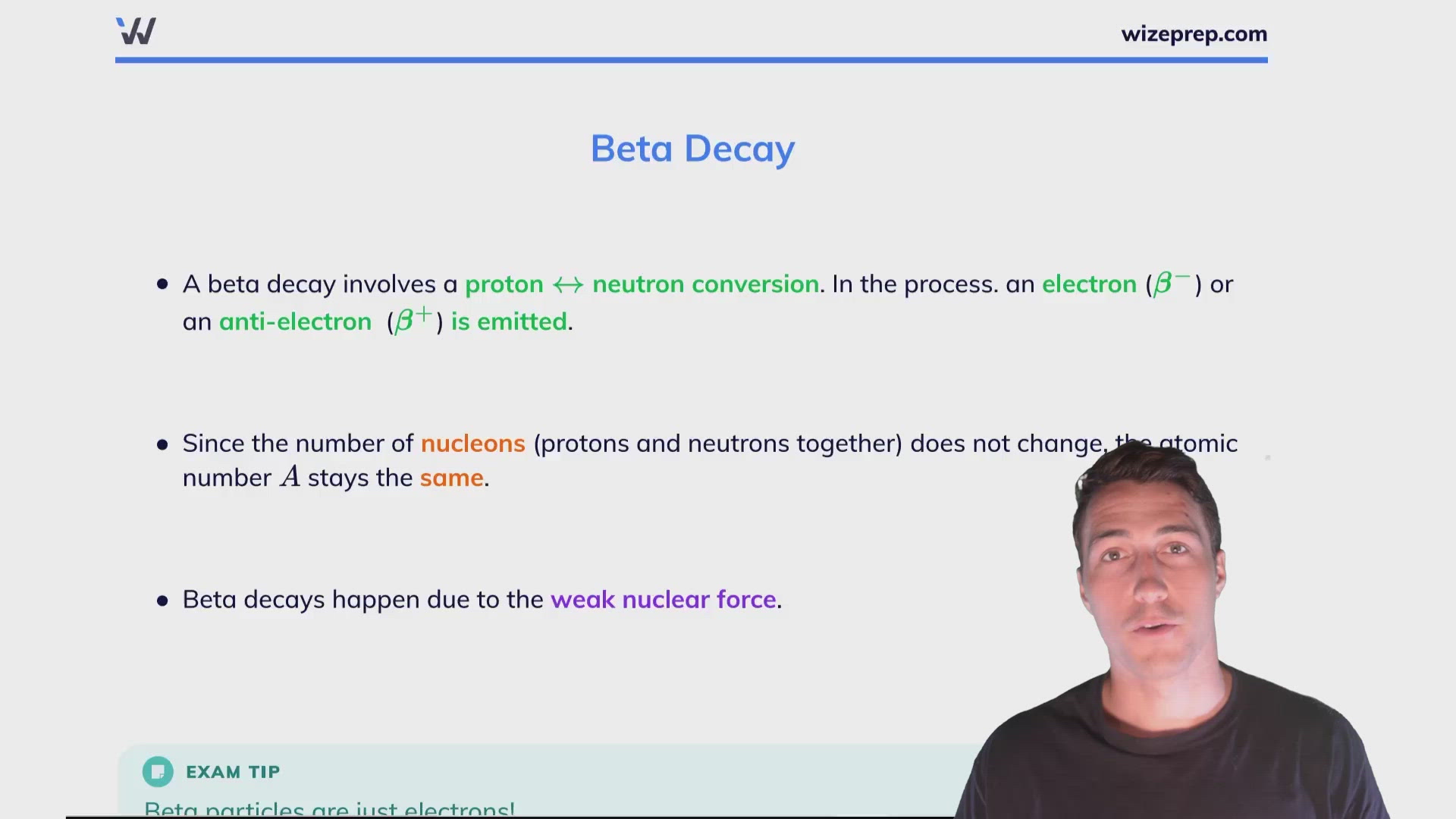
- A beta decay involves a proton neutron conversion. In the process. an electron () or an anti-electron () is emitted.
- Since the number of nucleons (protons and neutrons together) does not change, the atomic number stays the same.
- Beta decays happen due to the weak nuclear force.
Exam Tip
Beta particles are just electrons!
Wize Concept
Beta particles are lighter than alpha particles, so they keep their high energy for longer.
Because of this they will penetrate through materials like paper, but are stopped by aluminum, glass, or plastic.

0:00 / 0:00
Beta Negative Decay

In a beta negative decay, a neutron turns into a proton to reduce the energy of the nucleus, and an electron is created:
- is the neutron
- is the proton
- is the electron
- is an anti-neutrino , which is the anti-matter version of a neutrino
Wize Concept
Neutrinos are almost massless and extremely hard to detect, but they resolve conservation of momentum and energy in the decay.
Exam Tip
Use the following 2 concepts to balance both sides of the equation:
- To number at the bottom (usually the number of protons) can also be thought to represent the number of positive/negative charges, so that the electron has a there . The charge is conserved.
- The mass number at the top represents the total number of nucleons, which is also conserved.
The mass number doesn't change, but the atomic number goes up by one:
The decay equation is:
The energy released can be found using the mass defect:
Wize Tip
The beta negative decay happens when an unstable nucleus has too many neutrons.
0:00 / 0:00
Beta Positive Decay

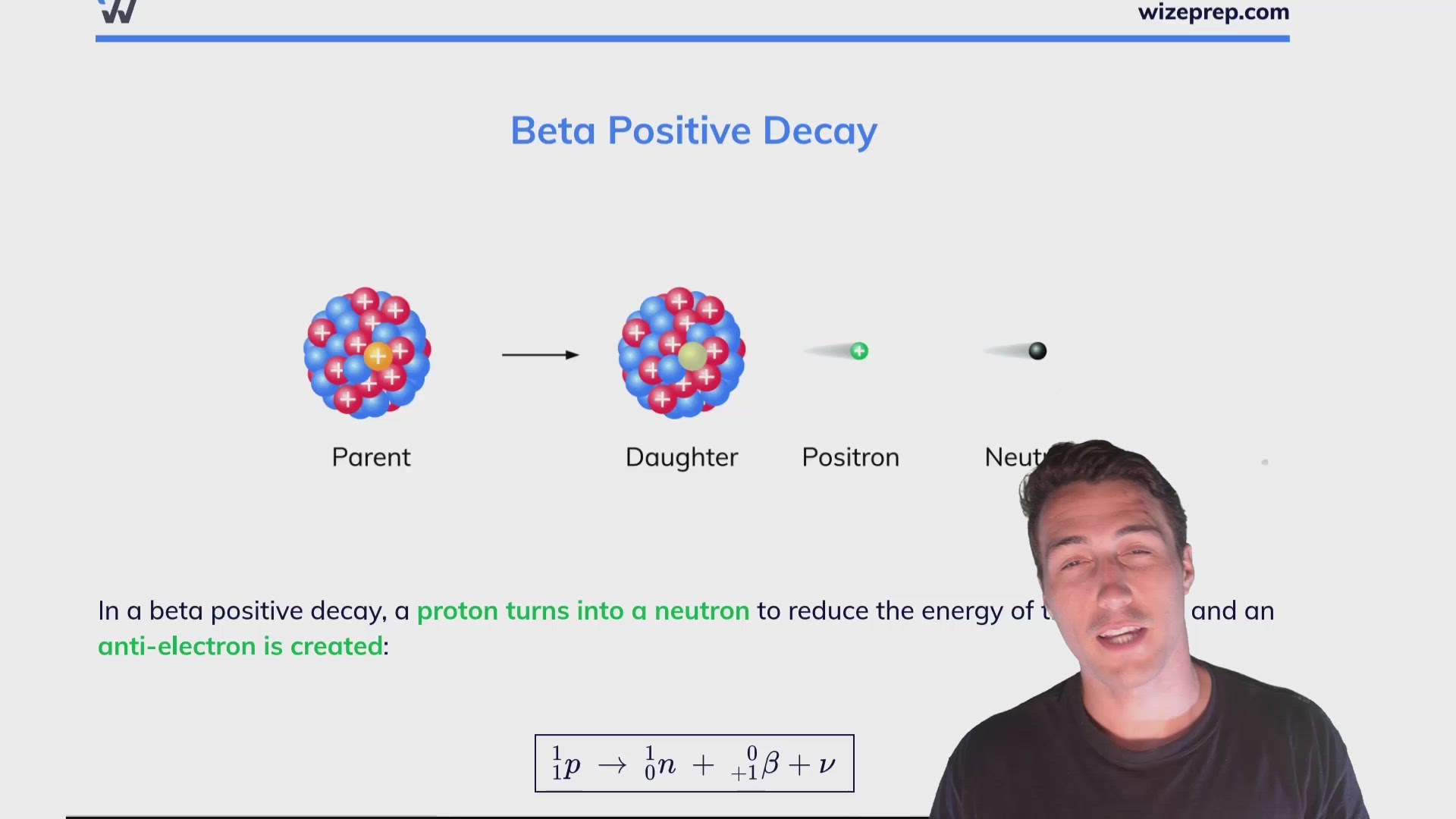
In a beta positive decay, a proton turns into a neutron to reduce the energy of the nucleus, and an anti-electron is created:
- is the neutron
- is the proton
- is the anti-electron or positron
- is the neutrino
Wize Concept
Anti-particles have the same mass as their corresponding particles, but carry the opposite charge.
The mass number doesn't change, but the atomic number goes down by one:
The decay equation is:
The energy released can be found using the mass defect:
NOTE: We have one extra electron at the end because the daughter nucleus has one less electron than the parent. Another extra electron is created in the decay process. This means we have a total of extra electrons whose mass has to be subtracted form the initial mass.
Exam Tip
- The regular electron is emitted together with the anti-neutrino (e.g. beta negative)
- The anti-electron is emitted together with the regular neutrino (e.g. beta positive)
Wize Tip
The beta positive decay happens when the unstable nucleus has too few neutrons.
0:00 / 0:00
Electron Capture

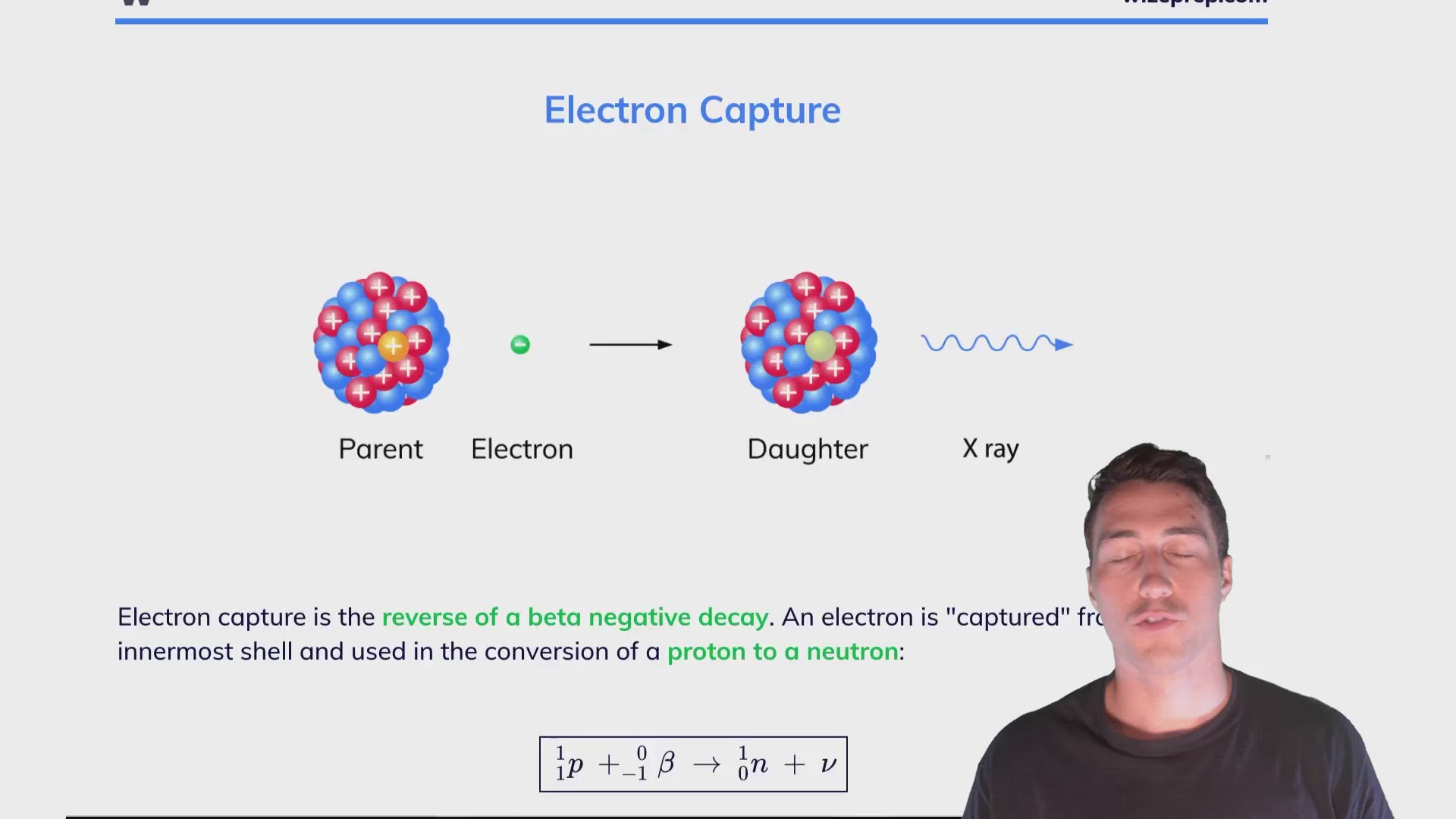
Electron capture is the reverse of a beta negative decay. An electron is "captured" from the innermost shell and used in the conversion of a proton to a neutron:
- is the neutron
- is the proton
- is the electron
- is the neutrino
The mass number doesn't change, but the atomic number goes down by one:
The decay equation is:
The energy released can be found using the mass defect:
Exam Tip
- The regular neutrino is emitted when a neutron is formed (e.g. beta positive, electron capture)
- The anti-neutrino is emitted when a proton is formed (e.g. beta negative)
Wize Tip
Electron capture happens when the unstable nucleus has too few neutrons.

0:00 / 0:00
Example: Multiple Decays
Plutonium-244 undergoes a chain of decays: alpha, alpha, beta negative, beta negative, and alpha decay.
a) Without writing the decay equations, find the resulting element.
b) Write all decay equations.
Note: you don't have to know the names of the resulting elements unless you're given the periodic table.
Part a)
We begin with . There are alpha decays and beta negative decays.
Each alpha decay decreases the atomic number by , and each beta negative increases it by . Therefore the new atomic number is:
Each alpha decay decreases the mass number by , but each beta negative leaves it unchanged. Therefore the new mass number is:
The resulting element is:
Part b)
1) alpha decay:
2) alpha decay:
3) beta negative decay:
4) beta negative decay:
5) alpha decay:

Mark Yourself Question
- Grab a piece of paper and try this problem yourself.
- When you're done, check the "I have answered this question" box below.
- View the solution and report whether you got it right or wrong.
Practice: Beta Positive and Negative
Assume Phosphorus-31stabilizes through beta decay. Write down the equation for both beta positive and beta negative decay processes. How much energy is released in each case?
Note: you don't have to know the names of the resulting elements unless you're given the periodic table.
(1amu = 1.66 x 10⁻²⁷kg)
mp = 1.00728 amu
mn = 1.00867 amu
me = 5.45 × 10⁻⁴ amu