Popular Courses
MCAT
General Course
Grade 12 Physics
Ontario High School
Grade 12 Physics
Canada High School
PHYS*1300
University of Guelph
Physics 30
Alberta High School
Physics 12
British Columbia High School
ENGG 212
University of Calgary
PHY132H1
University of Toronto
PHY132H1
University of Toronto
PHYS 111
University of Victoria
PHYS-1300
University of Windsor
PHY 1121
University of Ottawa
PHY 1124
University of Ottawa
PHYS 121
University of Waterloo
PHYSICS 1102A/B
Western University
PHYS 227
University of Calgary
SC/PHYS 2020 3.00
York University
PHYSICS 1AA3
McMaster University
PHY 9B
University of California - Davis
PHY 131
Arizona State University - Tempe
0:00 / 0:00
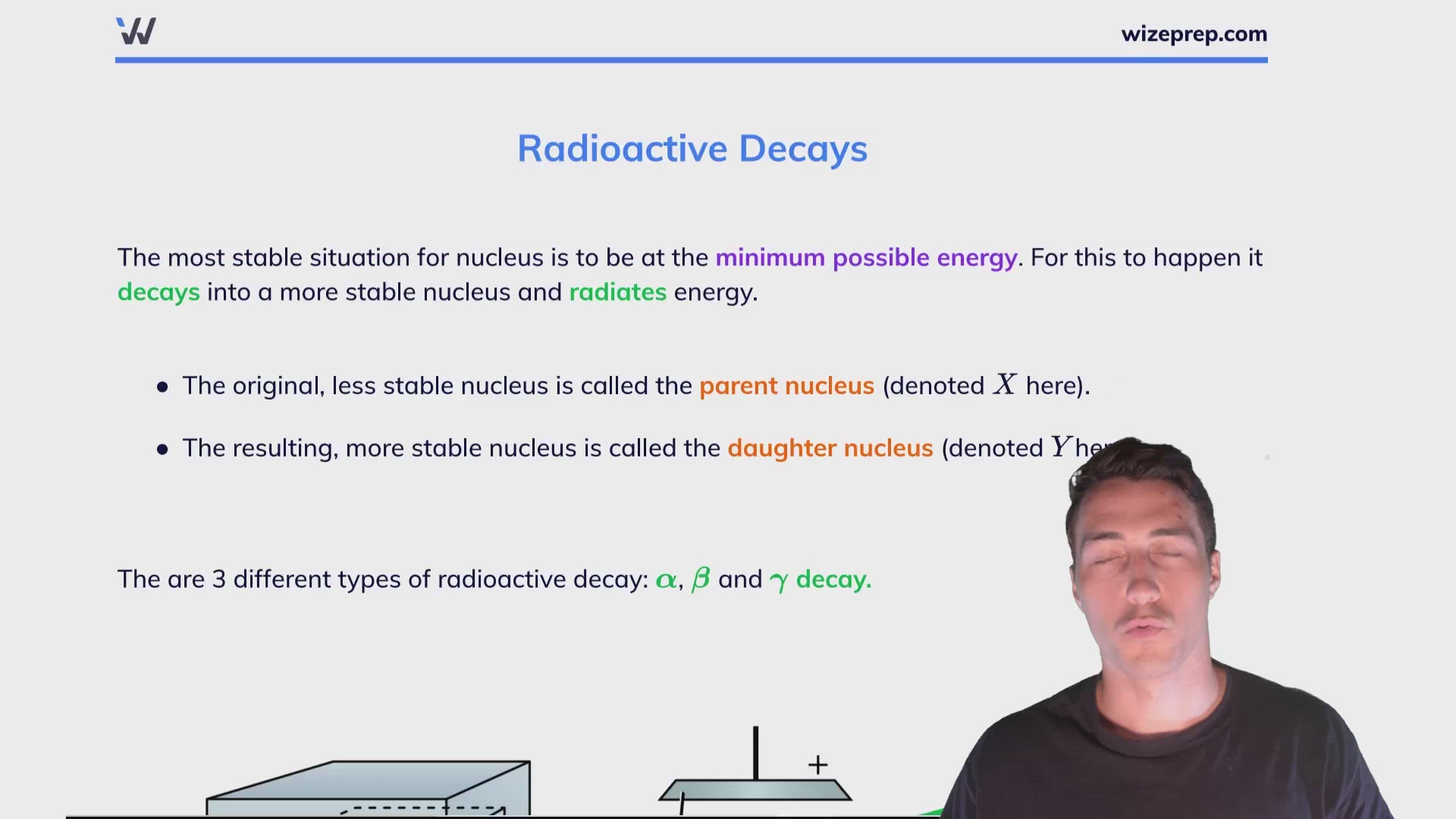
Radioactive Decays
The most stable situation for nucleus is to be at the minimum possible energy. For this to happen it decays into a more stable nucleus and radiates energy.
- The original, less stable nucleus is called the parent nucleus (denoted here).
- The resulting, more stable nucleus is called the daughter nucleus (denoted here).
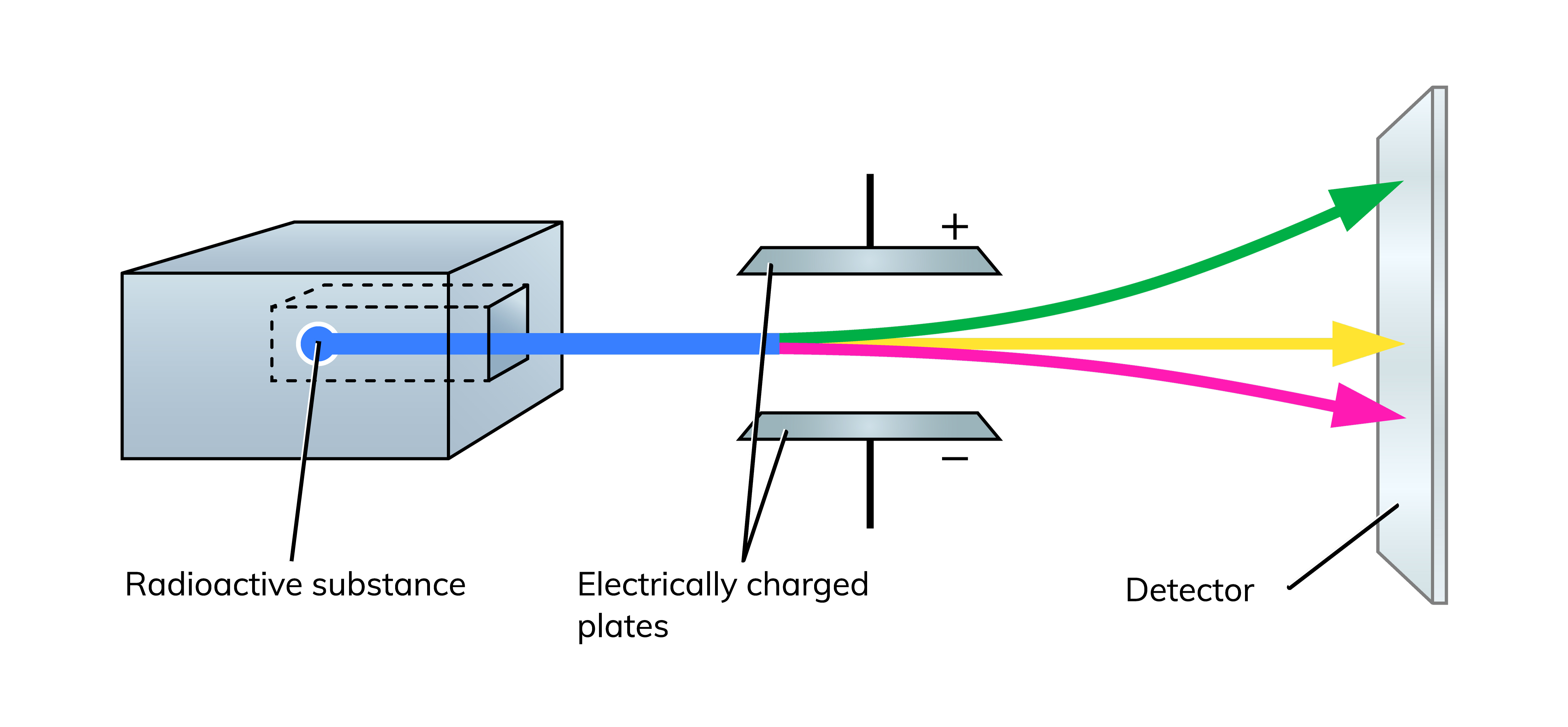
The are 3 different types of radioactive decay: , and decay.
Wize Concept
The gamma rays are the most powerful and the alpha particles the least powerful.

0:00 / 0:00
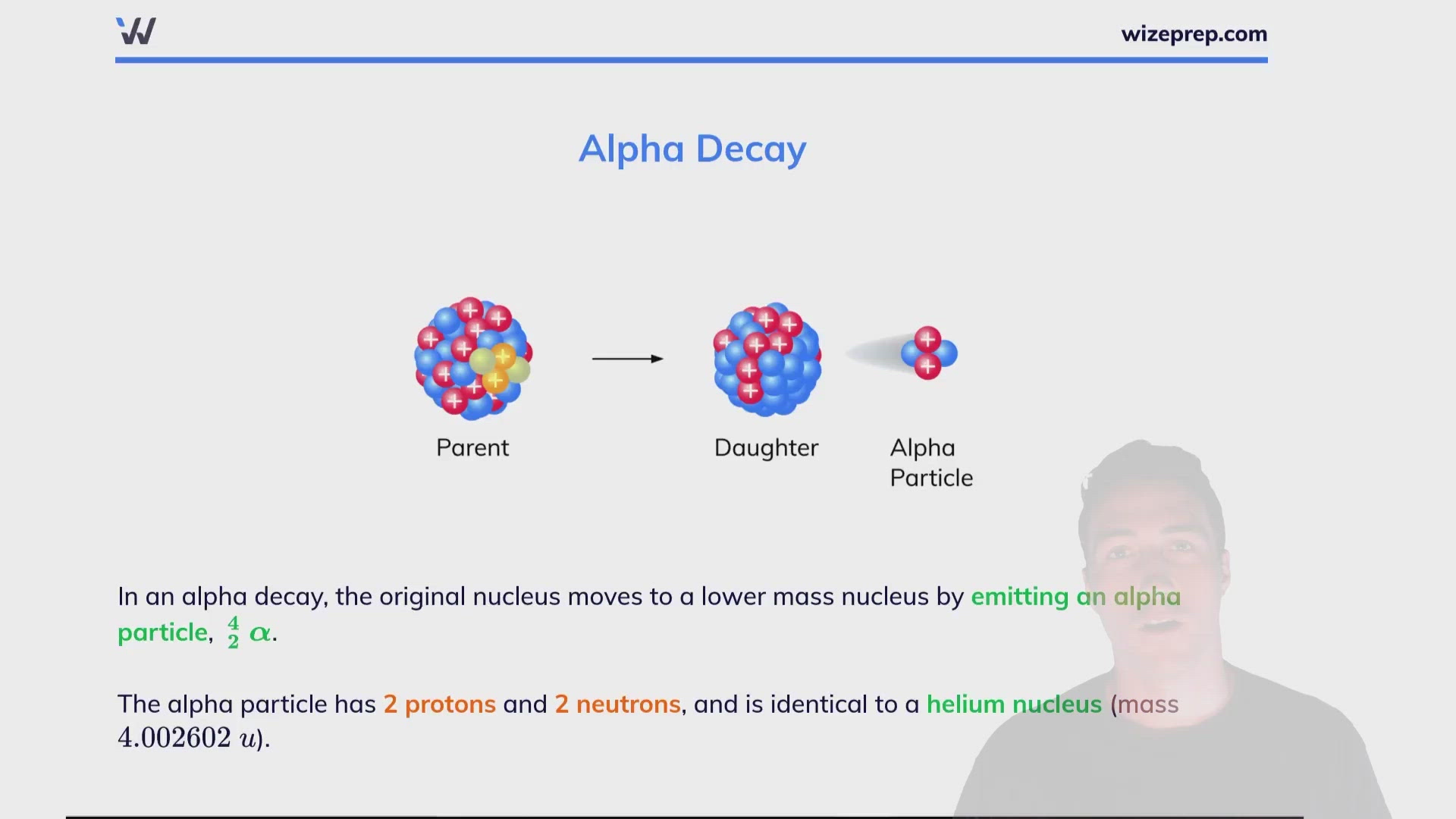
Alpha Decay

In an alpha decay, the original nucleus moves to a lower mass nucleus by emitting an alpha particle, .
The alpha particle has 2 protons and 2 neutrons, and is identical to a helium nucleus (mass ).
Exam Tip
You may see instead of , they are the same thing!
Both the atomic number and the mass number change:
and
The decay equation is:
Exam Tip
There is a small recoil for the new nucleus! (conservation of momentum)
The energy released becomes the kinetic energy of the alpha particles, and can be found using the mass defect:
Wize Concept
The binding energy per nucleon reaches a maximum for Bismuth with atomic number of 83 and decreases for higher atomic numbers. For atomic numbers higher than 83, the nuclei have the tendency to undergo alpha decay to increase their binding energy per nucleon and become more stable!
Wize Concept
Alpha particles are the heaviest type of radioactive decay. They start off with high energy but rapidly lose it and can be stopped by a sheet of paper!
Example: Alpha Decay
Find the energy emitted when uranium-238 undergoes alpha decay.
Note: you don't have to know the names of the resulting elements unless you're given the periodic table.
Find uranium in the periodic table and write the decay equation, then figure out what element has the atomic number of the daughter nucleus:
Find the emitted energy using the mass defect (look up the masses in the periodic table):
Let's use to get:

Mark Yourself Question
- Grab a piece of paper and try this problem yourself.
- When you're done, check the "I have answered this question" box below.
- View the solution and report whether you got it right or wrong.
Practice: Chain of Alpha Decays
Thorium-228 decays by emitting an alpha particle, then the daughter nucleus emits an alpha particle again, and so on until four alpha particles are emitted.
a) Write the decay equation for each alpha emission.
b) Write an equation for the total energy emitted.
Note: you don't have to know the names of the resulting elements unless you're given the periodic table.