Wize AP Biology Textbook > DNA Replication & Repair
Meselson-Stahl Experiment
Popular Courses
Find My Course
0:00 / 0:00
The Meselson-Stahl Experiment
In 1953, there were 3 theories as to how DNA might replicate:
- Conservative: The entire DNA molecule is copied making a second, completely new DNA molecule.
- Semi-conservative: The two strands of DNA separate, with each strand acting as a template to copy a new strand.
- Dispersive: The DNA was cleaved into small fragments, the fragments were copied and then re-attached.
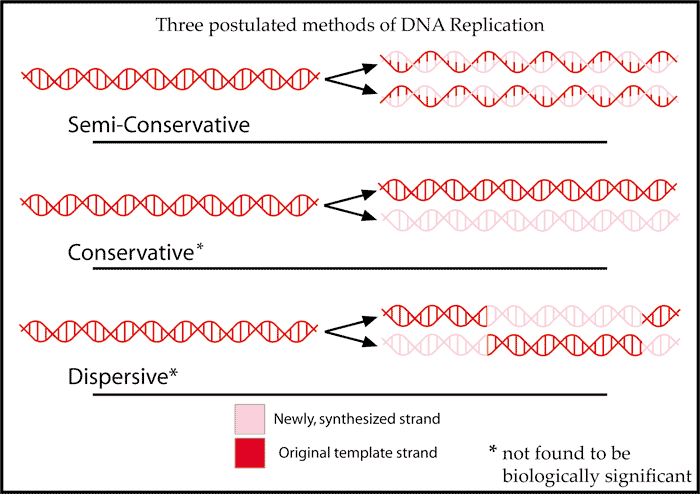
Matthew Meselson and Franklin Stahl designed an experiment in Escherichia Coli (E. coli) bacteria to determine which of the 3 was happening in cells. The procedure was as follows:
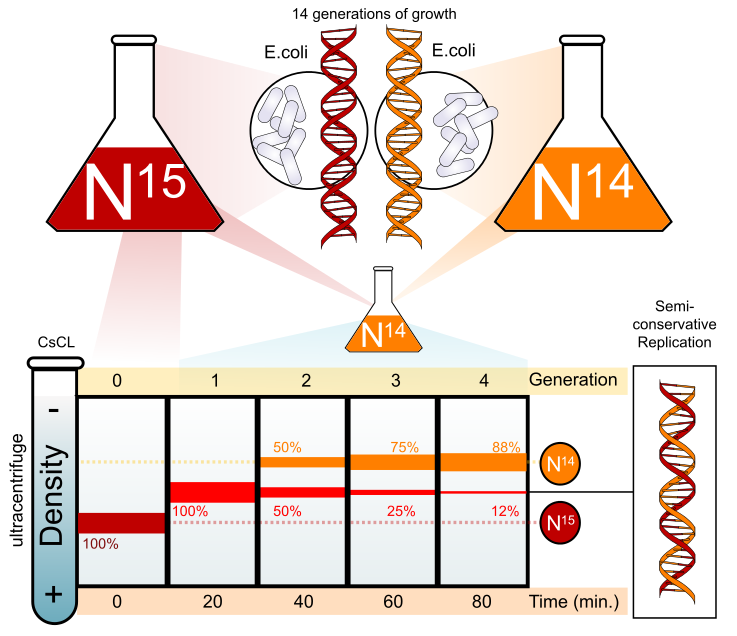
- Grow E. coli in "heavy" nitrogen (15N) so that all the DNA in the bacterial was labelled with 15N.
- When DNA was extracted and centrifuged (separated by weight), all DNA= "heavy."
- Transfer cells to "light" nitrogen (14N) and let DNA replicate once.
- When DNA was extracted and centrifuged, all DNA= 50% "heavy"/ 50% "light."
- This rules out the conservative theory which predicted that template DNA molecule would be all "heavy" and the new DNA would be all "light."
- Let DNA replicate in "light" nitrogen (14N) one more time.
- When DNA was centrifuged, DNA was either 50% "heavy"/ 50% "light" OR all "light."
- This rules out the dispersive theory which predicts that all the DNA would continue to be 50% "heavy"/ 50% "light."
Wize Concept
The Meselson-Stahl Experiment showed that DNA replicated using the semi-conservative mechanism.
Practice: Meselson-Stahl Experiment
Which of the following statements is true regarding the Meselson-Stahl experiment?