Wize University Biology Textbook > Cellular Respiration
Pyruvate Processing [Oxidation] [short]
Popular Courses
MCAT
General Course
AP Biology Exam Prep Course
AP Exam Prep
Biology
General Course
General Biology
University Study Guides
BIOLOGY 1002B
Western University
BIOL 211
University of Calgary
BIOL 107
University of Alberta
BIOL 102
Queen's University
BIOL 112
University of British Columbia
Grade 12 Biology
Canada High School
DAT
General Course
High School Biology
US High School
General Biology
University Study Guides
BIOL 130
University of Waterloo
SC/BIOL 1000 3.00
York University
BIOL 111
McGill University
BIO 1141
University of Ottawa
BLG 143
Toronto Metropolitan University
BIOL 112
McGill University
BIOL 186
University of Victoria
0:00 / 0:00
Pyruvate Processing
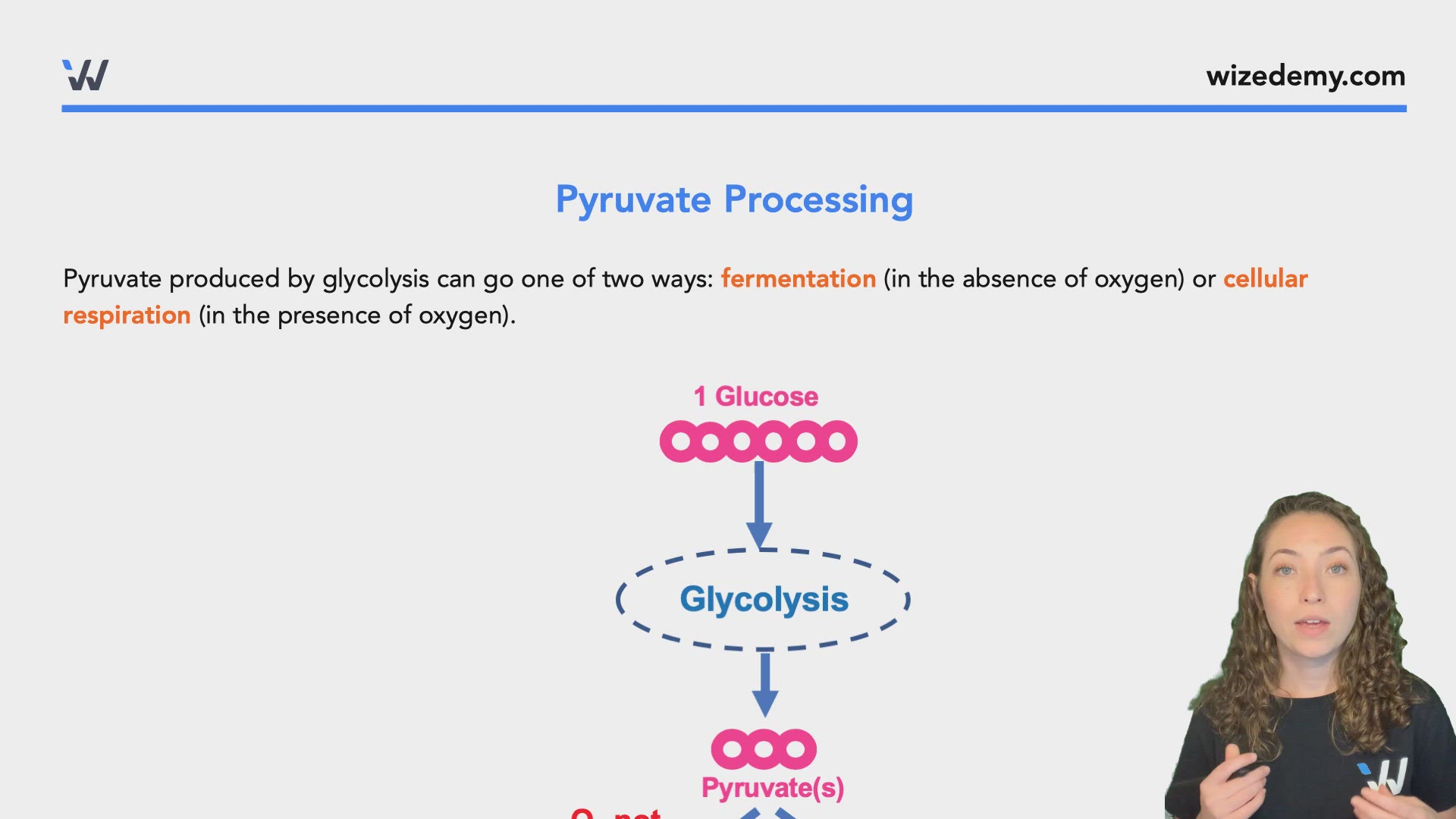
Pyruvate produced by glycolysis can go one of two ways: fermentation (in the absence of oxygen) or cellular respiration (in the presence of oxygen).

Pyruvate Processing or Oxidation
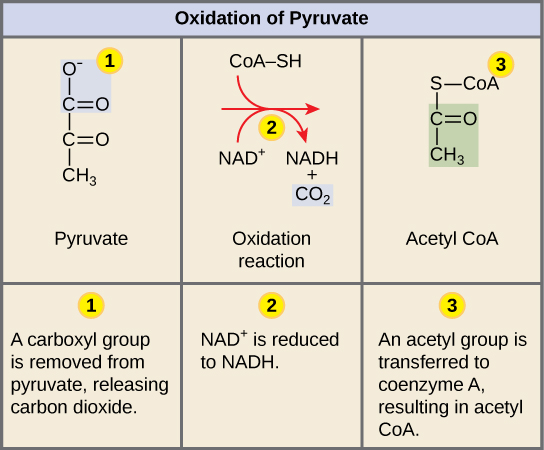
In eukaryotes, cellular respiration occurs in the mitochondrial matrix. Pyruvate is transported into the mitochondrial matrix and is converted to acetyl-CoA. In prokaryotes, it remains in cytosol.
- Pyruvate is converted to acetyl-CoA by pyruvate dehydrogenase.
- The reaction produces 1 NADH and therefore 2 NADH per molecule of glucose.
Balance after Glycolysis + Pyruvate Processing
After glycolysis and pyruvate processing, acetyl-CoA produced is ready to enter the Citric Acid or Krebs cycle (stage 3).

Practice: Addition of CoA
When does coenzyme A (coA) become attached to pyruvate?