Wize University Biology Textbook > Cellular Respiration
The TCA [Citric Acid / Krebs] Cycle [short]
Popular Courses
MCAT
General Course
AP Biology Exam Prep Course
AP Exam Prep
Biology
General Course
General Biology
University Study Guides
BIOLOGY 1002B
Western University
BIOL 211
University of Calgary
BIOL 102
Queen's University
BIOL 112
University of British Columbia
Grade 12 Biology
Canada High School
DAT
General Course
High School Biology
US High School
General Biology
University Study Guides
BIOL 130
University of Waterloo
BIOL 111
McGill University
BLG 143
Toronto Metropolitan University
BIOL 186
University of Victoria
BIOL 1010
Dalhousie University
BIOL-1101
University of Windsor
BIOL 1201
Western University
BISC 101
Simon Fraser University
0:00 / 0:00
The Citric Acid Cycle
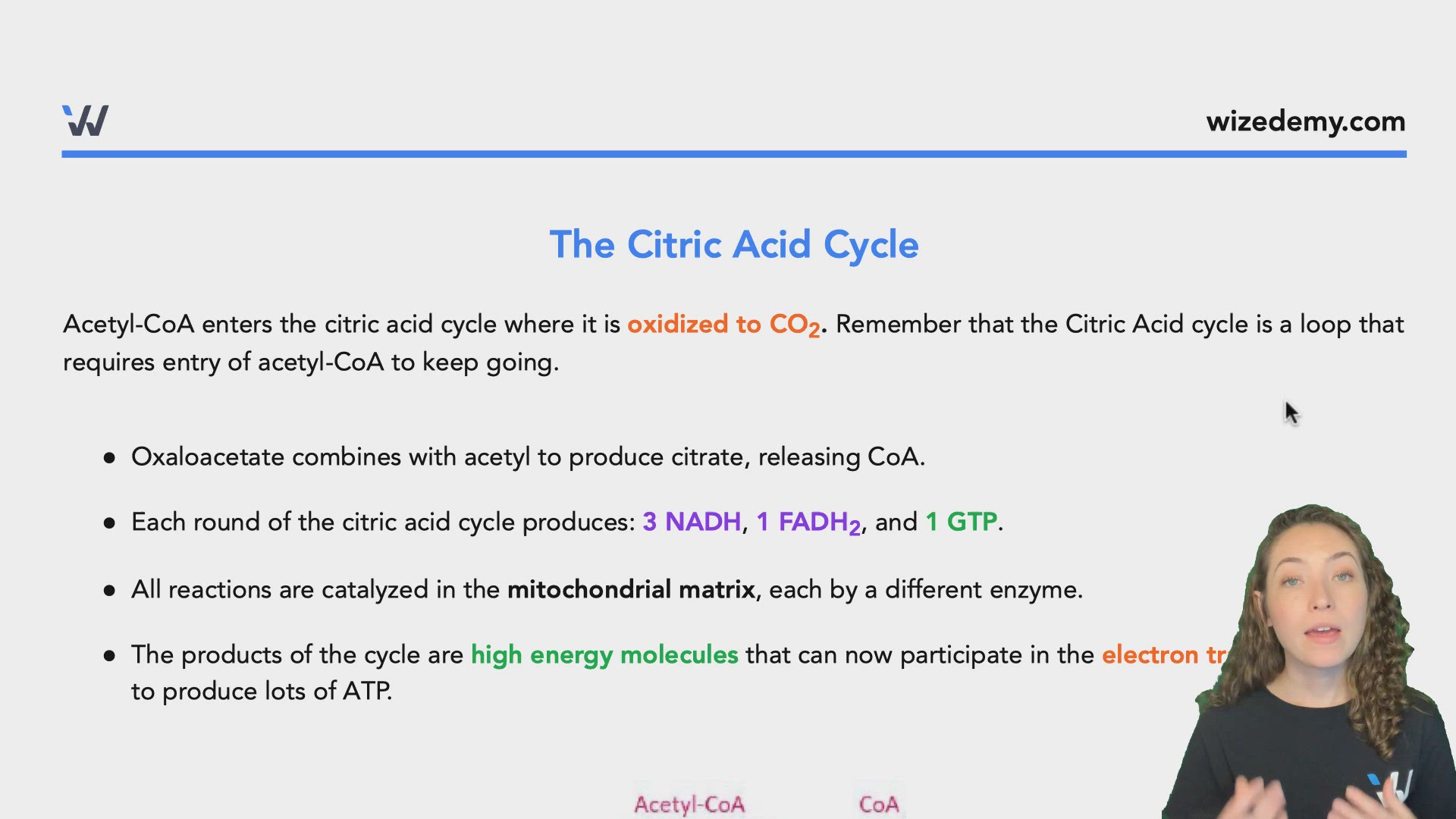
Acetyl-CoA enters the citric acid cycle where it is oxidized to CO2. Remember that the Citric Acid cycle is a loop that requires entry of acetyl-CoA to keep going.
- Oxaloacetate combines with acetyl to produce citrate, releasing CoA.
- Each round of the citric acid cycle produces: 3 NADH, 1 FADH2, and 1 GTP.
- All reactions are catalyzed in the mitochondrial matrix, each by a different enzyme.
- The products of the cycle are high energy molecules that can now participate in the electron transport chain to produce lots of ATP.

Balance After Glycolysis + Pyruvate Processing + Citric Acid Cycle
- Glycolysis: 2 pyruvate, 2 ATP, 2 NADH
- Pyruvate processing: 2 acetyl-CoA, 2 NADH
- Citric acid cycle: 6 NADH, 2 FADH2, 2 GTP
NET REACTION: 4 ATP, 10 NADH, 2 FADH2
Where does the Krebs Cycle occur?
Practice: Products of TCA/Citric Acid/Krebs Cycle
What is generated through one turn of the citric acid cycle?
Practice: CO2 Released by Krebs Cycle
How many molecules are released per acetyl group that passes through the Krebs cycle?