Wize University Biology Textbook > Cellular Respiration
The TCA [Citric Acid / Krebs] Cycle [detailed]
Popular Courses
MCAT
General Course
AP Biology Exam Prep Course
AP Exam Prep
Biology
General Course
General Biology
University Study Guides
BIOLOGY 1002B
Western University
BIOL 211
University of Calgary
BIOL 107
University of Alberta
BIOL 112
University of British Columbia
Grade 12 Biology
Canada High School
DAT
General Course
High School Biology
US High School
General Biology
University Study Guides
SC/BIOL 1000 3.00
York University
BIOL 111
McGill University
BIO 1141
University of Ottawa
BIOL 112
McGill University
BIOL 186
University of Victoria
BIOL 1201
Western University
BIOL 1P91
Brock University
BIOLOGY 2601A/B
Western University
0:00 / 0:00
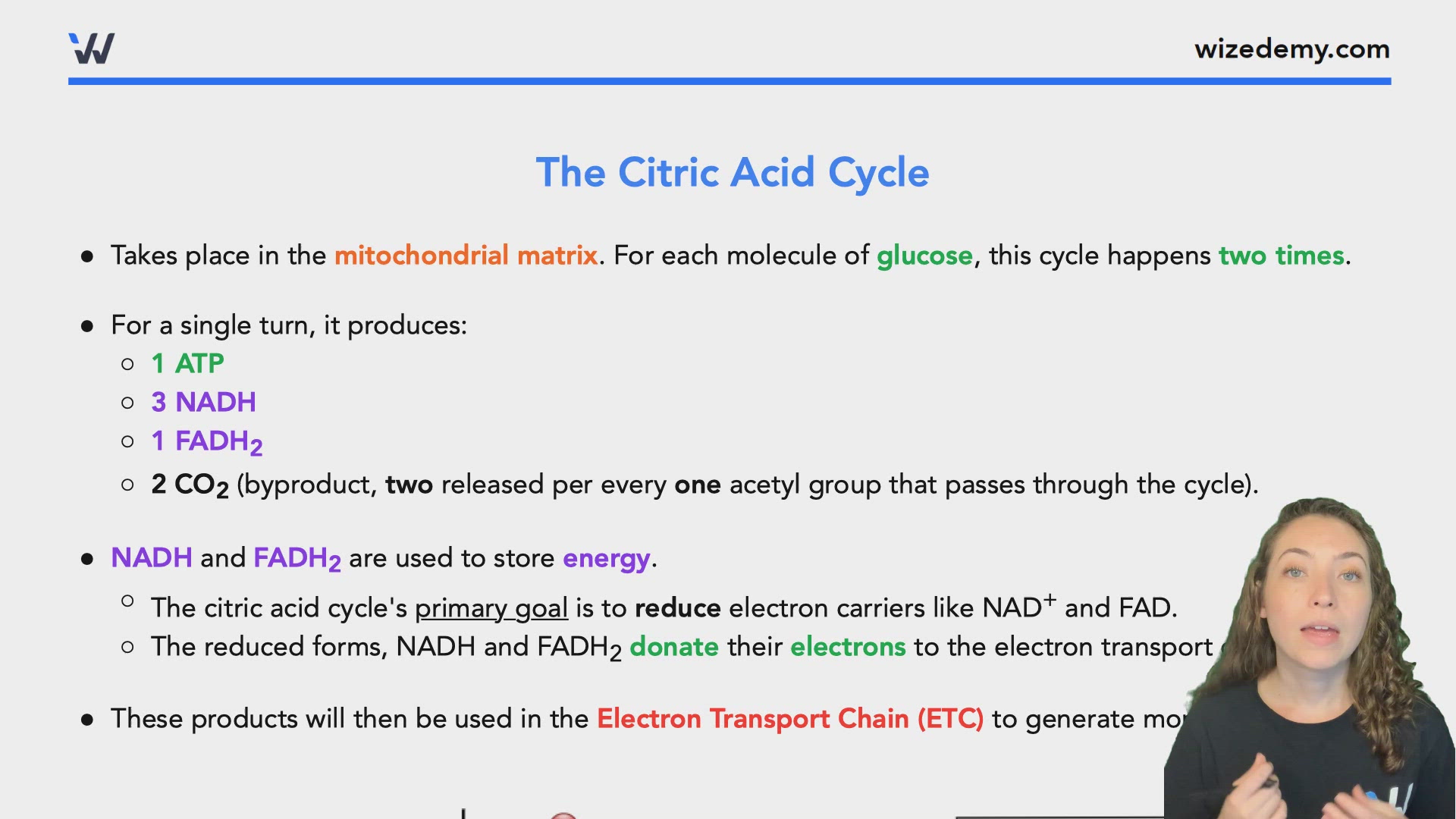
The Citric Acid Cycle
- Takes place in the mitochondrial matrix. For each molecule of glucose, this cycle happens two times.
- For a single turn, it produces:
- 1 ATP
- 3 NADH
- 1 FADH2
- 2 CO2 (byproduct, two released per every one acetyl group that passes through the cycle).
- NADH and FADH2 are used to store energy.
- The citric acid cycle's primary goal is to reduce electron carriers like NAD+ and FAD.
- The reduced forms, NADH and FADH2 donate their electrons to the electron transport chain.
- These products will then be used in the Electron Transport Chain (ETC) to generate more ATP.

Wize Tip
Mnemonic for Krebs intermediates: Citrate Is Krebs Special Substrate For Making Oxaloacetate

Reaction #1: Acetyl CoA + oxaloacetate + H2O → Citrate + CoA
- Condensation reaction (uses water).
- Catalyzed by citrate synthase.
- Acetyl transferred to oxaloacetate (OAA), plus water, to form citrate.

Reaction #2: Citrate → Isocitrate
- Catalyzed by aconitase.
- Transfers hydroxyl group from central carbon to the carbon beside it.

Reaction #3: Isocitrate + NAD+ → α-ketoglutarate + NADH + H+ + CO2
- Decarboxylation and oxidation.
- Catalyzed by isocitrate dehydrogenase.
- CO2 released by decarboxylation reaction, resulting in free energy loss that is harnessed as NADH.

Reaction #4: α-Ketoglutarate + NAD+ + CoA → Succinyl CoA + NADH + H+ + CO2
- Decarboxylation and oxidation.
- Catalyzed by α-Ketoglutarate dehydrogenase complex.
- Releases CO2 (free energy harnessed as NADH) and produces a high energy compound called succinyl CoA.
Reaction #5: Succinyl CoA + GDP + Pi → Succinate + GTP + CoA-SH

- Phosphorylation reaction.
- Catalyzed by succinyl CoA synthetase.
- Energy is transferred from high energy bonds in succinyl CoA to GDP, producing GTP.
- Succinate is produced in the process and the CoA group is removed.

Reaction #6: Succinate + FAD → FADH2 + Fumarate
- Oxidation reaction.
- Catalyzed by succinate dehydrogenase.
- Electrons and hydrogens removed and transferred form succinate to FAD (Q = FAD) to produce FADH2.
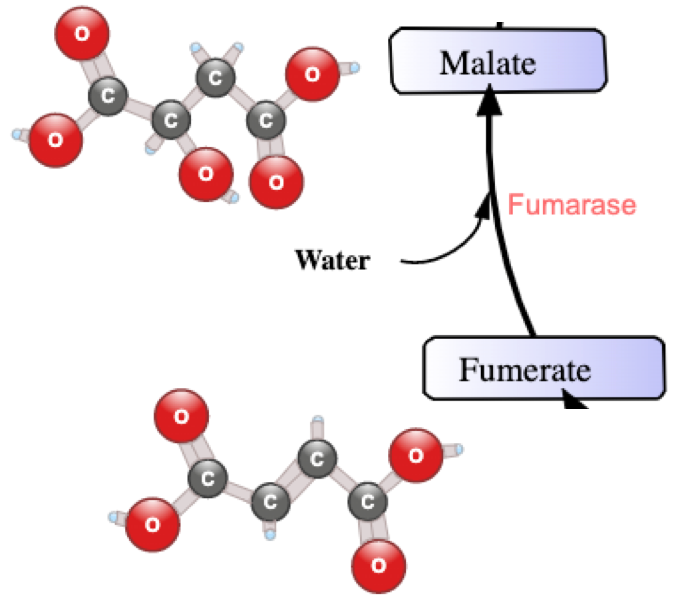
Reaction #7: Fumarate + H2O → Malate
- Condensation reaction.
- Catalyzed by fumarase.
- Hydroxyl group added to one of the carbons of fumarate.
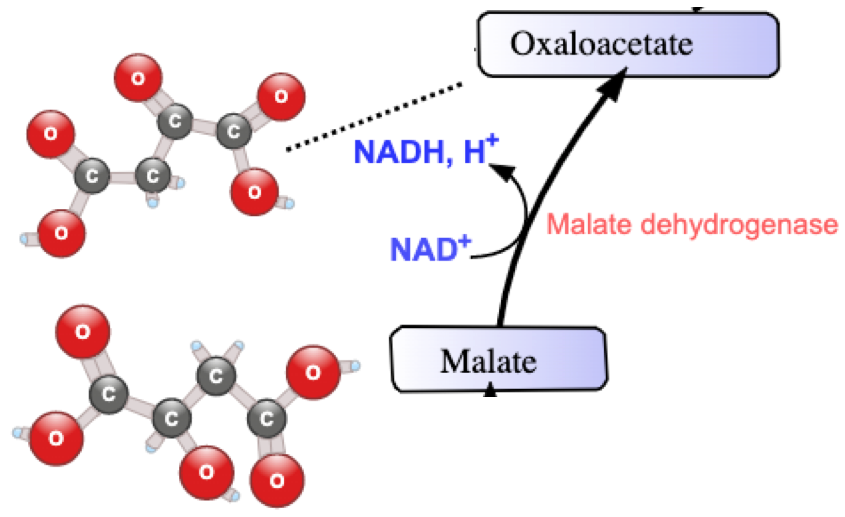
Reaction #8: Malate + NAD+ → Oxaloacetate + NADH + H+
- Oxidation reaction.
- Catalyzed by malate dehydrogenase.
- Hydroxyl (OH) group is oxidized, generating a carbonyl group. The electrons and hydrogens are transferred to NAD+ to form NADH + H+.
Summary of the citric acid cycle
- 2C's enter in acetyl-CoA and 2C's leave as CO2.
- 4 reduced electron carriers are generated: 3NADH and FADH2.
- High energy GTP is formed.
- Cycle happens in only one direction.
- Cycle depends on oxygen. NADH and FADH2 donate electrons to oxygen to regenerate NAD+ and FAD.
Net reaction: Acetyl-CoA + 3NAD+ + FAD + GDP + Pi → 2CO2 + CoA + 3NADH + FADH2 + GTP
Practice: Citric Acid Cycle Products
What electron carriers and in what quantity are produced per one cycle of the citric acid cycle?
Practice: Production of FADH2
Which enzyme and step catalyzes the production of FADH2?
Practice: Goal of Citric Acid Cycle
The primary goal of the citric acid cycle is to....