Wize University Calculus 1 Textbook > Pre-Calculus (Review)
Trigonometric Functions
Popular Courses
CALCULUS 1000A/B
Western University
Calculus 1
University Study Guides
AP Calculus (AB) Exam Prep Course
AP Exam Prep
MATH 100A
University of British Columbia
MATH 100C
University of British Columbia
MATH 1LS3
McMaster University
MATH 249
University of Calgary
MATH 265
University of Calgary
Calculus 1
General Course
MATH 275
University of Calgary
MATH 140
McGill University
MATH 121
Queen's University
MAT135H1
University of Toronto
MATH*1080
University of Guelph
MATH 134
University of Alberta
Calculus 1
University Study Guides
MAT 1320
University of Ottawa
MATH 100
University of Alberta
MATH 100B
University of British Columbia
MATH 203
Concordia University

0:00 / 0:00
Trigonometric (Trig) Functions
SOH CAH TOA
Using a right triangle, Trig Functions can be defined by using the hypotenuse, opposite side, and adjacent sides.

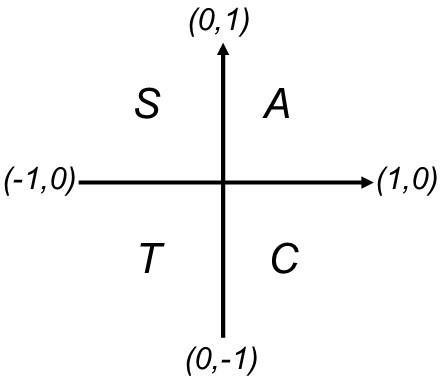
CAST Rule (All Students Take Calculus)
We can determine the sign (positive or negative) for our trig functions based on which quadrant the angle measure falls in.
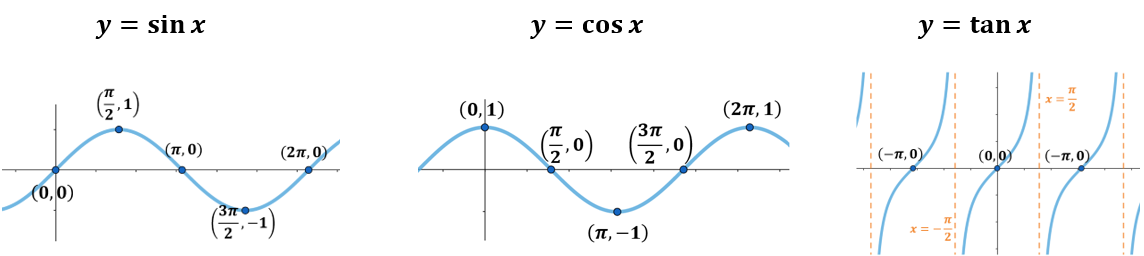
Trig Graphs
Special Triangles
So called 30-60-90 Triangles and 45-45-90 Triangles help us find exact values of trig functions.

- Draw out the angle given
- Identify the relative acute angle (RAA)--angle made with the x-axis
- Find the trig ratio of the RAA using special triangles
- Make the trig ratio positive or negative based on the CAST rule
Example:
0:00 / 0:00
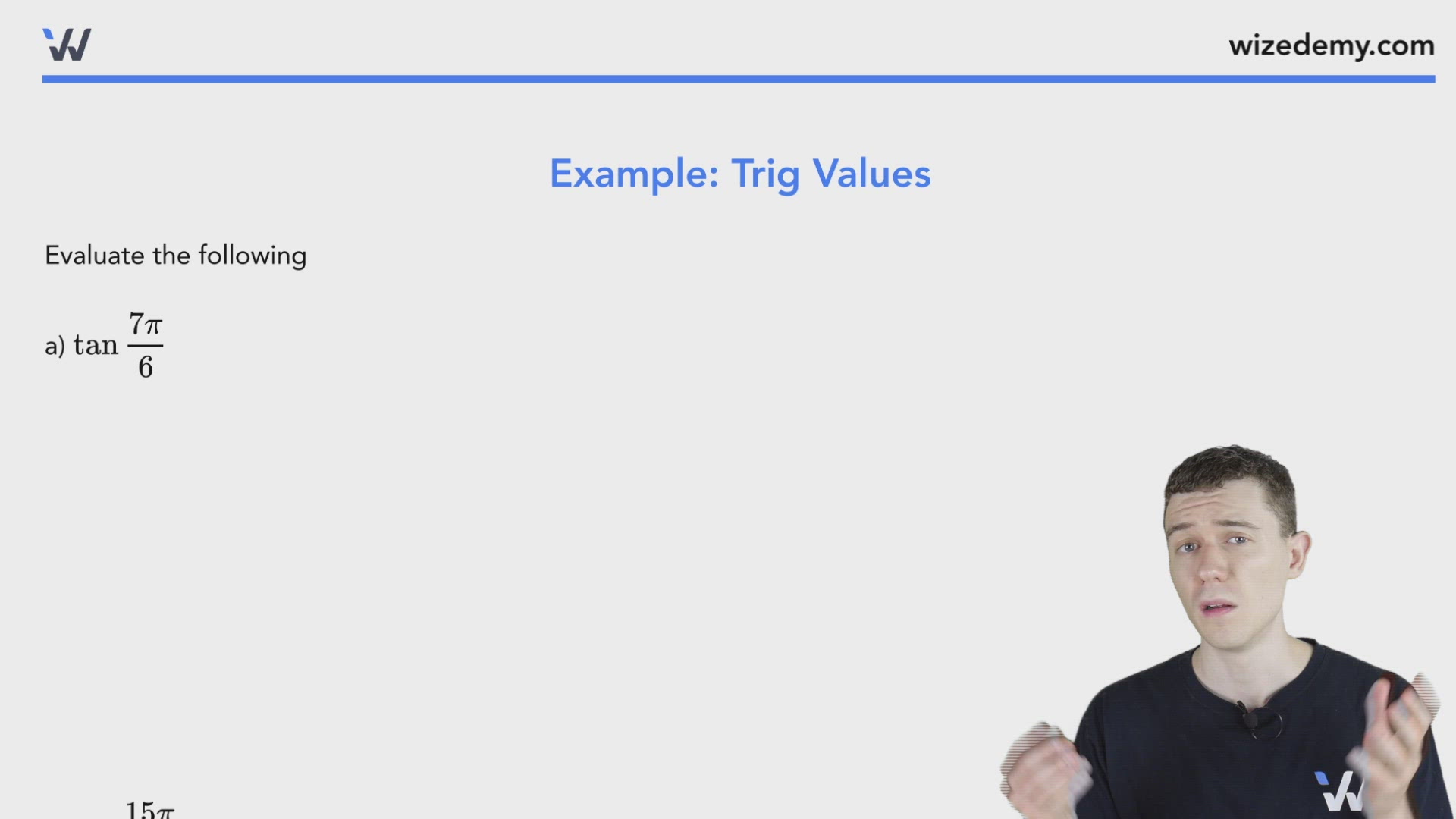
Example: Trig Values
Evaluate the following
a)
- The angle can be written as . So, when we draw out the angle, it’s in quadrant 3.
- The relative acute angle (RRA) is the angle it makes with the 𝑥-axis, which will be .
- Finding the trig. ratio of the relative acute angle, we get
- Since is positive in the 3rd quadrant (use CAST rule), our answer is
b)
- The angle can be written as . So, when we draw out the angle, it's in quadrant 4.
- The relative acute angle (RRA) is the angle it makes with the 𝑥-axis, which will be .
- Finding the trig. ratio of the relative acute angle, we get
- Since is negative in the 4th quadrant (use CAST rule), out answer is
0:00 / 0:00
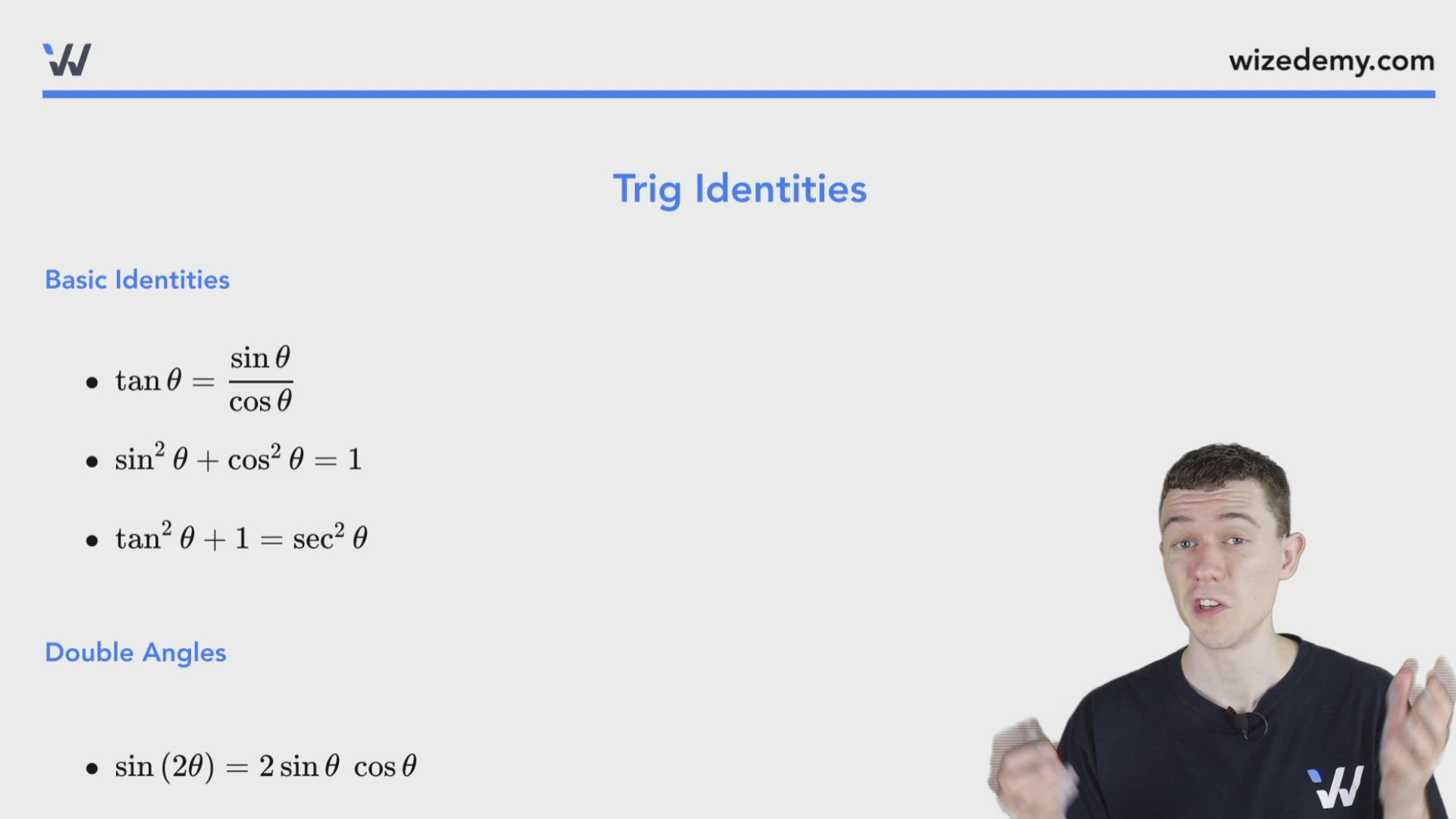
Trig Identities
Basic Identities
Double Angles
Angle Sum & Difference
Even and Odd Properties
- Odd function:
- Even function:
Given and , find the exact values of .
Solve the equation on the interval .