Wize High School Grade 11 Biology Textbook > Cell Biology
Moving Molecules Across Membranes

0:00 / 0:00
Passive Transport
In order for molecules or ions to get into a cell they must face the cell membrane. There are a few mechanisms by which they can get through this barrier:

(Simple) Diffusion
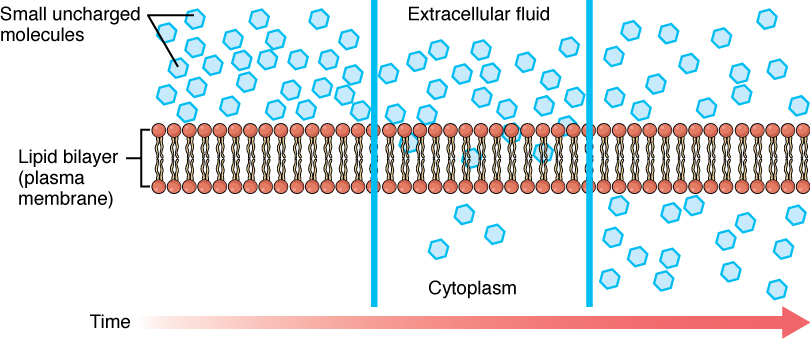
Simple diffusion occurs due to random thermal motion of molecules. When you add a drop of red dye to a glass of water, some time later the drop will have spread and the entire water will be pink. This is diffusion!
- Diffusion always occurs from high to low concentration regions (driving force), also known as the concentration gradient.
- When the concentrations are equal throughout, this system is said to be at equilibrium.
- In order for diffusion to occur across a membrane, the membrane must be permeable to the molecule.
Diffusion of Non-Electrolytes
Small, uncharged and lipophilic molecules can cross right through the lipid bilayer.
Facilitated Diffusion
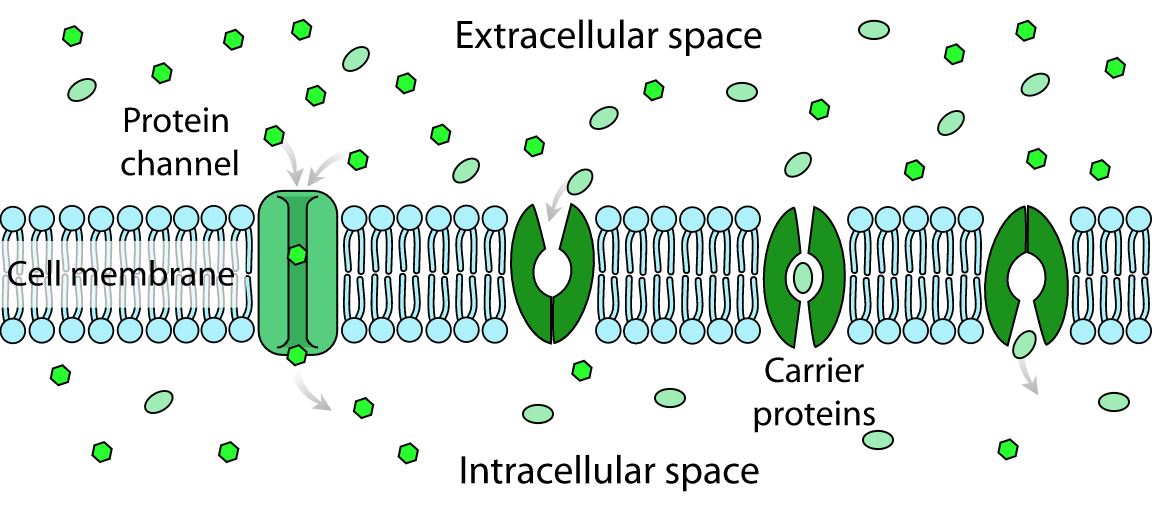
Molecules that cannot diffuse through the membrane require additional help of transport proteins to get into a cell.
- No energy required just like simple diffusion but instead uses the help of a membrane protein.
- Down the concentration gradient (i.e. molecules go from areas of high to low concentration).
- Two types of membrane proteins that help in facilitated diffusion: Channel Proteins and Carrier Proteins
- Channel proteins
- Specific for a certain molecule;
- Can be open all the time or need a trigger ("gated"). Example: channels for Na+ or Cl- ions.
- Carrier proteins
- Not just a hollow channel: when its specific molecule binds, it changes shape (conformation) and enables the passage of the molecule inside. Example: glucose transporters.
0:00 / 0:00
Membrane Permeability
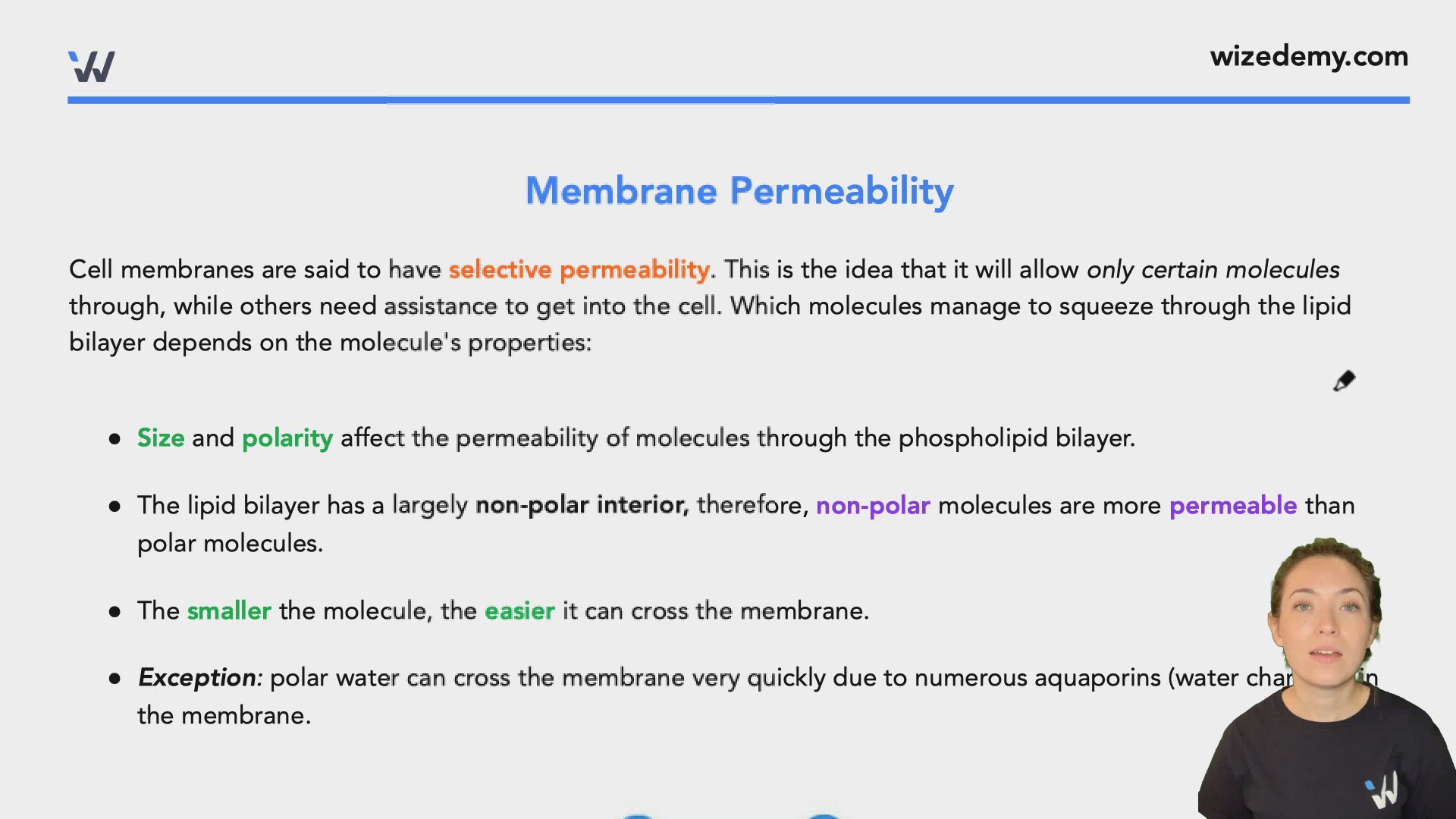
Cell membranes are said to have selective permeability. This is the idea that it will allow only certain molecules through, while others need assistance to get into the cell. Which molecules manage to squeeze through the lipid bilayer depends on the molecule's properties:
- Size and polarity affect the permeability of molecules through the phospholipid bilayer.
- The lipid bilayer has a largely non-polar interior, therefore, non-polar molecules are more permeable than polar molecules.
- The smaller the molecule, the easier it can cross the membrane.
- Exception: polar water can cross the membrane very quickly due to numerous aquaporins (water channels) in the membrane.


0:00 / 0:00
Osmosis and Osmolarity
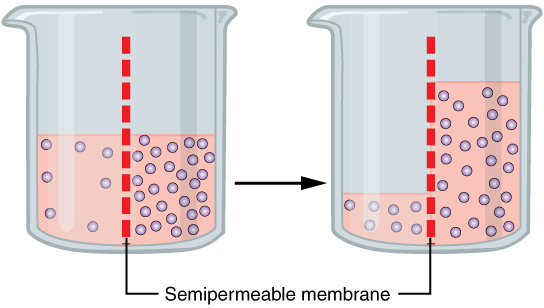
Simply put, osmosis is the diffusion of water.
- Water is a polar molecule that diffuses into the cell through aquaporins (channels).
- There must exist a concentration gradient. Example: Solute is added to intracellular or extracellular space.
- Degree to which the concentration of water is decreased depends on the number of particles of solute.
- Osmolarity is the number of particles a solute dissociates into when in solution (per liter).
Osmolarity and Cell Volume
Water can always diffuse through the membrane to establish diffusion equilibrium (intracellular = extracellular osmolarity).
- In an isotonic solution: the movement of water is even across the membrane in either direction (cell volume maintained).
- In a hypertonic solution: a gradient created by a molecule results in a net movement of water out of the cell resulting in shriveling. Example: a cell is put in a solution with a lot of salt.
- In a hypotonic solution: a gradient created by a molecule results in a net movement of water into the cell resulting in swelling. Example: a cell is put in a solution with no salt.

Practice: Passive Transport
Why do cells not need to expend any energy during passive transport?
Practice: Types of Passive Transport
Which of the following statement(s) are FALSE?
I. Ions like Na+ are small enough to cross the cell membrane through the lipid bilayer
II. Facilitated diffusion requires the input of energy
III. Small, uncharged and lipophilic molecules can enter the cell by diffusing through the lipid bilayer
IV. Ion channels are selective and can be gated
V. Availability of channels is not important in the ability of an ion to diffuse into a cell

0:00 / 0:00
Active Transport
Also involves a carrier or transporter. There are two types: primary and secondary active transport.
- Can transport solutes against its concentration gradient.
- Therefore, requires the input of energy.
- When there's no energy available, this cannot occur.
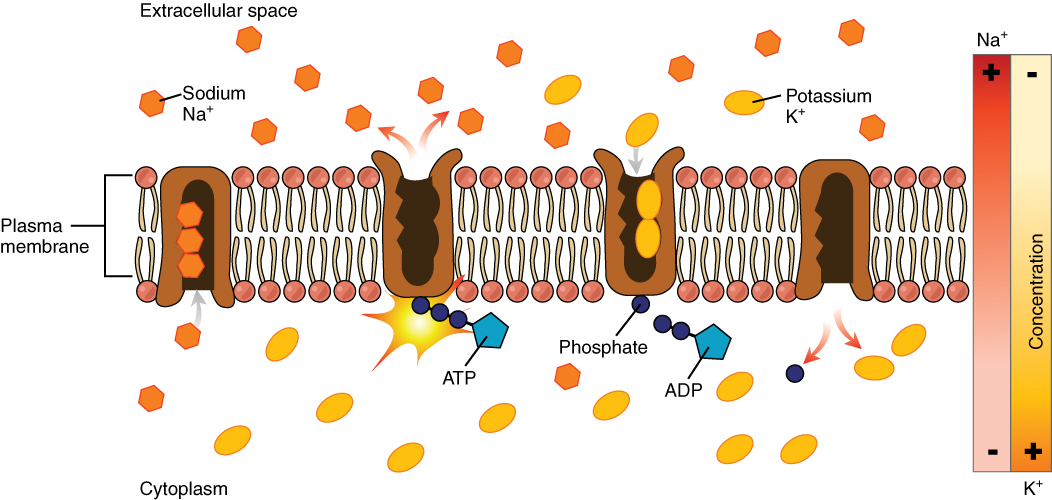
Primary Active Transport
- ATP is used as the source of energy.
- The transporter/carrier itself is an ATPase enzyme.
- Carrier takes a phosphate from ATP, changing its conformation. Examples: Na+/K+ ATPase, Ca2+ ATPase, H+ ATPase, H+/K+ ATPase
Secondary Active Transport
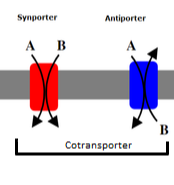
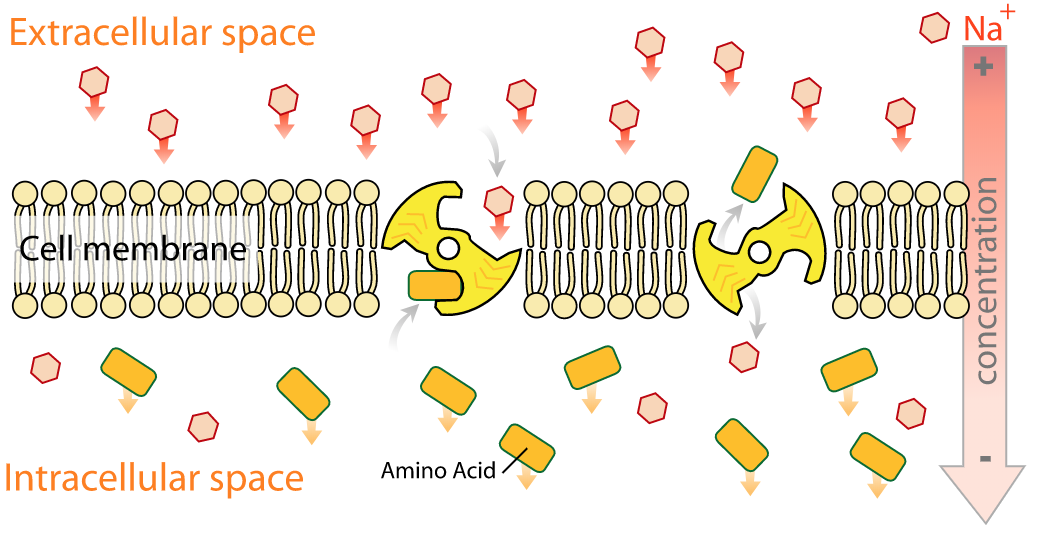
- Also known as co-transport. Energy used is from the movement of one ion down its electrochemical gradient, while another ion moves up its gradient.
- When both solutes move in the same direction, the carrier molecule is called a symporter (hitching a ride). Example: Na+/glucose cotransporter, Na+/amino acid cotransporter.
- When solutes move in opposite directions, the carrier molecule used is called an antiporter (club is at capacity). Example: Na+/H+ exchanger, Cl-/HCO3-exchanger, Na+/Ca2+ exchanger.
Summary
- Both require input of energy.
- Both move solutes against their electrochemical gradients
- Primary active transport uses ATPases.
- Secondary active transport uses another molecule that moves down its gradient.
0:00 / 0:00
Example: Build Your Own Transporter
Imagine you have to design a carrier to transport molecule X into a cell against its concentration gradient (it cannot cross the membrane through the phospholipid bilayer or a channel). The cellular environment in question has low ATP but abundant levels of Na+ ions in the extracellular space. How would you design this carrier to transport this molecule? What kind of transport would this be? Do you know any examples of this type of transport?
To design this carrier, several things should be considered:
1) The molecule to be transported will go against its concentration gradient: this will require active transport
2) The cell is low on ATP, but has lots of Na+: the sodium gradient can be used as the energy to transport the molecule
3) Since Na+ is abundant extracellularly, it will be going into the cell: the carrier should be a symporter
Therefore, designing a Na+/molecule X symporter would be a great solution to this problem. This carrier would be doing secondary active transport. Examples of this include the Na+/glucose or Na+/amino acid cotransporters.

Mark Yourself Question
- Grab a piece of paper and try this problem yourself.
- When you're done, check the "I have answered this question" box below.
- View the solution and report whether you got it right or wrong.
Practice: Predict Entry Method
By what method would you predict that these molecules would enter the cell?
a) Oxygen:
b) Potassium:
c) Water:
d) Glucose:
Practice: Shrink or Not to Shrink?
Sea urchin eggs are isotonic to seawater. Consider these conditions:
a) Eggs are in seawater.
b) Eggs are in 65% seawater (35% distilled water).
c) Eggs are in pure distilled water.
True or False?
i. Under condition b, the egg will not change size.
ii. Under condition a, the egg will not shrink.
iii. Under condition c, the egg will increase in size.
Endocytosis and Exocytosis
A way for molecules to enter or exit the cell without requiring them to pass through the membrane structure. Both require energetic input and utilize the cell membrane.
Exocytosis
Membrane-bound intracellular vesicles merge with the cell membrane to expel its contents into the extracellular space.

Endocytosis:
Can be thought of as the opposite of exocytosis. Membrane folds into the cell (invaginates) and pinch off to produce membrane-bound vesicles inside the cell containing extracellular components/fluids. There are three main types:

- Pinocytosis: fluid endocytosis ("cell drinking")
- Most cells can do this.
- Phagocytosis: solid endocytosis ("cell eating")
- Cell engulfs bacteria, other cell debris from tissue death, etc.
- Pseudopodia ("sham feet") are created to surround material;
- Usually specialized cells such as macrophages/other immune cells.
- Receptor-mediated endocytosis: specific uptake triggered by receptor binding
- Clathrin-dependent
- Formation of a clathrin-coated vesicle Example: cholesterol binds to LDL receptor in liver and clathrin is recruited in cytoplasm and coats the vesicles from the inside.
- Potocytosis: clathrin-independent
- Formation of tiny vesicles called caveolae that deliver their contents to cytosol.
Practice: Pinocytosis
Pinocytosis: