Wize University Physiology Textbook > Cardiovascular Physiology
Cardiovascular Regulation
Popular Courses
MCAT
General Course
DAT
General Course
Grade 11 Biology
Ontario High School
Grade 11 Biology
Canada High School
Intro to Physiology
University Study Guides
PHYSIOL 1021
Western University
Biology 20
Alberta High School
PHYSIOL 2130
Western University
Intro to Physiology
University Study Guides
PSL300H1
University of Toronto
PHYSL 210
University of Alberta
Life Sciences 11
British Columbia High School
PHGY 210
McGill University
PHGY 215
Queen's University
KNES 259
University of Calgary
PHGY 216
Queen's University
BIOL 273
University of Waterloo
BIOL 260
University of British Columbia
PHYSIOL 3120
Western University
KNES 260
University of Calgary
0:00 / 0:00
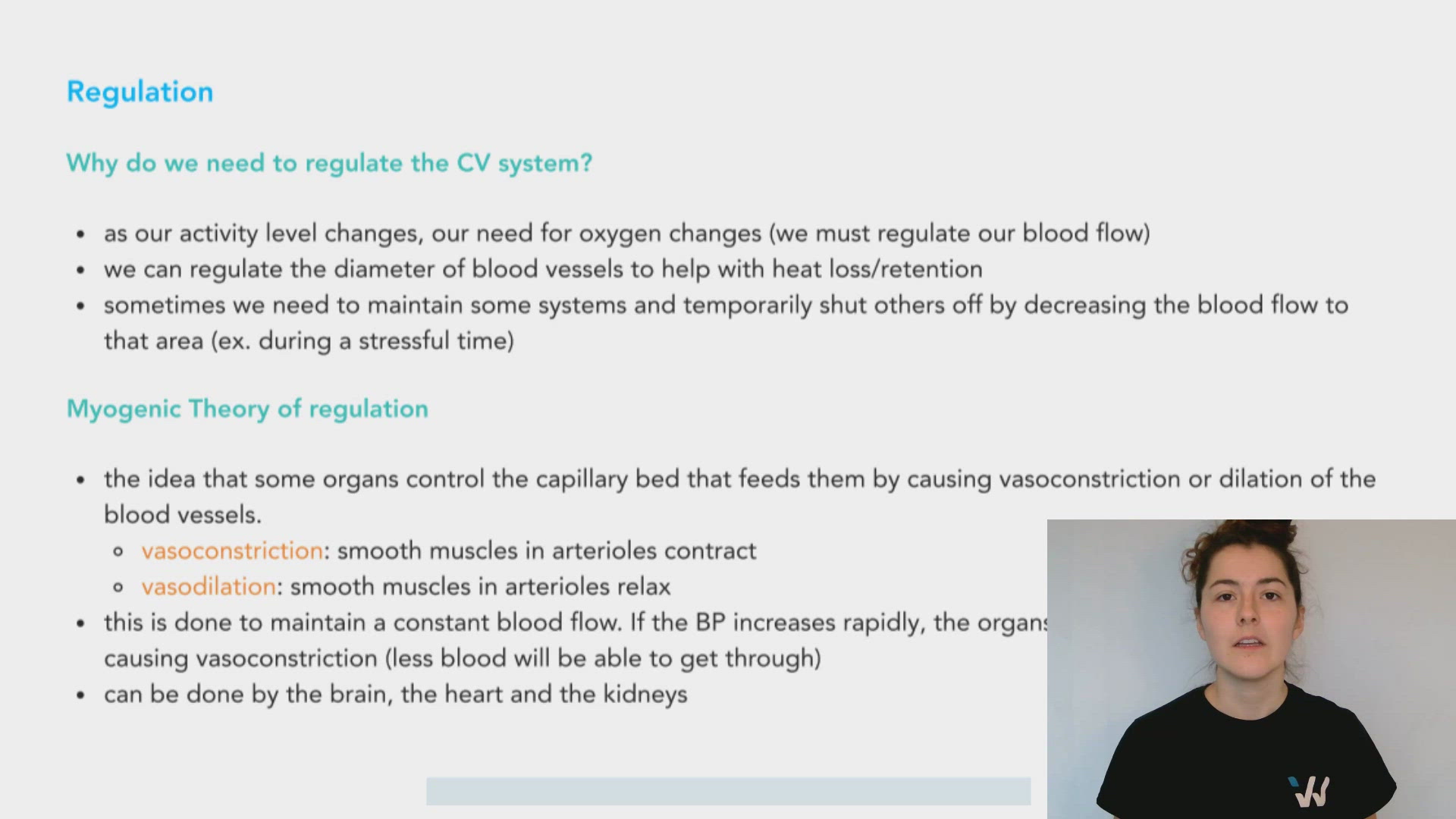
Regulation
Why do we need to regulate the CV system?
- as our activity level changes, our need for oxygen changes (we must regulate our blood flow)
- we can regulate the diameter of blood vessels to help with heat loss/retention
- sometimes we need to maintain some systems and temporarily shut others off by decreasing the blood flow to that area (ex. during a stressful time)
Myogenic Theory of regulation
- the idea that some organs control the capillary bed that feeds them by causing vasoconstriction or dilation of the blood vessels.
- vasoconstriction: smooth muscles in arterioles contract
- vasodilation: smooth muscles in arterioles relax
- this is done to maintain a constant blood flow. If the blood pressure gradient increases rapidly, the organs can decrease the blood flow by causing vasoconstriction (less blood will be able to get through - recall the blood flow equation and the effect of the vessels radius on blood flow)
- can be done by the brain, the heart and the kidneys
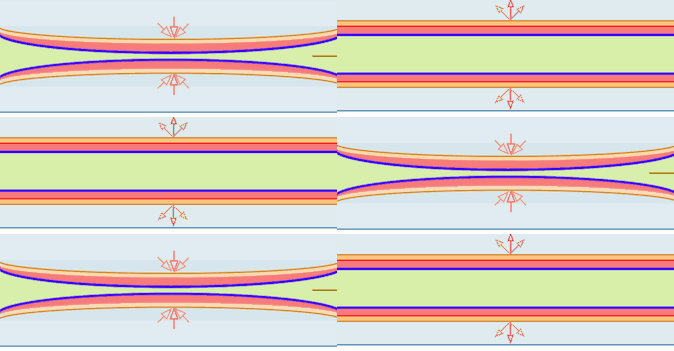
Metabolic Theory of regulation
- the idea that the more active we are, the more vasodilator metabolites (VDM) we produce.
- ex. if we are playing a game of soccer, we will produce lots of VDMs. These VDMs will cause arterioles to dilate, resulting in increased blood flow. We then get more O2 to the tissues that need it when we are running after the ball!
- some examples of VDMs:
- high CO2
- increased temperature
- increased acidity (hydrogen concentrations)
- decrease in O2
- if VDMs are present, it tells our body the alter vasoconstriction/vasodilation accordingly.
Humoral Regulation
- hormonal control of vasoconstriction and dilation
- hormones that cause vasoconstriction:
- vasopressin
- epinephrine
- angiotensin ll
- hormones that cause vasodilation
- kinins
- histamine
- ANF
- epinephrine
Neural Mechanisms
- neurons can cause direct vasoconstriction or vasodilation
- the ANS changes vessel diameters in order to change blood flow
- Sympathetic = vasoconstriction = decreased blood flow
- Parasympathetic = vasodilation = increased blood flow
0:00 / 0:00
Explain why you pass out when you hyperventilate using the metabolic theory of CV regulation. Why does using a paper bag help?
When we hyperventalate, we breathe in and out a lot. By doing this, we get rid of lots of CO2 and increase our O2 levels. Both of these are VDM signals to cause vasoCONSTRICTION. The blood flow to all tissues is decreased because we have too much O2 in our blood. The brain doesn't get enough blood, so eventually we just pass out.
The paper bag causes you to breath back in the same air you breathed out. By doing this, you take back in the CO2 that you breathed out already. This helps you're blood CO2 concentrations stay relatively stable, resulting in no vasoconstriction or dilation. Your brain still gets proper blood supply and you don't pass out.
0:00 / 0:00
Watch Out!
Important for this class is the BARORECEPTOR reflex!! Skip to 2:47
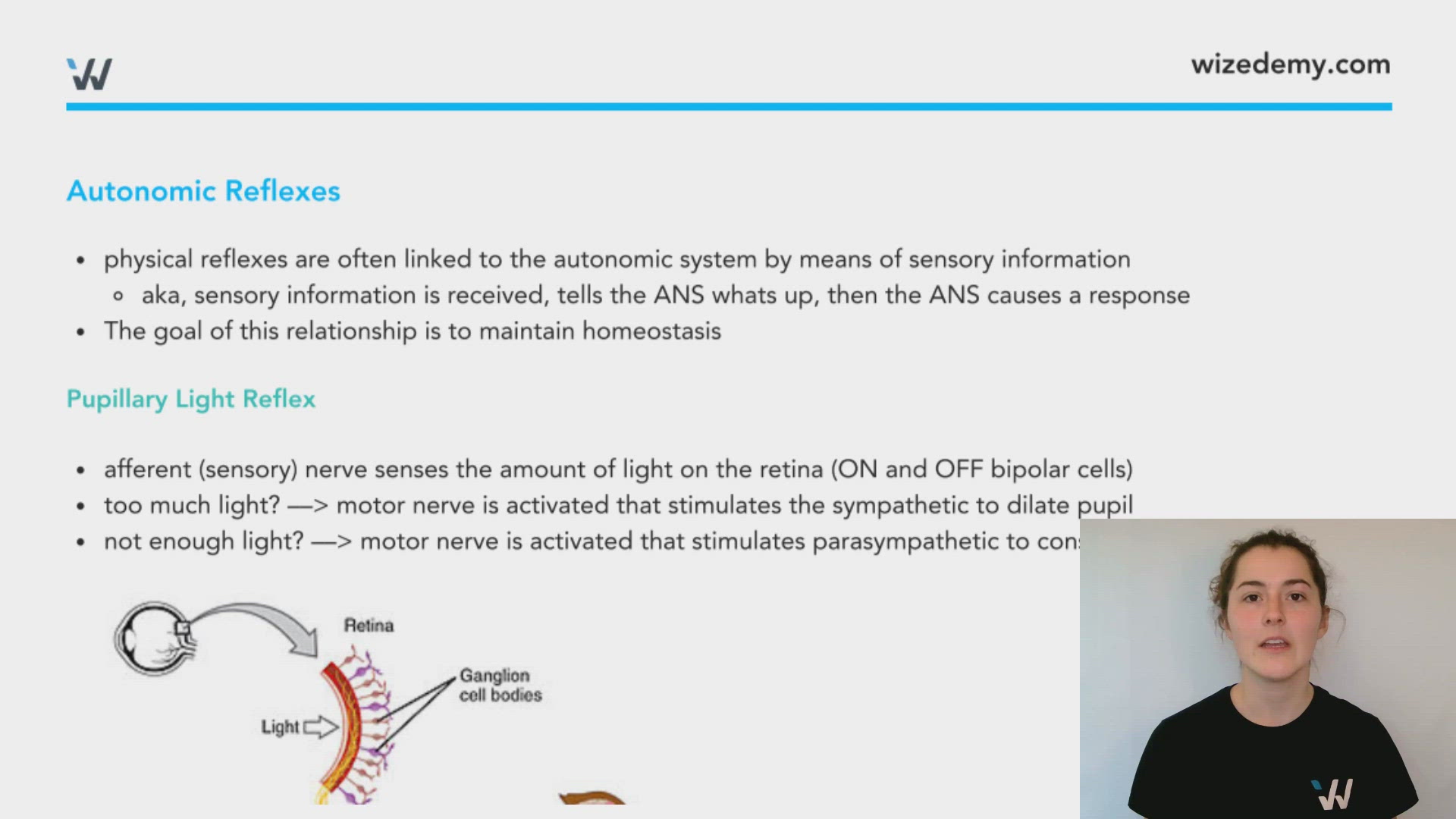
Autonomic Reflexes
- physical reflexes are often linked to the autonomic system by means of sensory information
- aka, sensory information is received, tells the ANS whats up, then the ANS causes a response
- The goal of this relationship is to maintain homeostasis
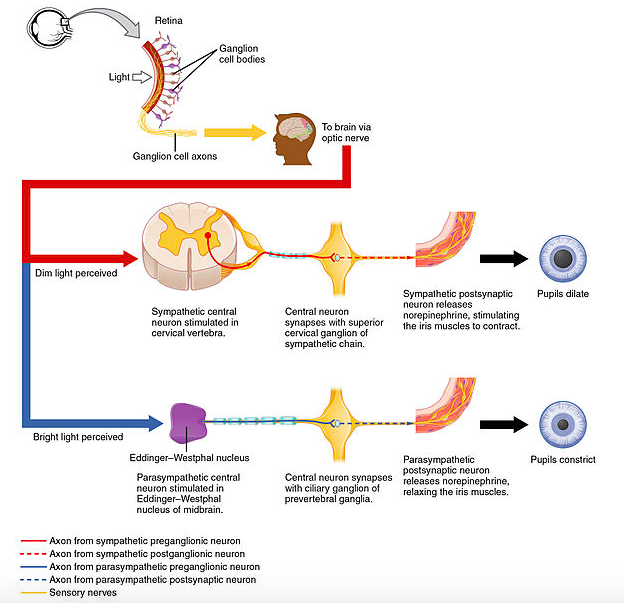
Pupillary Light Reflex
- afferent (sensory) nerve senses the amount of light on the retina (ON and OFF bipolar cells)
- too much light? ––> motor nerve is activated that stimulates the sympathetic to dilate pupil
- not enough light? ––> motor nerve is activated that stimulates parasympathetic to constrict pupil
Baroreflex
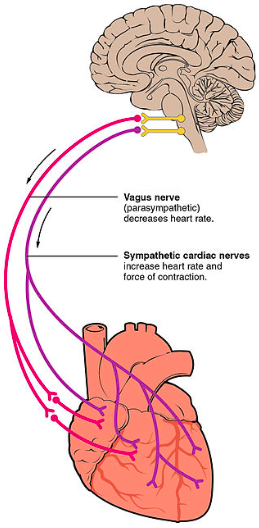
- brain region located in the ventrolateral medulla (VLM), receptors located in the walls of arteries.
- baroreceptors sense need for changing heart rate, they travel through the nucleus solitary tract in the spinal cord up into the medulla. After processing, either a sympathetic (increased HR) or parasympathetic (decrease HR) response will happen
- parasympathetic response is actually caused by sympathetic part in VLM being inhibited.
- ANALOGY: Water running through pipes (see video)
What is the correct order of events for the baroreceptor reflex?