Popular Courses
Find My CourseMitochondria
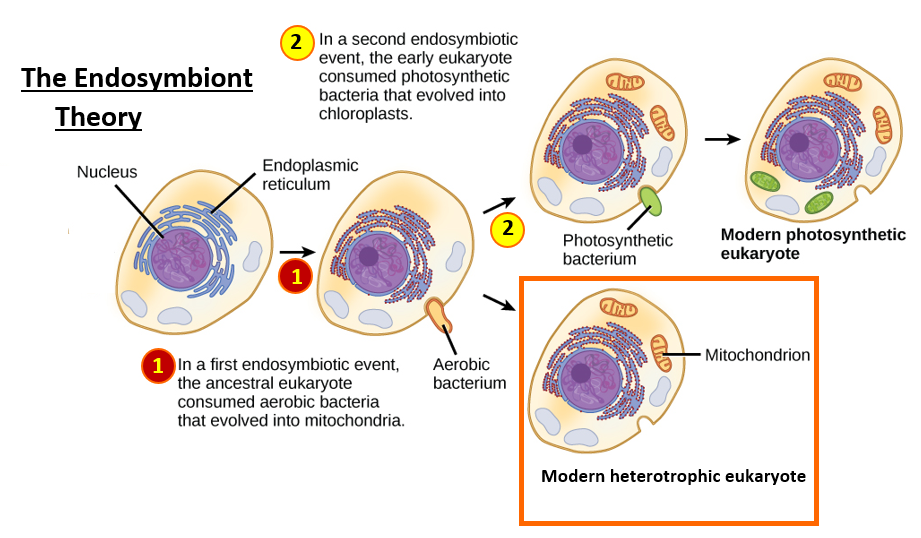
The mitochondrion is a fairly large (3-10μm) organelle that contains its own ribosomes and DNA. These features suggest an evolutionary origin in which an endosymbiotic relationship developed between a eukaryotic cell which engulfed an aerobic prokaryote, and then gradually developed into a mitochondrion (Endosymbiont theory).
Wize Tip
The term "endosymbiosis" can be broken down to be easily remembered: the prefix "endo" means within and "symbiosis" means state of living together, so you have organisms living together within one another.
Structure
- Double Membrane: Both outer and inner membranes are phospholipid bilayers with a unique collection of embedded proteins. The space between them is known as the intermembrane space.

- Outer membrane:
- Smooth; it does not fold.
- Have pores constructed from porin proteins that allow for the passive movement of ions and small molecules between the cytosol and the intermembrane space.
- Inner membrane:
- Convoluted into foldings called cristae, which help to increase its surface area.
- Does not have pores; more restricted permeability.
- Enclosed by the inner membrane is the mitochondrial matrix.
- Mitochondrial matrix: It is called matrix due to its viscous consistency. It is even more viscous than the cell's cytosol.
- Contains the mitochondrial genetic material.
- Circular DNA molecules.
- Exist as multiple copies.
- Enables the mitochondria to reproduce on its own, independent of the cell's cycle.
- Contains ribosomes.
- That produce proteins used by the mitochondrion, but not all.
- Contains soluble enzymes.
- Catalyze some of the steps of cellular respiration
- Contains granules.
- Particles containing calcium, phospholipids, and proteins
Function
The mitochondria is the site of cellular respiration, a metabolic reaction that uses oxygen to convert the chemical energy found in sugars, fats and other fuels to the usable energy form, ATP. For this reason, the mitochondria is nicknamed the "cell's powerhouses."
The 3 steps of Cellular Respiration:

Just how many mitochondria are found in cells?
The number of mitochondria present in a cell is directly related to the cell's level of metabolic activity.
- The greater the cell's energy demands, the more mitochondria it will have! Such as muscle, liver, nerve cells and fibroblast cells.
- Fibroblast cells have a considerable number of mitochondria as they have to synthesize many important components of the extracellular matrix.
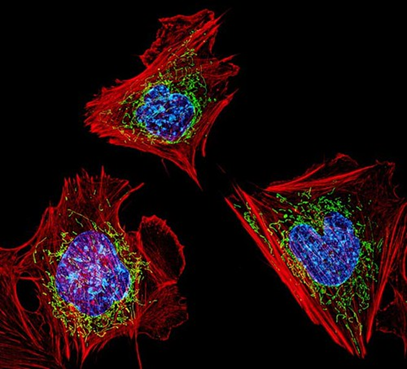
- Below is a fluorescent microscopy image showing the inside of a mouse fibroblast cell; DNA within the nucleus (blue), cytoskeleton (red) and mitochondria (green).
Practice: Mitochondria Function
What is the main function of mitochondria?
Practice: Mitochondria Structure and Function Correlation
Which step of respiration is made more efficient by the inward folding of the inner membrane?
Practice: Mitochondria Structure
Match the definition with the correct term.
A.
Krebs cycle takes place here
B.
Protein lined pores on the outer membrane
C.
Space between the outer and inner membrane
D.
A fold in the inner membrane of a mitochondrion
E.
Particles that can contain food storage and calcium
Intermembrane space
Matrix
Cisternae
Granules
Porin