Popular Courses
Find My CourseChloroplast
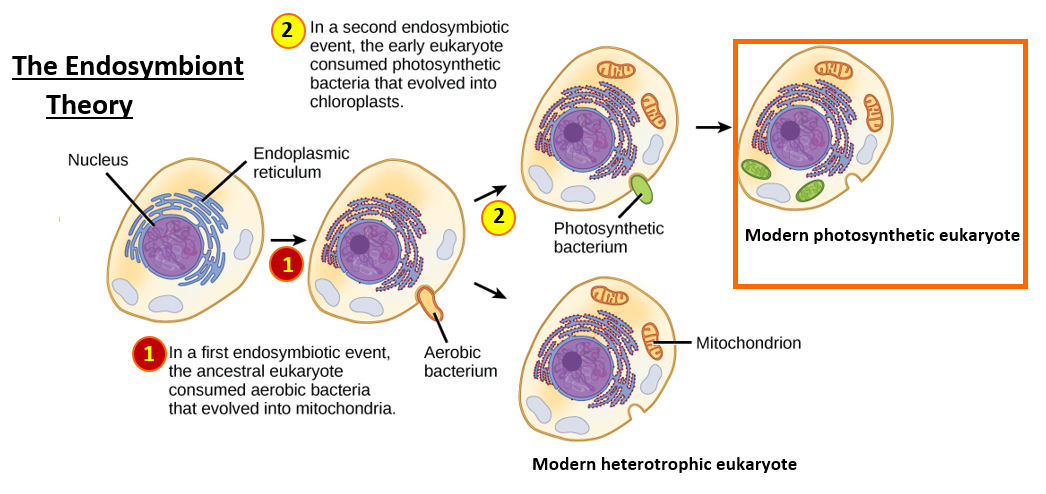
The chloroplast is a fairly large (3-6μm) organelle that contains its own ribosomes and DNA. These features suggest an evolutionary origin in which the early mitochondria containing eukaryotic cells engulfed photosynthetic prokaryotes, which then evolved to become specialized chloroplast organelles(Endosymbiont theory).
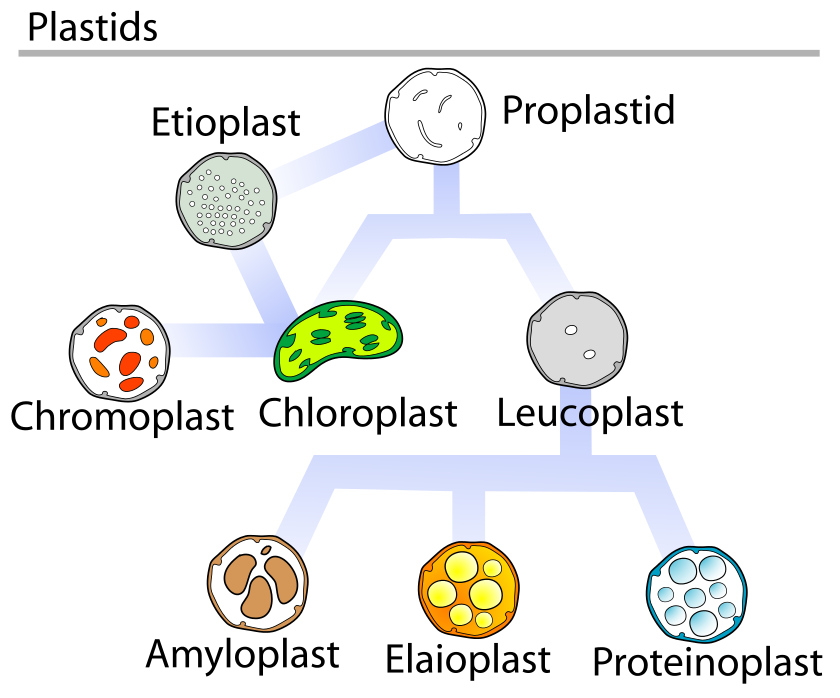
The chloroplast belongs to a larger family of plant organelles called plastids. All plastids differ from one another in both structure and function, with chloroplasts being specialized for photosynthesis.
Structure
- Chloroplast envelope: The chloroplast envelope consists of an outer and inner membrane. The space between them is known as the intermembrane space.

- Outer membrane:
- Smooth; it does not fold.
- Has pores constructed from porin proteins that allow for the passive movement of ions and small molecules between the cytosol and the intermembrane space.
- Inner membrane:
- Smooth; it does not fold.
- Does not have pores; more restricted permeability.
- It is studded with transport proteins.
- Thylakoid membrane:
- This is the third inner membrane. It is organized into flattened, interconnected discs called thylakoids, which are frequently arranged into stacks called grana.
- Located on the surface of each thylakoid is the pigment chlorophyll, which is the primary pigment used in photosynthesis.
- Since this pigment primarily reflects green light, structures containing this pigment will appear green.
- Chlorophyll functions by absorbing light energy from the sun to aid in the process of photosynthesis.
- The 3 distinct internal compartments: The 3 membranes divide the chloroplasts into 3 distinct compartments, the intermembrane space, stroma, and the thylakoid lumen.
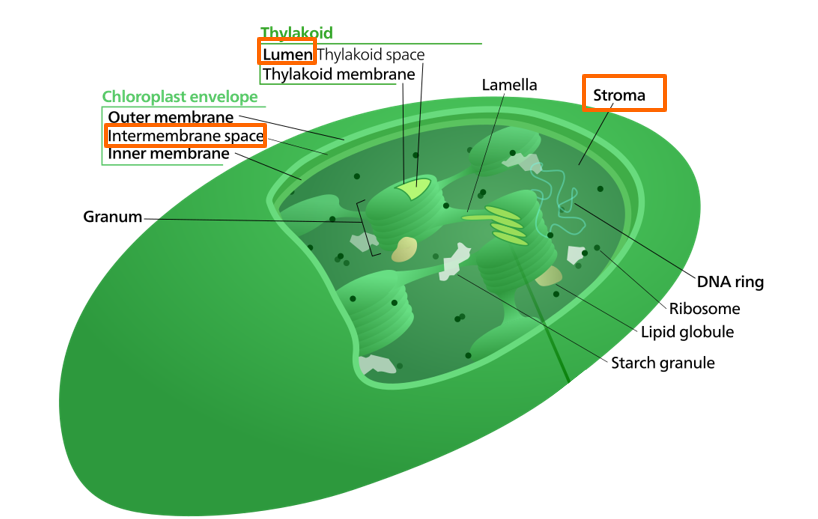
- The intermembrane space: This is the space between the outer and inner membranes of the chloroplast envelope
- The stroma: which is enclosed by the inner membrane and outside the thylakoid membrane. The stroma contains:
- Ribosomes:
- That produce proteins used by the mitochondrion, but not all.
- The chloroplast genetic information (DNA):
- Circular DNA molecules.
- Exist as multiple copies.
- Enables the chloroplasts to reproduce on its own, independent of the cell's cycle.
- A variety of metabolic enzymes:
- Including those required for the conversion carbon dioxide (CO2)to carbohydrates during photosynthesis.
- The lumen: The space enclosed by the thylakoid membrane.
- Contains protons, which have been pumped in from the stroma.
Function
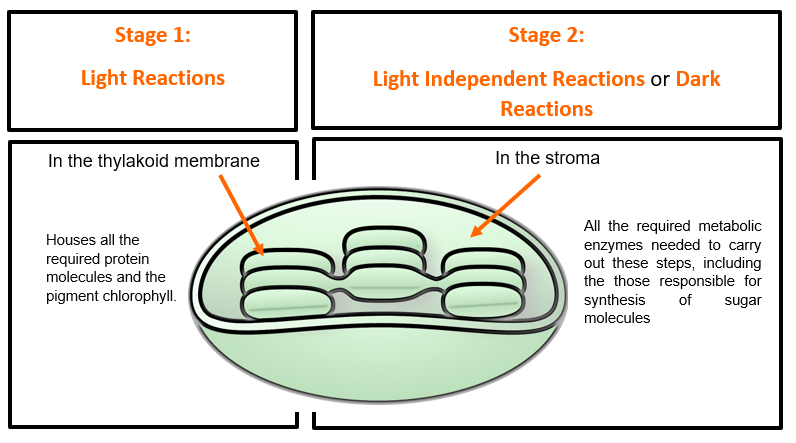
The chloroplast is the site of photosynthesis, and can only be found in photosynthetic organisms such as plants, algae and cyanobacteria. Photosynthesis is the metabolic reaction that uses light energy absorbed from the sun to drive the synthesis of organic compounds such as sugars, from carbon dioxide and water.
The 2 stages of Photosynthesis:
Practice: Chloroplast Function
Where do the dark reactions take place?
Practice: Chloroplast Structure
Where can the green pigment chlorophyll be found in the chloroplast?
Practice: Chloroplast Structure
Match the definition with the correct term.
A.
Space inside the thylakoid
B.
Where the light reactions of photosynthesis take place
C.
Where the dark reactions of photosynthesis take place
D.
The space in between the outer and inner membrane
E.
Resemble a stack of discs
F.
Protein lined pores on the outer membrane of the chloroplast envelope
lumen
Stroma
Intermembrane space
Thylakoid
Porins
Granum