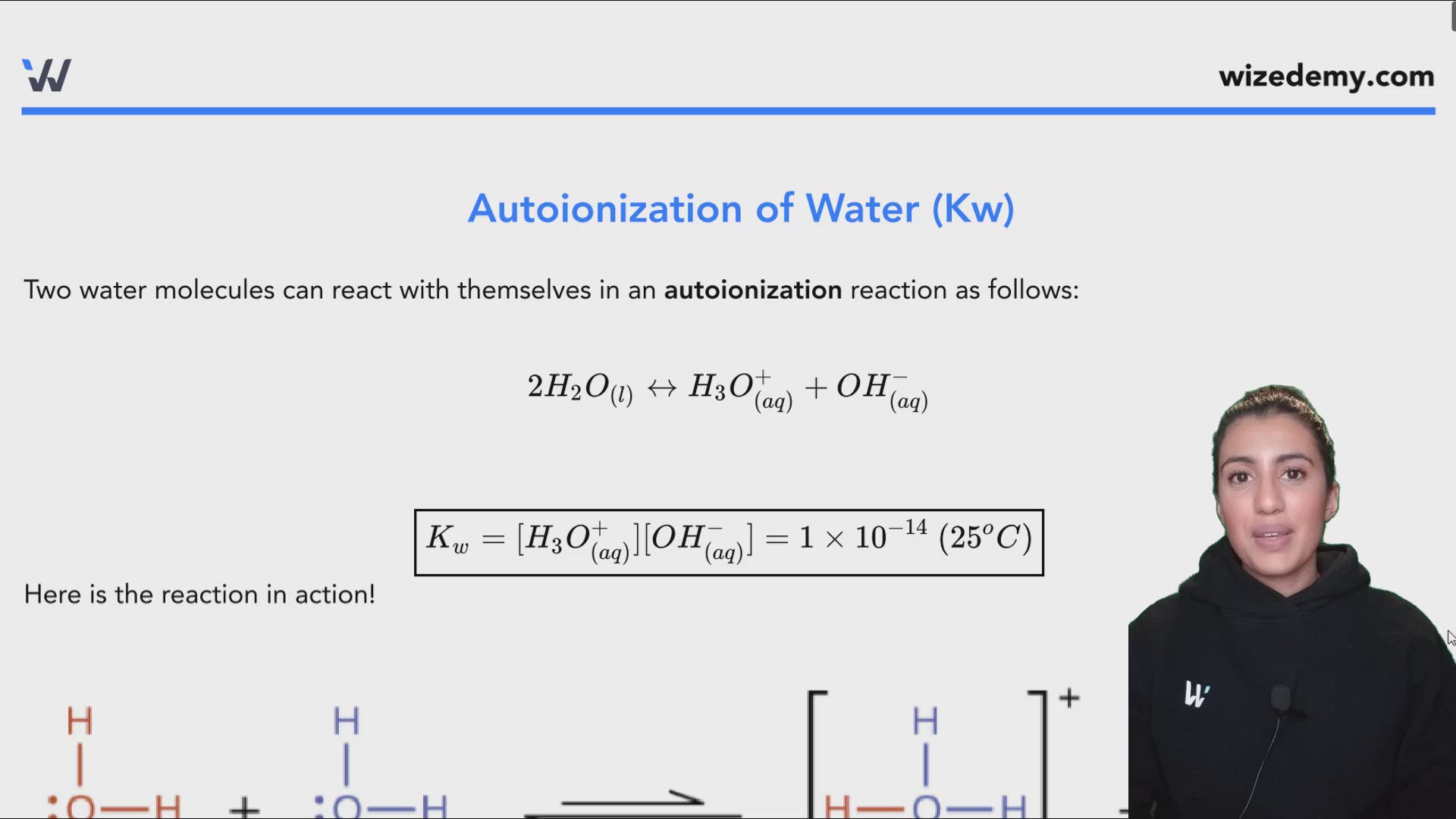
Autoionization of Water (Kw)
Two water molecules can react with themselves in an autoionization reaction as follows:
Here is the reaction in action!
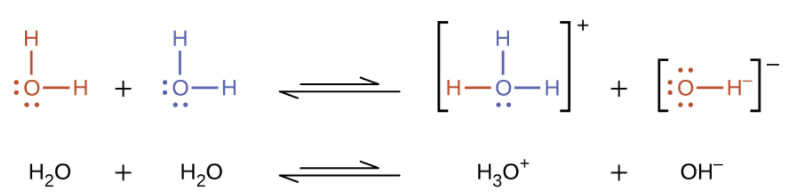
Photo by Rice University / CC BY
Label whether each reactant and product in the above reaction is acting as an acid/base or conjugate acid/conjugate base.
Water is amphoteric: it can act as an acid or a base!
Other Key Relationships
Kw = [H+][OH-] = 1x10-14, [H+]= 1x10⁻⁷M and [OH-]= 1x10⁻⁷M at 25oC
This is why the pH (and pOH) of neutral water is 7
*Ka and Kb have to be the K values for an acid and its conjugate base (or a base and its conjugate acid)
If [H+] goes higher, what do you think would happen to [OH–]? Goes higher/lower: ________
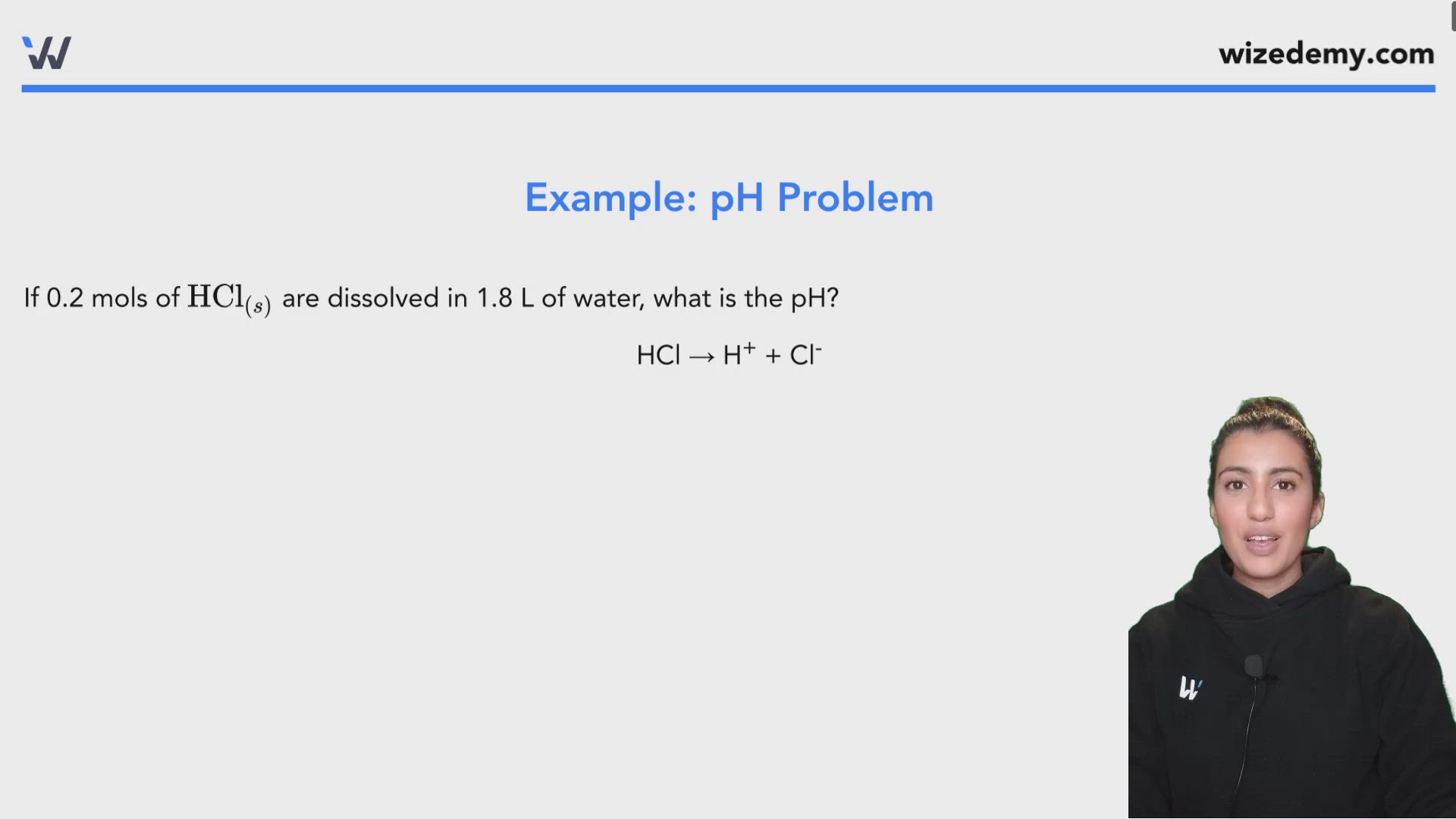
Example: pH Problem
If 0.2 mols of are dissolved in 1.8 L of water, what is the pH?
HCl → H+ + Cl-
Since is a strong acid, we will be adding 0.2 mols of to 1.8 L of water.
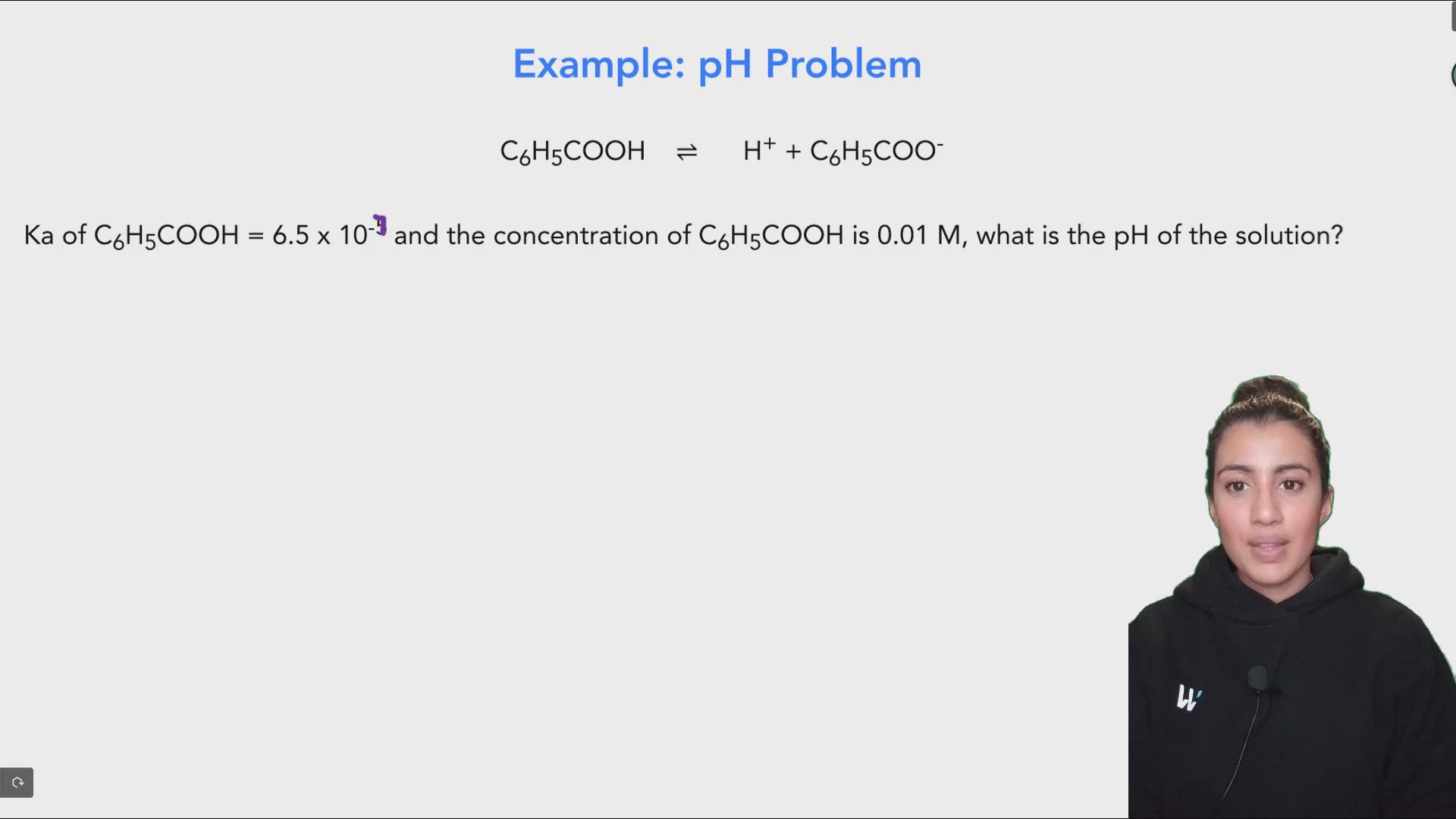
Example: pH Problem
C6H5COOH ⇌ H+ + C6H5COO-
The Ka of C6H5COOH = 6.5 x 10⁻⁷ and the concentration of C6H5COOH is 0.01 M. What is the pH of the solution?
Write Out an ICE Table
I 0.01M 0 0
C -x +x +x
E 0.01-x x x
Write a K expression and solve for x
Ka = x²/(0.01 - x) Ka = x²/0.01
We can ignore the "-x" part since y/K > 400
x² = Ka·0.01
x² = (6.5 x 10⁻⁷)(0.01) x² = 6.5 x 10⁻⁹ x = 8.06 x 10⁻⁵
x=[H+]
Find pH
pH = -log[H+] pH = -log(8.06 x 10⁻⁵) pH = 4.09
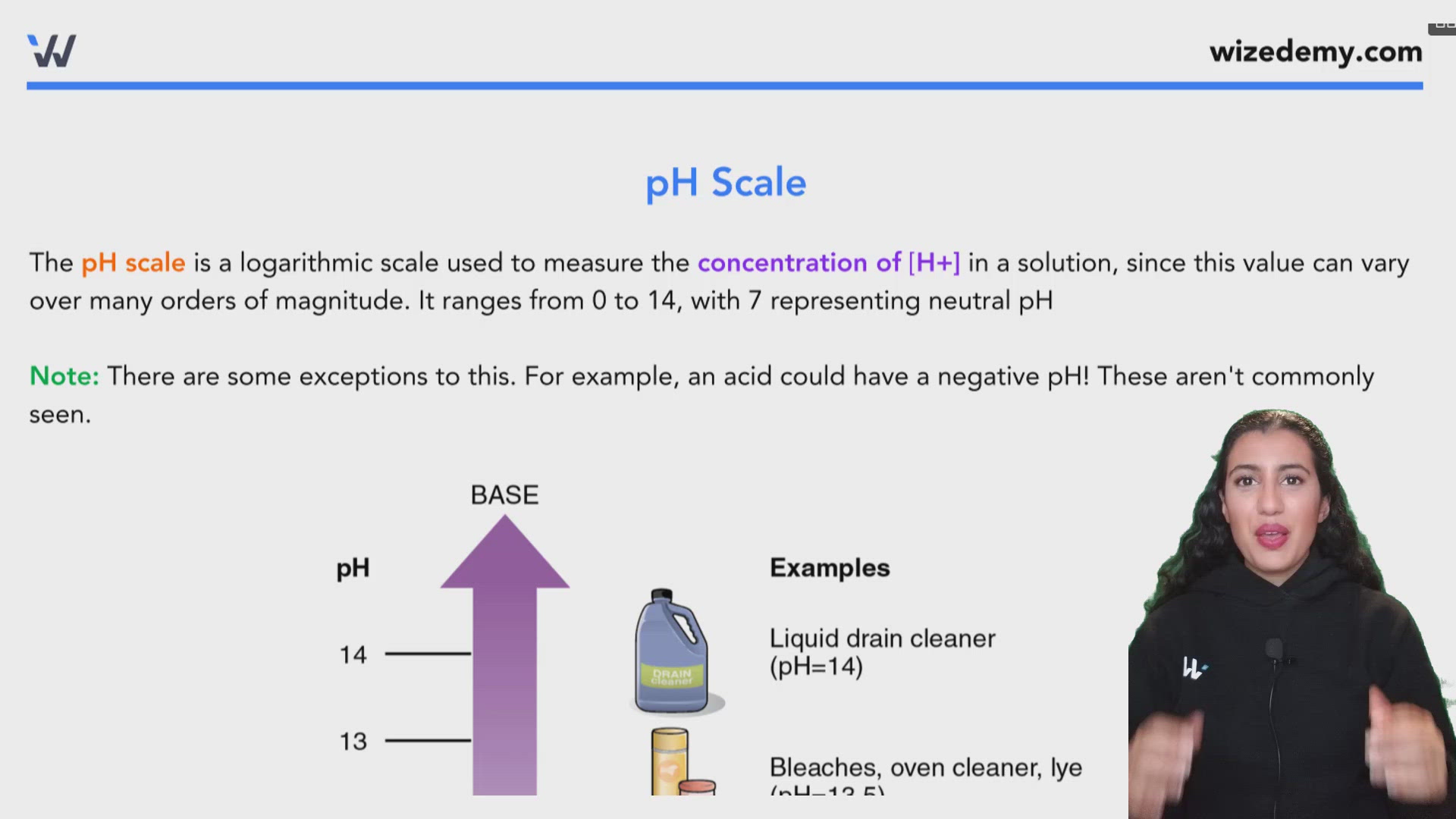
pH Scale
The pH scale is a logarithmic scale used to measure the concentration of [H+] in a solution, since this value can vary over many orders of magnitude. It ranges from 0 to 14, with 7 representing neutral pH
Note: There are some exceptions to this. For example, an acid could have a negative pH! These aren't commonly seen.

Photo by OpenStax College / CC BY
A lower pH indicates that a substance is more (acidic/basic) ________ and has a (higher/lower) ________ [H+]
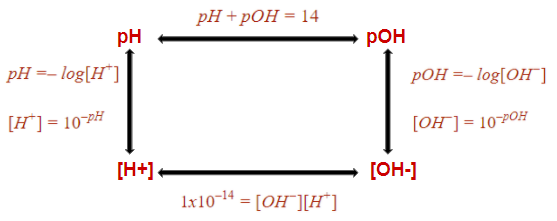
We also have Ka and pKa equations:
As well as Kb and pKb equations:
What does it mean to be a logarithmic scale?
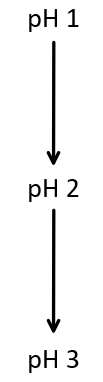
How does the [H+] change as the pH goes from 1 to 2 or 1 to 3??