Wize High School Grade 12 Chemistry Textbook > Acids and Bases
pH equations and Problems
0:00 / 0:00
pH Scale
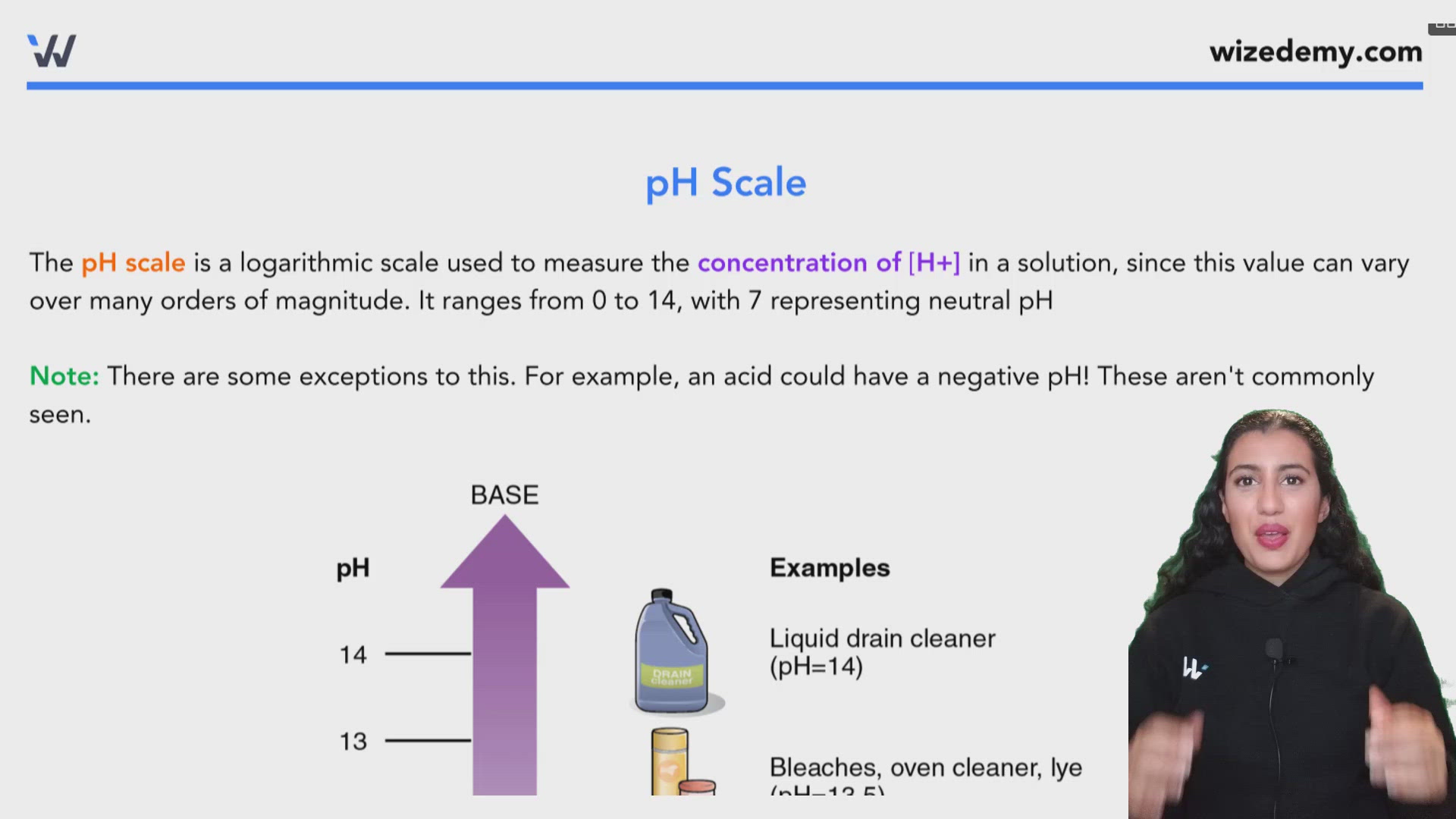
The pH scale is a logarithmic scale used to measure the concentration of [H+] in a solution, since this value can vary over many orders of magnitude. It ranges from 0 to 14, with 7 representing neutral pH
Note: There are some exceptions to this. For example, an acid could have a negative pH! These aren't commonly seen.

A lower pH indicates that a substance is more (acidic/basic)
acidic
and has a (higher/lower) higher
[H+] 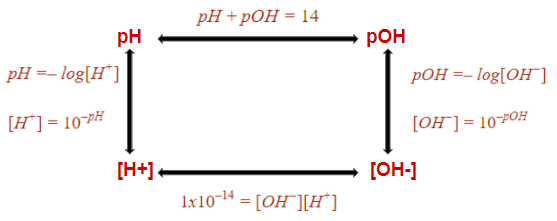
We also have Ka and pKa equations:
As well as Kb and pKb equations:
What does it mean to be a logarithmic scale?
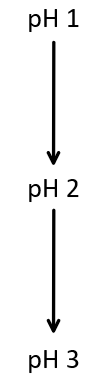
How does the [H+] change as the pH goes from 1 to 2 or 1 to 3??
Wize Concept
Since pH is a logarithmic scale, each 1 unit change in pH corresponds to a 10-fold change in [H+]!
0:00 / 0:00
Example: pH Problem
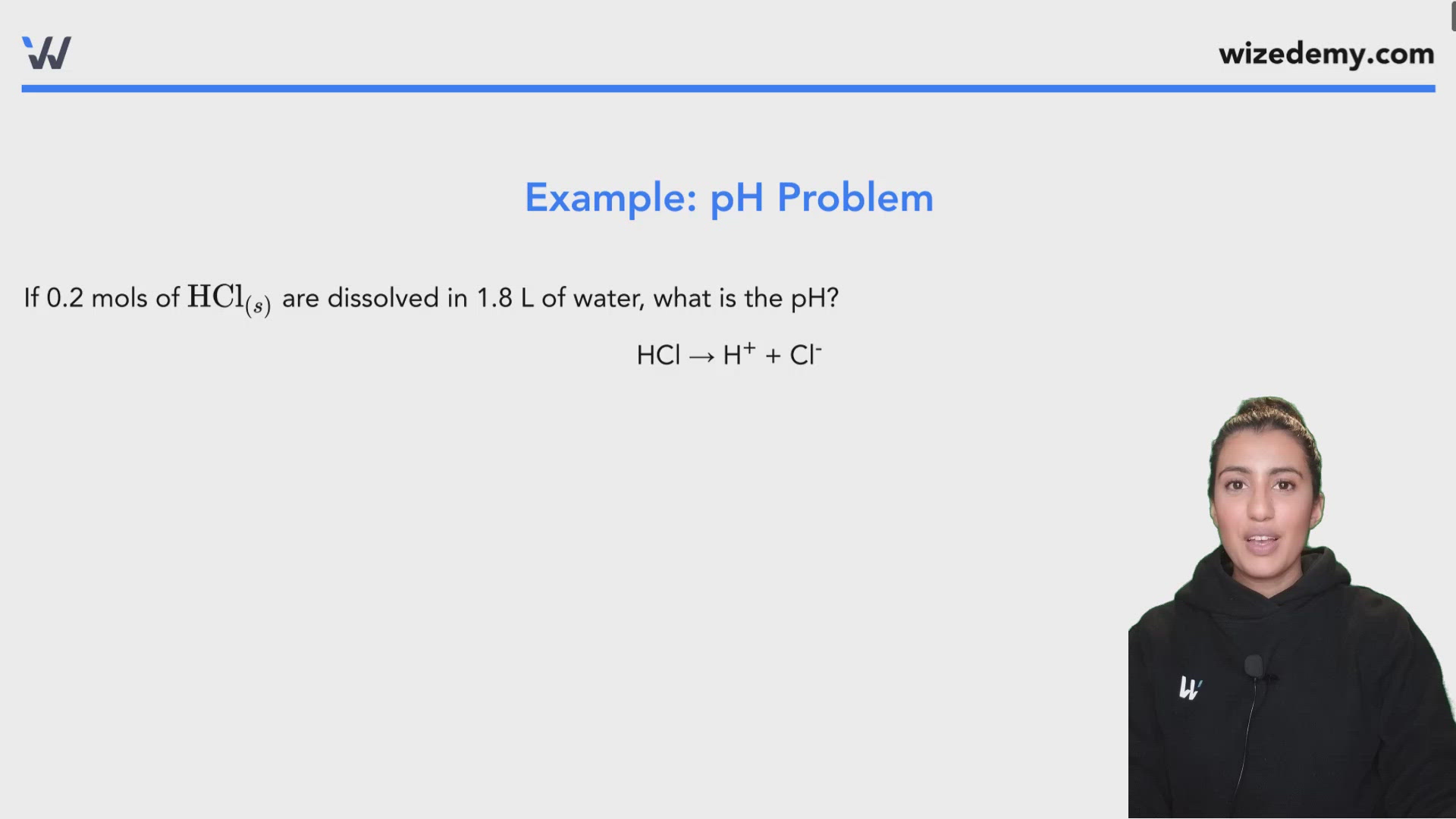
If 0.2 mols of are dissolved in 1.8 L of water, what is the pH?
HCl → H+ + Cl-
Since is a strong acid, we will be adding 0.2 mols of to 1.8 L of water.
Practice: Solve for [H+]
A solution of HBr has a pOH of 12.2, what is the [H+] concentration?