Popular Courses
English (Senior)
US High School
Grade 12 English
Canada High School
AP English Language and Composition Exam Prep Course
AP Exam Prep
AP English Literature and Composition Exam Prep Course
AP Exam Prep
English (Junior)
US High School
Grade 11 English
Canada High School
Intro to English
University Study Guides
English & Composition
University Study Guides
0:00 / 0:00
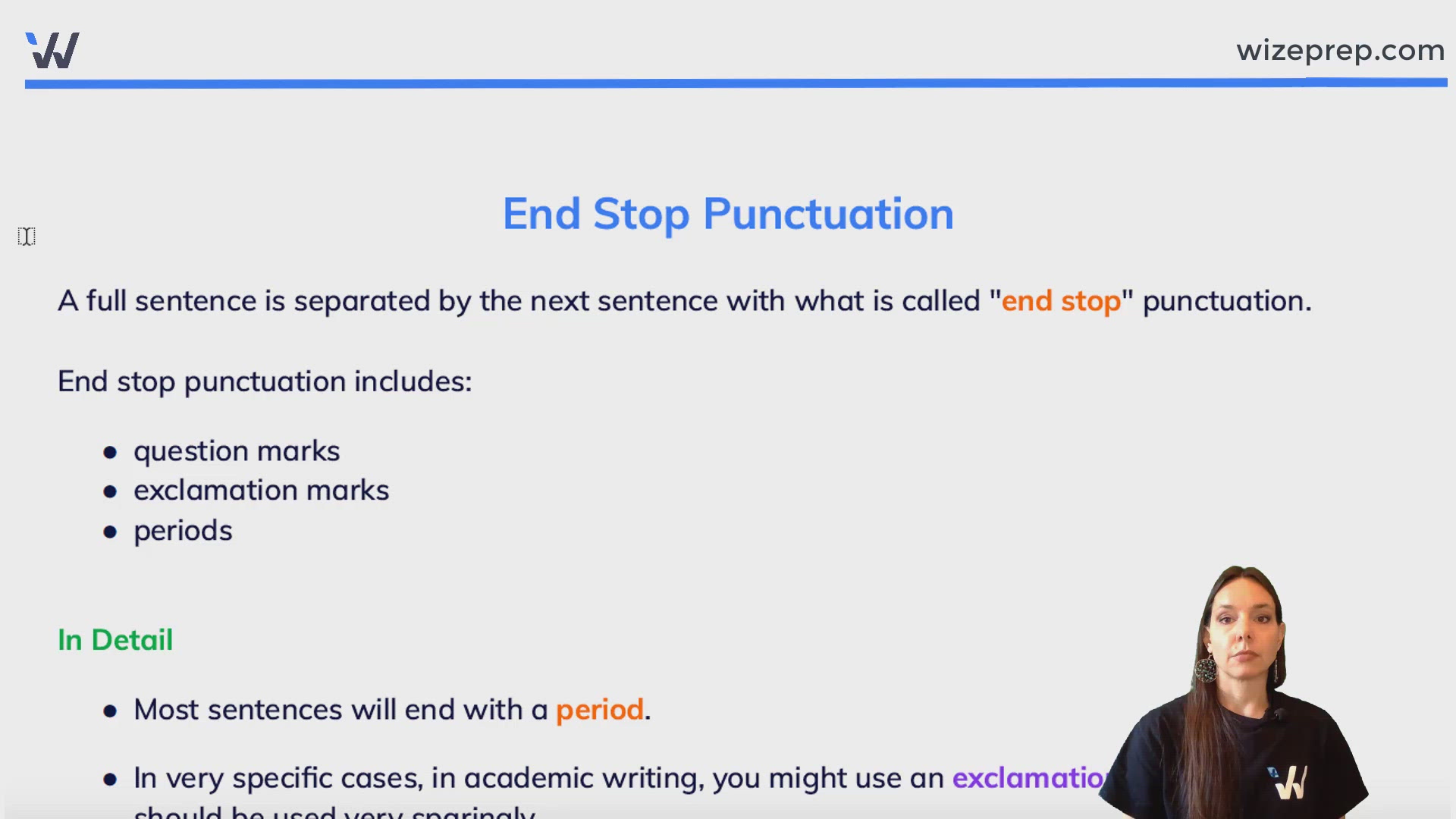
End Stop Punctuation
A full sentence is separated by the next sentence with what is called "end stop" punctuation.
End stop punctuation includes:
- question marks
- exclamation marks
- periods
In Detail
- Most sentences will end with a period.
- In very specific cases, in academic writing, you might use an exclamation mark, but these should be used very sparingly.
- Similarly, a question mark is something that should be used very judiciously in academic writing.
- One rhetorical question may be used to great effect. Six of them, not so much.
Examples:
- Did you ever see a coyote in real life?
- One ran across the road right in front of us!
- Then it went off into the distance.
0:00 / 0:00
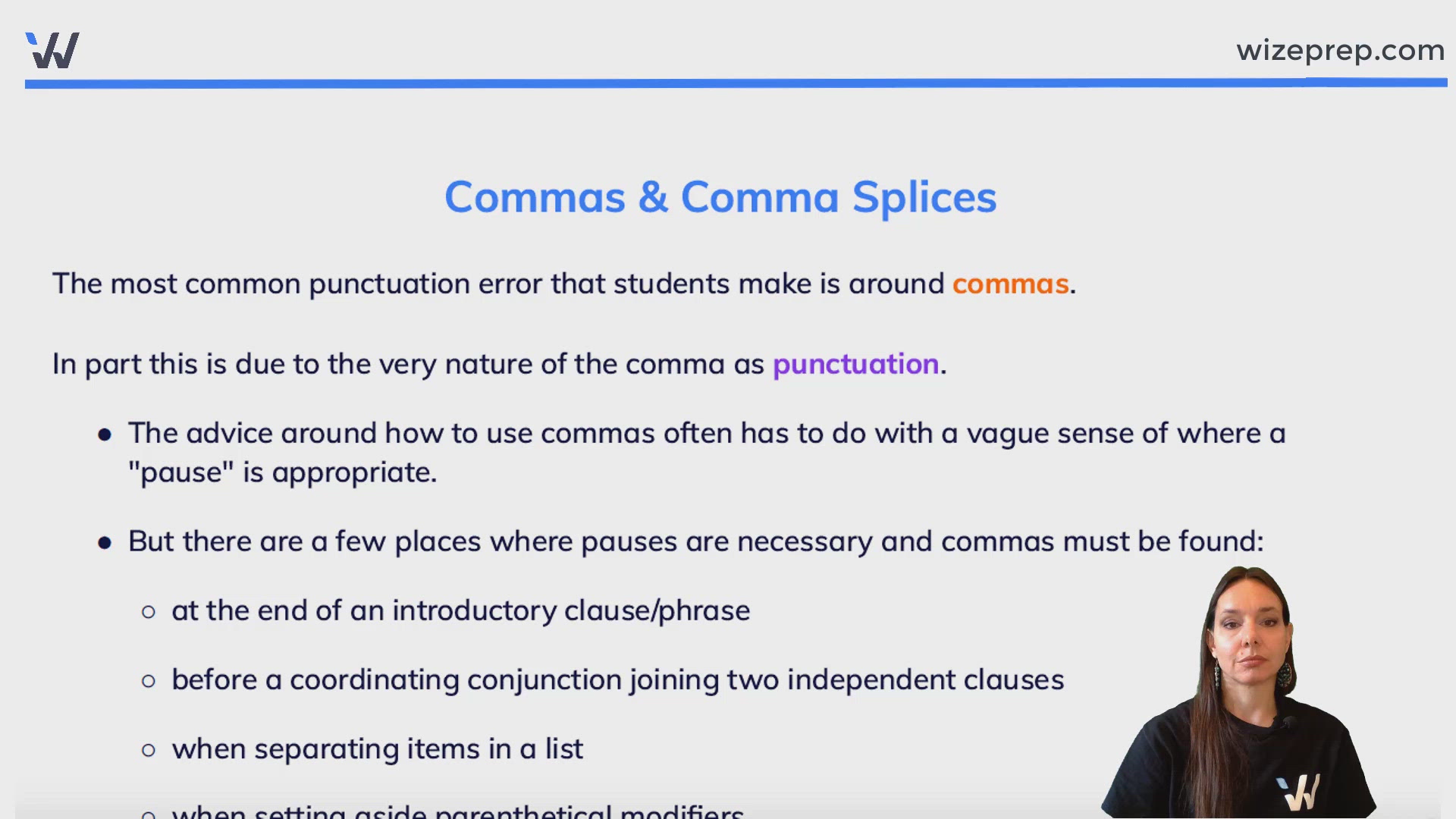
Commas & Comma Splices
The most common punctuation error that students make is around commas.
In part this is due to the very nature of the comma as punctuation.
- The advice around how to use commas often has to do with a vague sense of where a "pause" is appropriate.
- But there are a few places where pauses are necessary and commas must be found:
- when separating items in a list
- when setting aside parenthetical modifiers
- before a coordinating conjunction joining two independent clauses
- at the end of an introductory clause/phrase
Watch Out!
Do NOT use a comma to join to independent clauses together.
- That's called a comma splice and leads to a run-on sentence.
- A run-on sentence is not simply an extra long sentence, but a sentence that has been inappropriately extended without the proper punctuation.
Top Rules for Commas
- Use a comma separating elements in a list. Example: I like to eat apples, bananas, and oranges.
- Use a comma to set aside a parenthetical modifier. Example: My brother, that silly boy, spilled his drink
- Use a comma when joining two independent clauses with a coordinating conjunction. Example: I like to read, but I love to write
- Use a comma after an introductory phrase. Example: Upon opening the door, she saw a bear in her living room
0:00 / 0:00
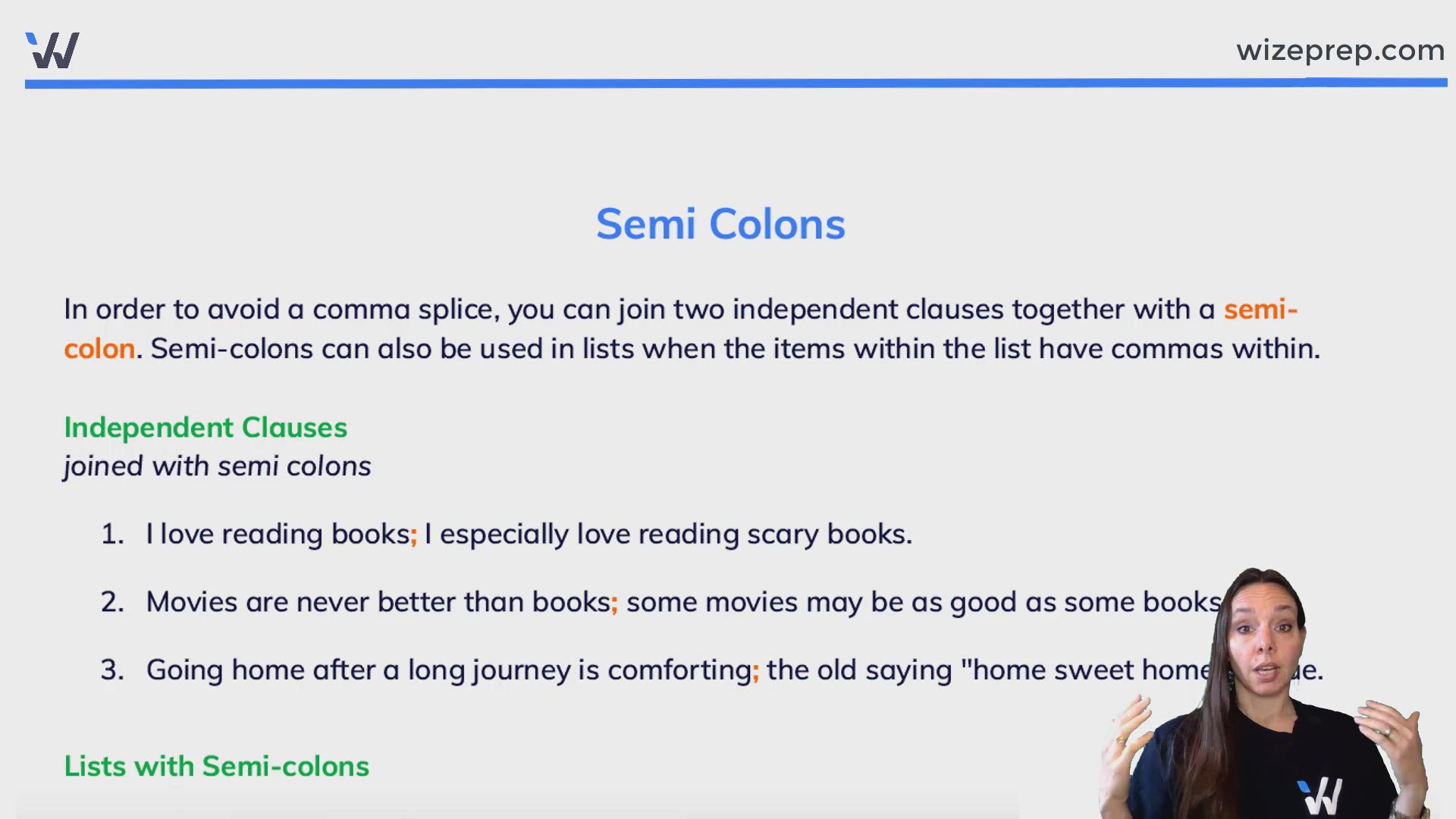
Semi Colons
In order to avoid a comma splice, you can join two independent clauses together with a semi-colon. Semi-colons can also be used in lists when the items within the list have commas within.
Independent Clauses
joined with semi colons
- I love reading books; I especially love reading scary books.
- Movies are never better than books; some movies may be as good as some books.
- Going home after a long journey is comforting; the old saying "home sweet home" is true.
Lists with Semi-colons
- Life-altering things happened in New York City on May 24, 1883; December 8, 1980; February 26, 1993; and September 11, 2001.
- I have many cousins who have brown hair, blue eyes, and glasses; who are tall, skinny, and smart; and who love books, movies, and chocolate.
- Last year, I travelled to Bangkok, Thailand; Kuala Lumpur, Malaysia; Melbourne, Australia; and Jakarta, Indonesia.