Popular Courses
English (Senior)
US High School
Grade 12 English
Canada High School
AP English Language and Composition Exam Prep Course
AP Exam Prep
AP English Literature and Composition Exam Prep Course
AP Exam Prep
English (Junior)
US High School
Grade 11 English
Canada High School
Intro to English
University Study Guides
English & Composition
University Study Guides
What are Argumentative & Persuasive Essays?
There are different types of argumentative essays (sometimes called persuasive essays), and these essay types are the most common that you will find in scholastic settings (high school, college, and university). They all share some common characteristics, which is that they seek to convince the reader of something (called a thesis statement) through the process of logical argumentation.
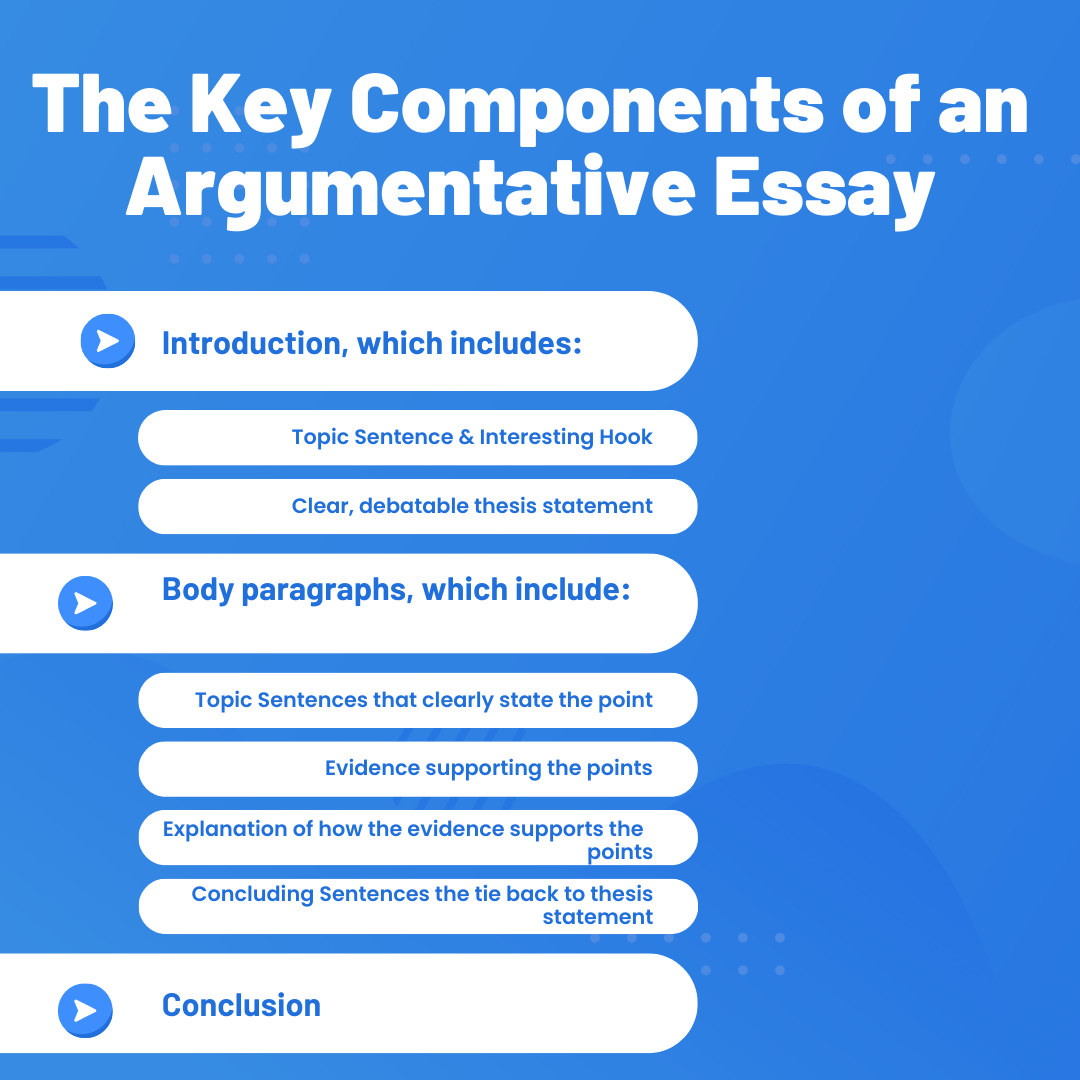
Each argumentative essay will always have:
- an introductory paragraph that sets the stage and provides a debatable thesis statement;
- body paragraphs that outline the points that support the thesis statement with evidence and explanation of how the evidence (quotations, data, etc.) do what you say it does; and
- a concluding paragraph.
Write it Down
Make a note: you can learn more about essay structure and organization in our Writing Overview chapter!
There are different types of argumentative or persuasive essays, and the most common types are:
Compare and Contrast Essays:
- These essay types take two (or more) things that have certain similarities and yet other differences and compares the similarities and contrasts the differences. The most important tip for these types of essays is that you want to organize them around a key theme or idea rather than just list some random similarities and differences. A good way to think about this is to surprise your reader. If your reader thinks the two things are very similar, you might want to foreground how, in fact, they are quite different.
- For example, you might have a thesis statement that says something like "While culturally it is easy to believe that Canada and the USA are very similar, because they share English as the main language of communication and government and because of their shared media and entertainment context, these two countries - while close geographically - are, in fact quite different culturally." Then you would go on to explain the differences between the two.
Wize Tip
Organize a compare and contrast essay around a big idea, not just a list of similarities and differences.
Agree or Disagree Essays:
- These essay types begin with a prompt that comes from the instructor or on the exam. You are then asked to agree or disagree with the statement given and provide your reasons. What you are doing is convincing a reader that the statement is correct (if you agree with it) or that the statement is incorrect (if you disagree with it).
- For example, you might be given a statement that says something like "Contemporary politics have become so polarized as to undermine democracy." If you think that statement is correct, then you would build an essay with body paragraphs outlining the points that demonstrate the truth of the statement. On the other hand, if you think that the statement is incorrect, then you would build an essay with body paragraphs that demonstrate how the statement is wrong in some manner.
- A little known trick about these types of argumentative essays is that, in fact, there's a third option that you might choose, which is to agree AND disagree. If you choose this option, then you are doing what is called qualifying your response. You must convince a reader that the statement as given is somewhat correct in some ways, but also incorrect in others.
Wize Tip
Agree or Disagree essays are all about convincing the reader of the correctness or incorrectness of a statement.
Advantages or Disadvantages Essays:
- These essay types are often policy type essays or opinion type essays where you are given a statement or question from your instructor or on an exam, and it is up to you to convince the reader of the relative advantages or disadvantages of the particular position being advanced. You can include an analysis of both advantages and disadvantages in your body paragraphs, but the most sophisticated versions of these types of essays will weigh slightly more heavily to one side or the other, i.e. agreeing more or disagreeing more with the statement.
- For example, you might be given a prompt that says something like "Do you think the advantages outweigh the disadvantages? With the rise of e-books comes the decline in paper books. Some people see this as a good step forward while others do not. What are the advantages and disadvantages of this trend?" (Note: this is a real IELTS test question). In answering this you will want to indicate the pros and cons of e-books. Ideally you will weight your answer to have slightly more pros or cons, but having it balanced equally is also good. The main take away is that you should have a clear position (i.e. more advantages/disadvantages or equal weight) which becomes the thesis that you will argue.
Wize Tip
Advantages and Disadvantages essays weigh the pros and cons to a particular position and convince the reader of your view.
There are other types of argumentative or persuasive essays, but they all share the same key point: you are trying to convince your reader of something by way of argumentation. Argumentation moves forward based on logically progressing ideas where proof and evidence help to support and suggest the rightness of your position. Argumentation in essay writing isn't like arguing out loud between friends!
Watch Out!
It's easy to mistake asserting a point for arguing a point. Asserting is merely stating it. Arguing for a position relies on evidence and explanation of that evidence.
What are Narrative or Descriptive Essays?
Outside of the more standard academic essays that are usually persuasive or argumentative in nature, there are other more "creative" types of essays that you might be asked to write. Both narrative and descriptive essays are the types of essays that you might be asked to write in Journalism and Communication courses or even Creative Writing courses.
What is a narrative essay?
A Narrative essay is one that tells a story. These are sometimes called "creative non fiction" pieces, and they are the types of essays that you'll often see in magazines or blogs. They're very personal in nature and often tell a story from a first-person perspective (i.e. "I" and "me").
While argumentative or persuasive essays are often the type of academic essays that most Humanities and Liberal Arts courses like to assign, and those types of essays cohere around convincing a reader of a specific point or thesis statement, a narrative essay coheres around a story.
A narrative essay focuses on a lesson or idea or insight or experience that emerges from a particular story. Remember, stories have a beginning-middle-end structure, with the middle portion being the climax or the highest point in the arc of tension.
Usually narrative essays focus on one, simple event, using sensory details to make the event vivid in the reader's mind. Sometimes narrative essays focus on a series of events that are thematically linked.
Write it Down
What is a descriptive essay?
A Descriptive essay is rarely a stand-alone essay unto itself. Often descriptive essays are assigned so that you learn the skills necessary to describe something, and then you use those descriptive skills in other expository or narrative essays. However, sometimes, a descriptive essay is an assignment unto itself where the sole purpose is to choose something that you then describe really well, painting a picture with your words!
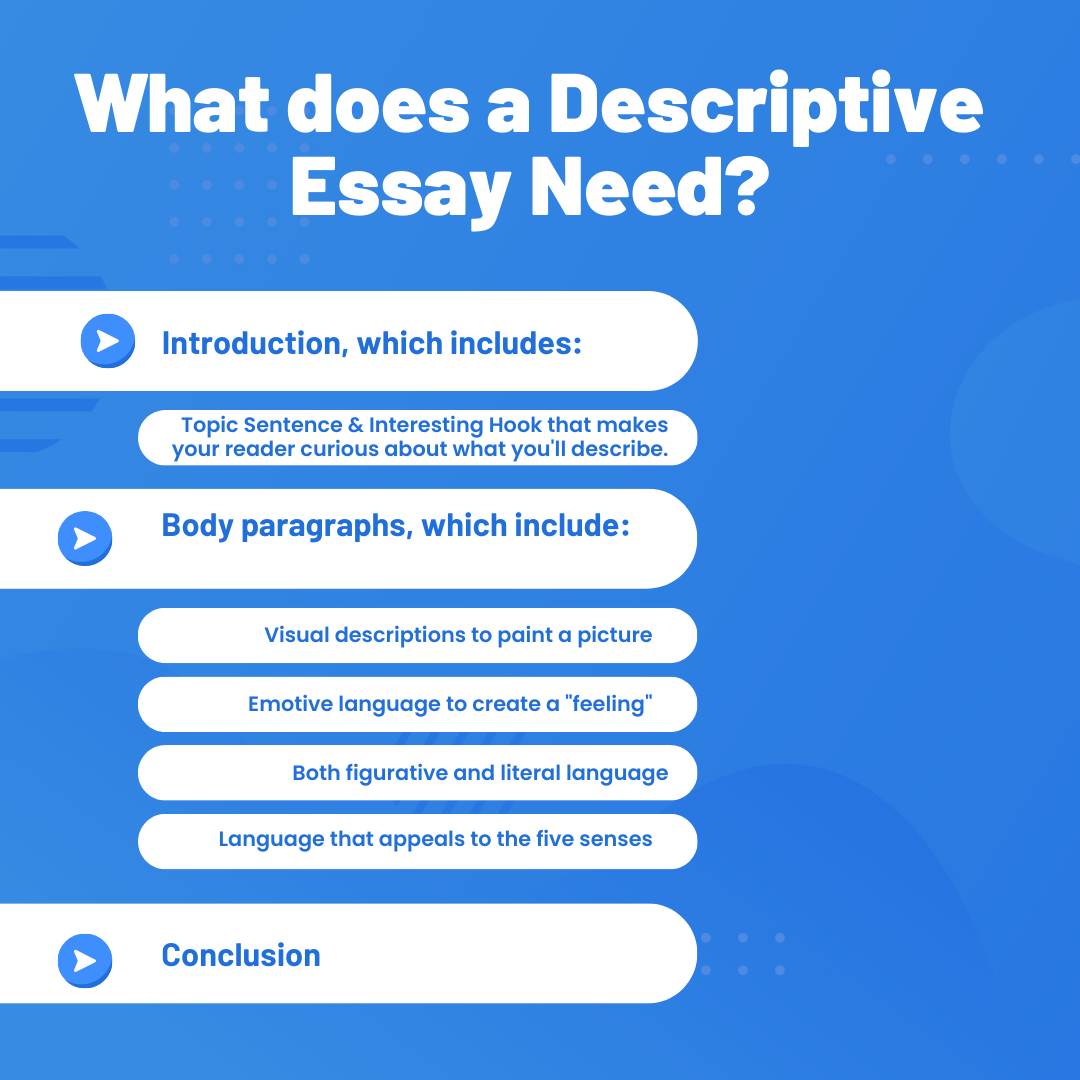
The main thing to remember about descriptive essays is that they are almost like poetry. They use language to evoke emotions and feelings in the reader, and they use language to paint a picture of an image using all the senses, especially if you move outwards in. For example, describe the sound first, and then the sight of the thing, moving inwards to its taste (if appropriate).
Wize Tip
Remember, when writing a descriptive essay try to include descriptions from all 5 senses: sound, sight, touch, smell, and taste!