0:00 / 0:00

Adding & Subtracting Integers & Decimals
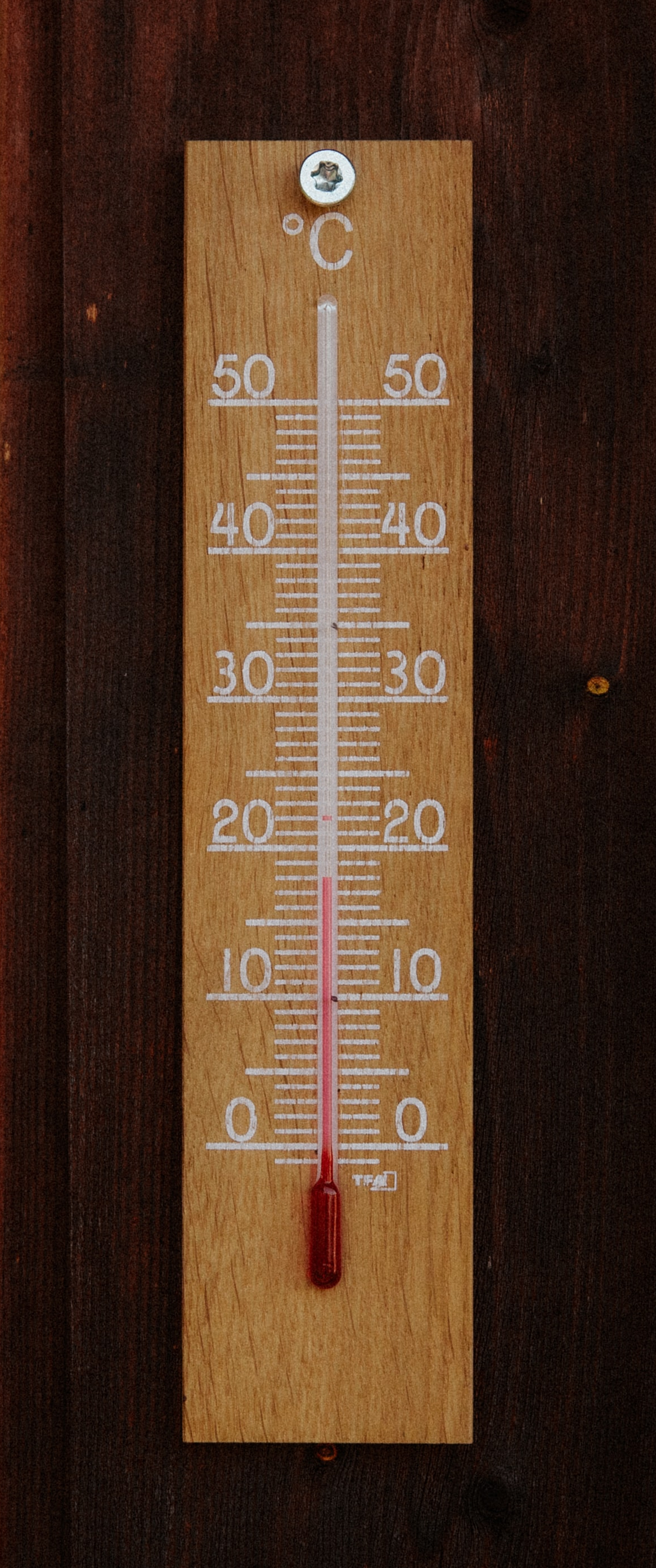

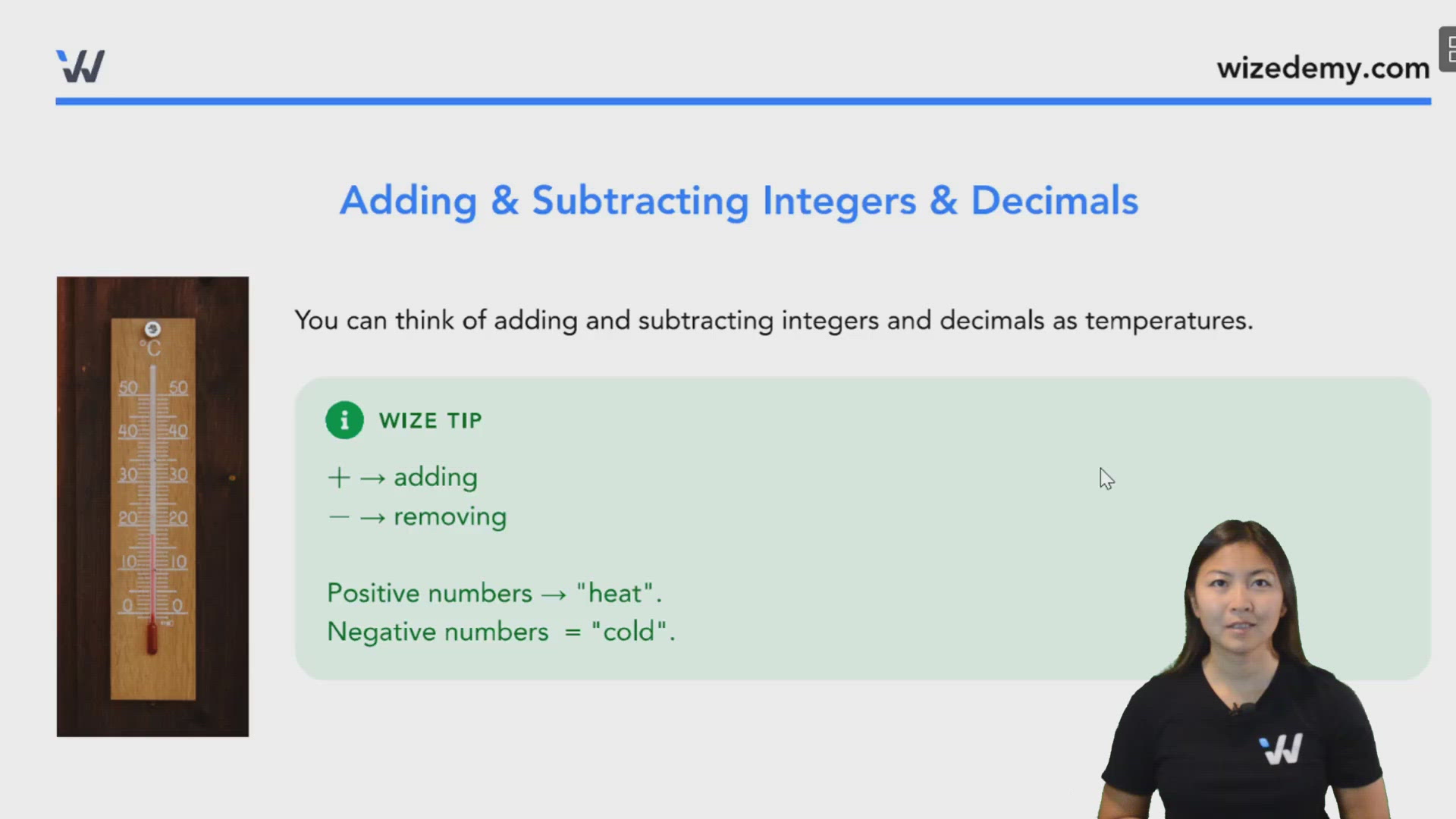
You can think of adding and subtracting integers and decimals as temperatures.

Wize Tip
++ → adding
- → removing

Positive numbers → "heat".
Negative numbers = "cold".

PAGE BREAK
Example 1
14.1(+5.3)=14.1-(+5.3)=
8.8

It's 14.1 degrees, and you're "removing 5.3 degrees of heat" → the final temperature will be 8.8 degrees.

Example 2
14.1+(5.3)=14.1+\left(-5.3\right)=
8.8

It's 14.1 degrees, and you're "adding 5.3 degrees of cold" → the final temperature will be 8.8 degrees.

Example 3
14.1(5.3)=14.1-\left(-5.3\right)=
19.4

It's 14.1 degrees, and you're "removing 5.3 degrees of cold" → the final temperature will be 19.4 degrees.

PAGE BREAK

Remember these Shortcuts!

Wize Tip
Same signs side-by-side make a positive+ + +   +Ex.  3+(+2)=3+2=5Ex.  3(2)=3+2=5Opposite signs side-by-side make a negative+   +  Ex.  3+(2)=32=1Ex.  3(+2)=32=1\begin{array}{|c|c|} \hline \\ \begin{array}{c}\text{Same signs side-by-side make a positive}\\+\ +\ \to +\\-\ -\ \to\ +\end{array} & \begin{array}{l}\text{Ex. \ }3\bcf+(\bcf+2)=3\bcf+2=5\\ \text{Ex. \ }3\bcf-(\bcf-2)=3\bcf+2=5 \end{array} \\ \\ \hline \\ \begin{array}{c}\text{Opposite signs side-by-side make a negative}\\+\ -\ \to -\\-\ +\ \to\ -\end{array} & \begin{array}{l}\text{Ex. \ }3\bcf+(\bcf-2)=3\bcf-2=1\\ \text{Ex. \ }3\bcf-(\bcf+2)=3\bcf-2=1 \end{array} \\ \\ \hline \end{array}

Examples 4 (revisited)
  1. 14.1(+5.3)=14.15.3=8.814.1\bcf-(\bcf+5.3)=14.1\bcf-5.3=8.8
  2. 14.1+(5.3)=14.15.3=8.814.1\bcf+\left(\bcf-5.3\right)=14.1\bcf-5.3=8.8
  3. 14.1(5.3)=14.1+5.3=19.414.1\bcf-\left(\bcf-5.3\right)=14.1\bcf+5.3=19.4
0:00 / 0:00

Multiplying & Dividing Integers & Decimals

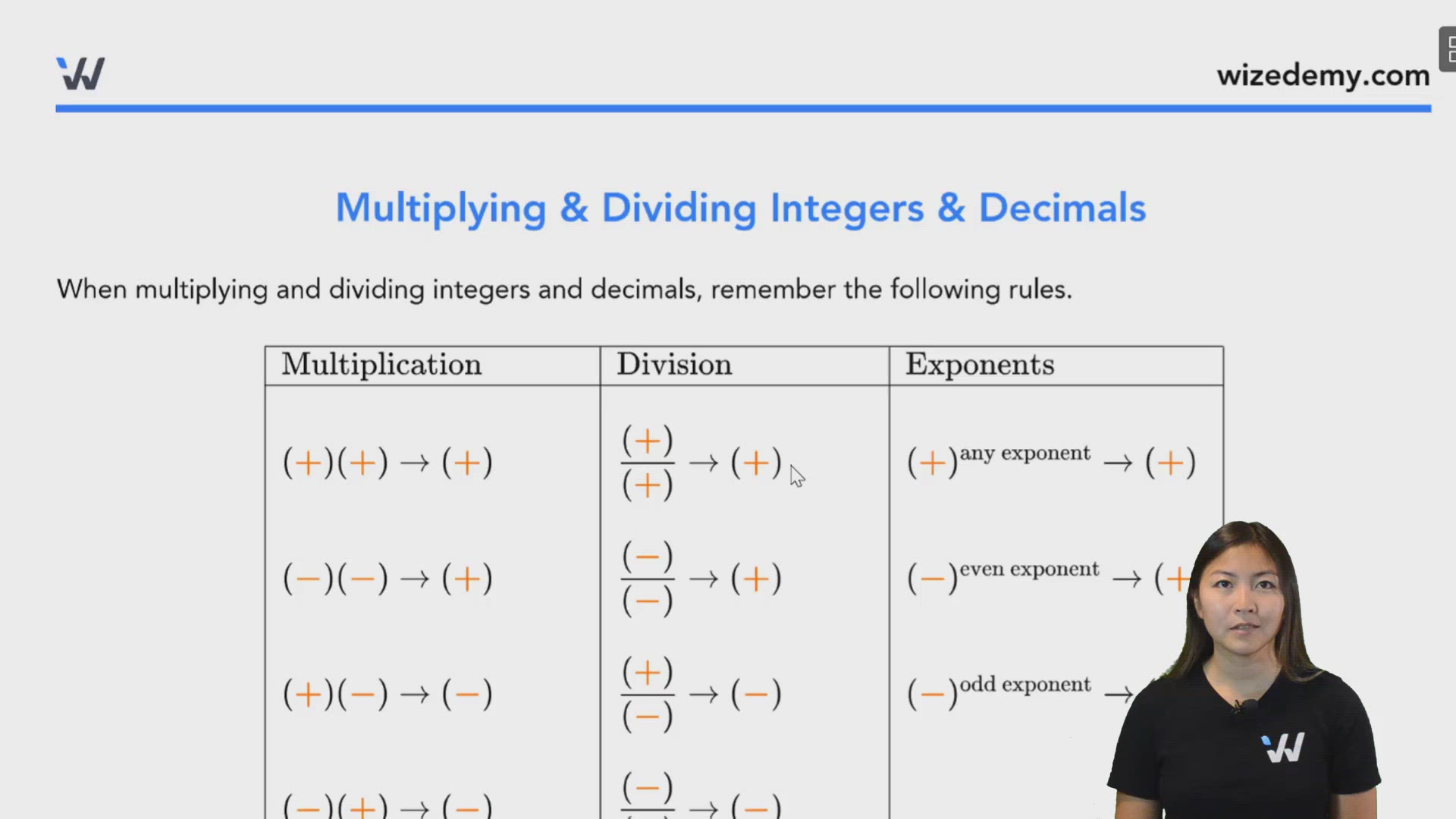
When multiplying and dividing integers and decimals, remember the following rules.

Multiplication       Division(+)(+)(+)(+)(+)(+)()()(+)()()(+)(+)()()(+)()()()(+)()()(+)()\begin{array}{|lc|lc|} \hline \text{Multiplication}&~~~~~~~&\text{Division}\\ \hline\\ (\bcf+)(\bcf+)\to(\bcf+)&& \displaystyle\frac{(\bcf+)}{(\bcf+)}\to(\bcf+)\\\\ (\bcf-)(\bcf-)\to(\bcf+)&& \displaystyle\frac{(\bcf-)}{(\bcf-)}\to(\bcf+)\\\\ (\bcf+)(\bcf-)\to(\bcf-)&& \displaystyle\frac{(\bcf+)}{(\bcf-)}\to(\bcf-)\\\\ (\bcf-)(\bcf+)\to(\bcf-)&&\displaystyle\frac{(\bcf-)}{(\bcf+)}\to(\bcf-)\\\\ \hline \end{array}

PAGE BREAK
Example 1
a) 4.7×(2)=-4.7\times(-2)=
9.4

Remember: ()×()(+)(\bcf-)\times(\bcf-)\to(\bcf+)

So the answer is +(4.7×2)=+9.4\bcf+(4.7\times2)=\bcf+9.4

b) 5.5(3)=5.5(-3)=
- 16.5

Remember: (+)×()()(\bcf+)\times(\bcf-)\to(\bcf-)

So the answer is (5.5×3)=16.5\bcf-(5.5\times3)=\bcf-16.5

c) 10÷2.5=-10\div2.5=
- 4

Remember: ()÷(+)()(\bcf-)\div(\bcf+)\to(\bcf-)

So the answer is (10÷2.5)=4\bcf-(10\div2.5)=\bcf-4

d) 8(2.5)5=\dfrac{8(-2.5)}{-5}=
4

This can be rewritten as 8(2.5)÷(5)8(-2.5)\div(-5)
Remember: (+)×()÷()    ()÷()    (+)(\bcf+)\times(\bcf-)\div(\bcf-)~~\to~~(\bcf-)\div(\bcf-)~~\to~~(\bcf+)

So the answer is +[8×2.5÷5]=+4\bcf+[8\times2.5\div5]=\bcf+4

e) (3)2×(2)3=(-3)^2\times(-2)^3=
- 72

Rewriting this as multiplication:
(3)(3)×(2)(2)(2)(-3)(-3)\times(-2)(-2)(-2)

Since every two negatives make a positive, we get
+(3×3)×(2×2×2)\bcf+(3\times3)\times\bcf-(2\times2\times2)
=(3×3×2×2×2)=\bcf-(3\times3\times2\times2\times2)
PAGE BREAK
Example 2
Evaluate 2×(3.5)×(3)2(1.1)2\times\left(-3.5\right)\times\left(-3\right)-2\left(-1.1\right)

Simplify this using BEDMAS

(+2)×(3.5)×(3)MultiplicationThe first two numbers make a Then this and the third number make a+(+2)(1.1)Multiplication \underbrace{(\bcf+2)\times(\bcf-3.5) \times(\bcf-3)}_ {\begin{array}{c} \scriptsize{\text{Multiplication}}\\ \scriptsize\text{The first two numbers make a }-\\ \scriptsize\text{Then this }- \text{and the third number make a}+ \end{array}} -\underbrace{(\bcf+2)(\bcf-1.1)}_\text{Multiplication}

=(+21)(2.2)Subtraction=\underbrace{(\bcf+21)-(\bcf-2.2)}_\text{Subtraction}

=+21+2.2=\bcf{+}21\bcf+2.2

=+23.2=\bcf+23.2

=23.2=\boxed{23.2}
PAGE BREAK
Example 3
Evaluate [1.5(4)10.2]÷(2)2.1(3)(2.5)5\displaystyle [-1.5\left(-4\right)-10.2]\div{(-2)}-\frac{2.1\left(-3\right)\left(-2.5\right)}{-5}

[1.5(4)10.2]BracketDeal with multiplication first÷(2)2.1(3)(2.5)5\underbrace{[\bcf-1.5\left(\bcf-4\right)-10.2]}_{\begin{array}{c}\scriptsize\text{Bracket}\\\scriptsize\text{Deal with multiplication first}\end{array}}\div{(-2)}-\dfrac{2.1\left(-3\right)\left(-2.5\right)}{-5}

=[+610.2]Bracket÷(2)2.1(3)(2.5)5=\underbrace{[\bcf+6-10.2]}_\text{Bracket}\div{(-2)}-\dfrac{2.1\left(-3\right)\left(-2.5\right)}{-5}

=4.2÷(2)Division2.1(3)(2.5)5Multiplication and DivisionThe 3 negatives make a negative=\underbrace{\bcf-4.2\div{(\bcf-2)}}_\text{Division}-\underbrace{\dfrac{2.1\left(\bcf-3\right)\left(\bcf-2.5\right)}{\bcf-5}}_{\begin{array}{c}\scriptsize\text{Multiplication and Division}\\\scriptsize\text{The 3 negatives make a negative}\end{array}}

=+2.1(3.15)=\bcf+2.1-(\bcf-3.15)

=+2.1+3.15=\bcf+2.1\bcf+3.15

=5.25=\boxed{5.25}

Practice: Muliplying & Dividing Integers & Decimals

What is the simplified answer to (2)(5.55)(0.5)(2)4(-2)\left(\dfrac{5.5}{-5}\right)-(-0.5)(-2)^4?

Practice: Working with Integers & Decimals

Evaluate (x)3(y3+(x)(y))(x×2.2y)+(y)4(-x)^3\left(y^3+(x)(-y)\right)-\left(\dfrac{-x\times2.2}{y}\right)+(-y)^4 when x=3x=3 and y=2y=2.

Practice: Multiplying & Dividing Integers & Decimals

Evaluate the following without using a calculator.
  • If the answer is negative, make sure to include - in your answer (for example, if the answer is negative ten, you should type -10).
  • If the answer is positive, don't include + in your answer (for example, if the answer is positive 10, you should just type 10).

a) (25)(6)=(-25)(-6)=

b) 4×(13)=4\times(-13)=

c) 497=\dfrac{-49}{7}=

d) 125÷(5)=-125\div(-5)=