Wize High School Grade 10 Math Textbook > Factored Form of a Quadratic Equation
Factored Form of a Quadratic Equation
Popular Courses
Grade 10 Math
Canada High School
Algebra I
US High School
DAT
General Course
Grade 10 Principles of Mathematics
Ontario High School
QMS 110
Toronto Metropolitan University
Grade 10 Foundations of Mathematics
Ontario High School
MATH 157
Simon Fraser University
MA129
Wilfrid Laurier University
MATH 1314
Tarrant County College District
MATH 1148
Ohio State University
MATH 1302
University of Texas at Arlington

0:00 / 0:00
Factored Form of a Quadratic Equation
Recall
The standard/ general form of a quadratic equation is .
- We can solve problems involving quadratic relations by sketching its graph
- We can sketch its graph by creating a table of values
Graphing with a table of values can be very tedious and inaccurate without the help of technology.
Factored Form
Instead, we turn to a different form-- the factored form of a quadratic equation is .
* and are called the factors of this quadratic equation.

How do we graph from the factored form?
Direction of the opening
The value tells us the
direction of the opening
- If is positive, the parabolaopens up
- If is negative, the parabolaopens down
Zeros and roots
The x-intercepts/ roots/ zeros of a quadratic graph in factored form are
x=r and x=s
- If the factored form of the quadratic equation is , where and are different, thenthere are 2 different zeros (r,0) and (s,0)
- If the factored form of the quadratic equation is , thenthere is 1 single zero (r,0)
- If we cannot find the factored form of the quadratic equation , thenthere are no zeros
Vertex
To find the coordinates of the vertex :
- The x-coordinate of the vertex is directly in between the two zeros --
- Substitute this x-coordinate into the quadratic equation to dtermine , the y-coordinate of the vertex

0:00 / 0:00
Example: Factored Form of a Quadratic Equation
Given the factored form ,
a) determine the direction of opening of the quadratic graph.
The factored form is , so , meaning that the parabola will be .
b) determine the zeros.
The zeros/ x-intercepts/ roots is when the y value is 0:
Notice that if either of the brackets equal 0, then the y value will be 0:
So, the zeros are and , which correspond to the points .
*Notice that these are the and values in the factored form .
c) determine the y-intercept.
y-intercept is where the graph meets the y-axis, meaning when :
So, the y-intercept is , which corresponds to the point .
d) determine the axis of symmetry.
Since the zeros have the same y-values, they are reflections of one another along the axis of symmetry, meaning that the axis of symmetry should be right in the middle between the 2 zeros:
So, the axis of symmetry is
e) determine the coordinates of the vertex.
The x-coordinate of the vertex is the same as the axis of symmetry: .
To find the y-coordinate, we substitute back into the quadratic equation :
So, the vertex is
f) determine the standard form of the quadratic equation.
To go from the factored form to the standard form of a quadratic equation, we need to expand and simplify the equation:
So, the standard form is
g) sketch the graph (without using a table of values or technology).
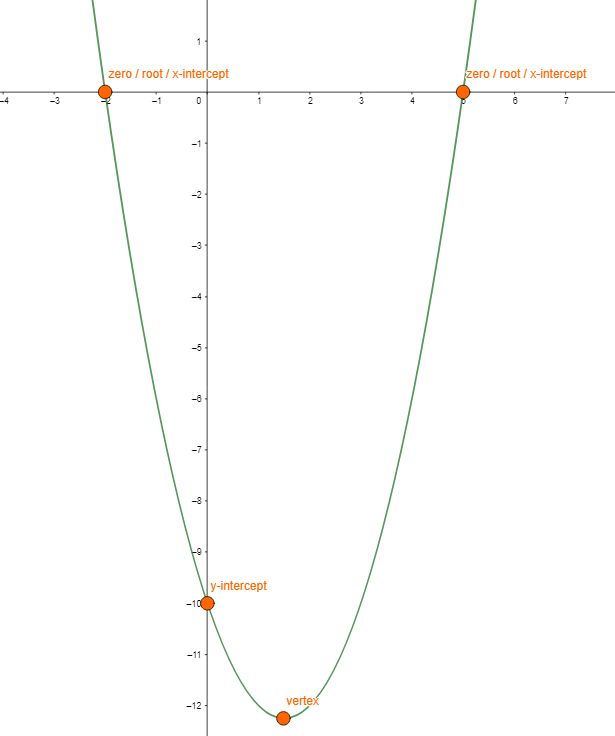
Practice: Factored Form of a Quadratic Equation
Determine the zeros of the following quadratic equations.
Select all of the zeros that apply.
Practice: Factored Form of a Quadratic Equation
For each of the following quadratic equations,
i) determine the zeros
ii) determine the vertex
iii) determine the y-intercept
iv) graph the quadratic equation.
Practice: Factored Form of a Quadratic Equation
You are walking through a forest and you see a bridge in front of you. The height of the bridge above the ground (in meters) can be modelled by the equation , where is the distance (in meters) from you to the start of the bridge.
a) How far away is the start of the bridge from you?
b) What is the horizontal length of this bridge? (Meaning the horizontal distance between the two ends of the bridge)
c) How tall is this bridge (Meaning the vertical height of the bridge)
d) If you walk onto the bridge and then walk forward 10 meters on the bridge, how high off the ground will you be?

Summary - Factored Form of a Quadratic Equation
Given the factored form of a quadratic equation :
