Create a free account to get started

Unlock full course notes by signing up

  • Video lessons taught by top educators
  • Practice questions with guided solutions
  • Written review notes for reference
  • Expert answers anytime from course tutors

Properties of Quadratic Graphs

We are often interested in certain properties of the graph of a quadratic relation:


The axis of symmetry

  • This is an equation of the form ________
  • It represents a vertical line that separates the parabola into two identical parts


The direction of the opening

  • If the parabola looks like a right side up U, then it is opening up
  • If the parabola looks like an upside down U, then it is opening down


The vertex

  • This is a point where the parabola turns around from increasing to decreasing or decreasing to increasing
  • If the parabola is opening up, then the vertex is at the very bottom, the y-coordinate represents the minimum value
  • If the parabola is opening down, then the vertex is at the very top, the y-coordinate represents the maximum value


The y\bcf{y}-intercept

  • This is where the parabola meets the y-axis
  • A parabola will have exactly 1 y-intercept


The x\bcf{x}-intercepts,

  • This is where the parabola meets the x-axis
  • This is also known as the ________ or the ________
  • A parabola can have ________ possible x-intercepts
Create a free account to get started

Unlock full course notes by signing up

  • Video lessons taught by top educators
  • Practice questions with guided solutions
  • Written review notes for reference
  • Expert answers anytime from course tutors

Example: Properties of Parabolas (Graphs of Quadratic Relations)

For each of the following quadratic relations, identify

i) the axis of symmetry

ii) the direction of the opening

iii) the vertex

iv) the y-intercept

v) the x-intercept(s)


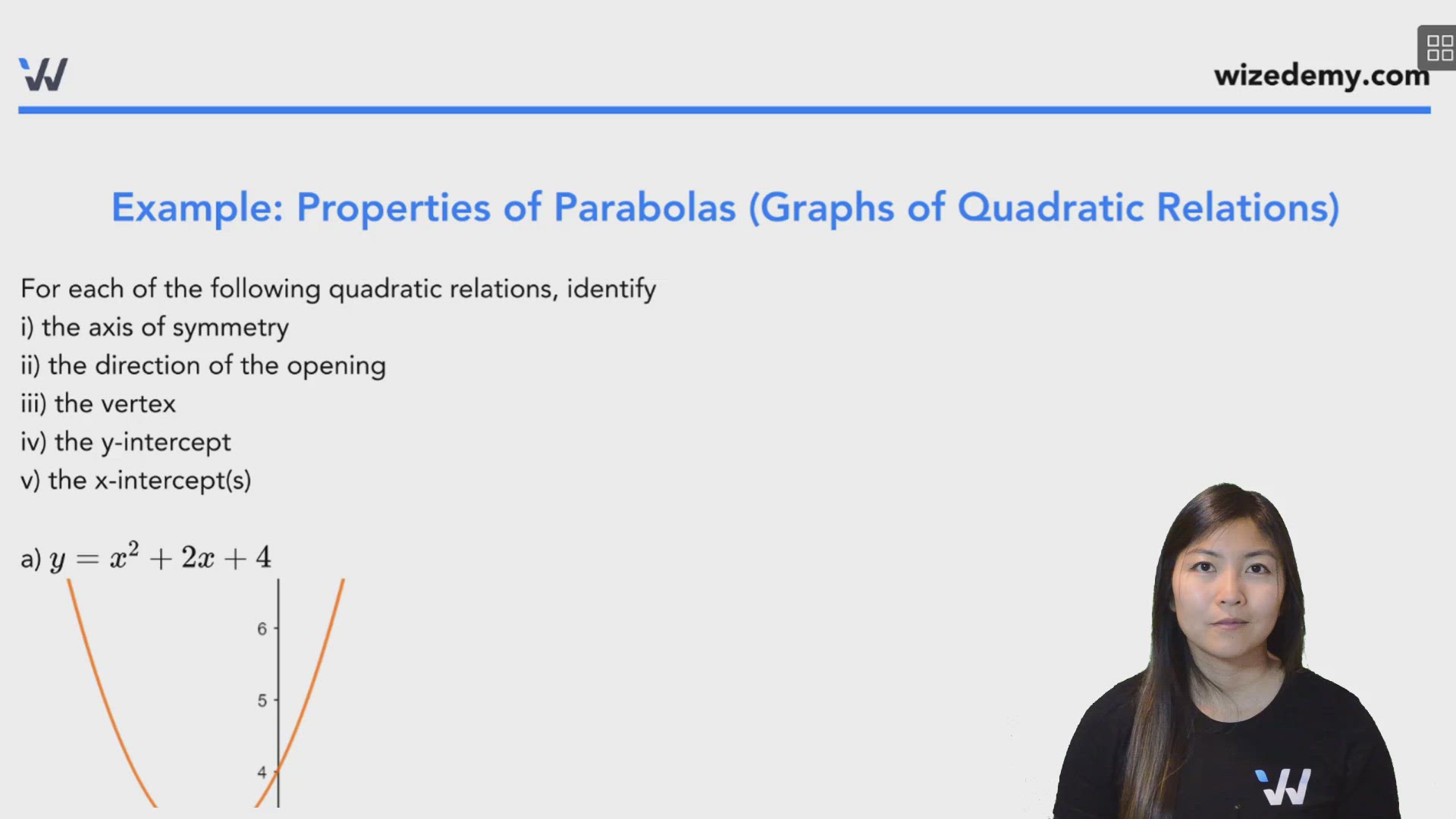
a) y=x2+2x+4y=x^2+2x+4
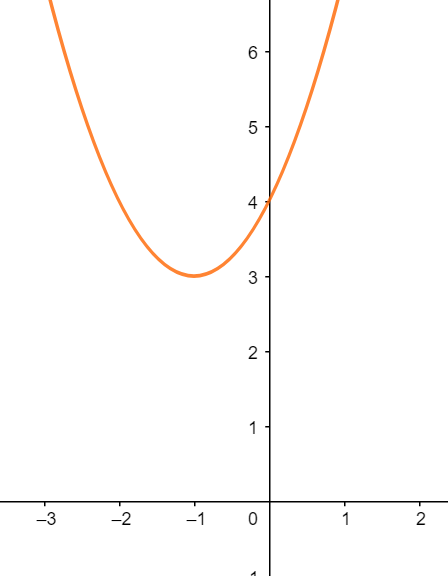
Image illustrating Example


axis of symmetryx=−1direction of openingupvertex(−1,3)maximum or minimum valuemin=3y-intercept(0,4)x-intercept(s)None\begin{array}{|c|c|} \hline \text{axis of symmetry}&x=-1\\ \hline \text{direction of opening}&\text{up}\\ \hline \text{vertex}&(-1,3)\\ \hline \text{maximum or minimum value}&\text{min}=3\\ \hline \text{y-intercept}&(0,4)\\ \hline \text{x-intercept(s)}&\text{None}\\ \hline \end{array}

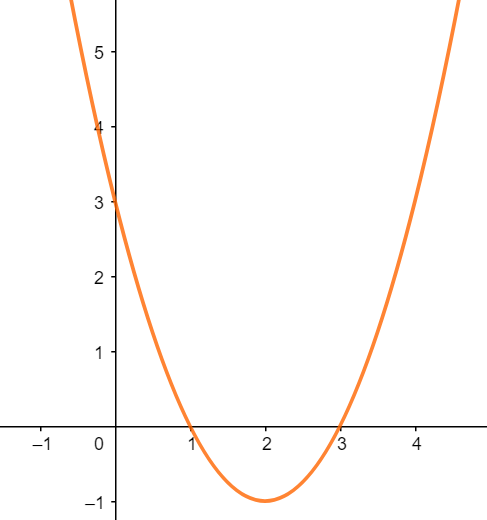
b) y=x2−4x+3y=x^2-4x+3

Image illustrating Example


axis of symmetryx=2direction of openingupvertex(2,−1)maximum or minimum valuemin=−1y-intercept(0,3)x-intercept(s)(1,0) & (3,0)\begin{array}{|c|c|} \hline \text{axis of symmetry}&x=2\\ \hline \text{direction of opening}&\text{up}\\ \hline \text{vertex}&(2,-1)\\ \hline \text{maximum or minimum value}&\text{min}=-1\\ \hline \text{y-intercept}&(0,3)\\ \hline \text{x-intercept(s)}&(1,0)~\&~(3,0)\\ \hline \end{array}

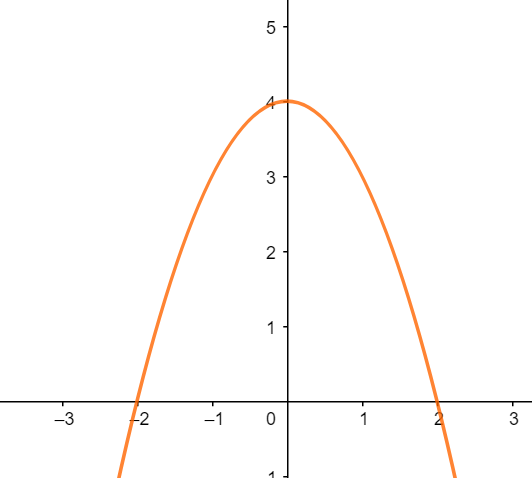
c) y=−x2+4y=-x^2+4

Image illustrating Example


axis of symmetryx=0direction of openingdownvertex(0,4)maximum or minimum valuemax=4y-intercept(0,4)x-intercept(s)(−2,0) & (2,0)\begin{array}{|c|c|} \hline \text{axis of symmetry}&x=0\\ \hline \text{direction of opening}&\text{down}\\ \hline \text{vertex}&(0,4)\\ \hline \text{maximum or minimum value}&\text{max}=4\\ \hline \text{y-intercept}&(0,4)\\ \hline \text{x-intercept(s)}&(-2,0)~\&~(2,0)\\ \hline \end{array}

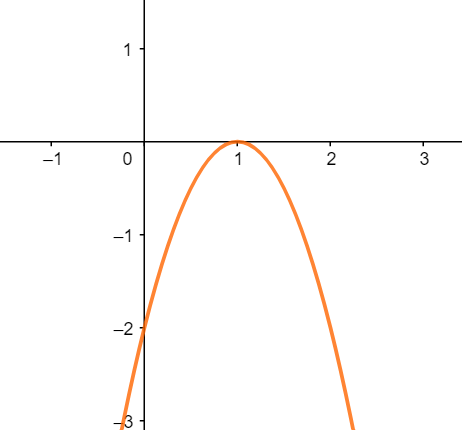
d) y=−2x2+4x−2y=-2x^2+4 x-2

Image illustrating Example


axis of symmetryx=1direction of openingdownvertex(1,0)maximum or minimum valuemax=0y-intercept(0,−2)x-intercept(s)(1,0)\begin{array}{|c|c|} \hline \text{axis of symmetry}&x=1\\ \hline \text{direction of opening}&\text{down}\\ \hline \text{vertex}&(1,0)\\ \hline \text{maximum or minimum value}&\text{max}=0\\ \hline \text{y-intercept}&(0,-2)\\ \hline \text{x-intercept(s)}&(1,0)\\ \hline \end{array}


Summary


Practice: Properties of Quadratic Graphs

Given the quadratic equation y=−x2+4x+5y=-x^2+4x+5,

a) create a table of values.


b) graph the parabola.


c) Identify the vertex.


d) Identify the axis of symmetry.


e) Identify the direction of the opening.


f) Identify the y-intercept.


g) Identify the x-intercept(s).

  • If there is no x-intercept, enter DNE
  • If there is more than one x-intercept, enter them in the form (x,0), (x,0)(x,0),~(x,0), put the one with the smaller x value first


h) Identify the max or min value.

Your answers

Create a free account to get started

Unlock full course notes by signing up

  • Video lessons taught by top educators
  • Practice questions with guided solutions
  • Written review notes for reference
  • Expert answers anytime from course tutors

Mark Yourself Question

  1. Grab a piece of paper and try this problem yourself.
  2. When you're done, check the "I have answered this question" box below.
  3. View the solution and report whether you got it right or wrong.

Practice: Sketching Quadratic Graphs

Sketch a parabola with the following information:

a) x-intercepts of(3,0)(3,0) and (7,0)(7,0), and a maximum value of 5.

b) y-intercept of (0,5)(0,5), an axis of symmetry of x=−1x=-1, and a minimum value of −2-2.

Create a free account to get started

Unlock full course notes by signing up

  • Video lessons taught by top educators
  • Practice questions with guided solutions
  • Written review notes for reference
  • Expert answers anytime from course tutors

Practice: Axis of Symmetry & Vertex

A parabola passes through the points (−2,1)(-2,1) and (0,1)(0,1).


a) Determine the x-coordinate of the vertex.


b) If this quadratic equation is y=2x2+4x+1y=2x^2+4x+1, determine the y-coordinate of the vertex.

Your answers

Create a free account to get started

Unlock full course notes by signing up

  • Video lessons taught by top educators
  • Practice questions with guided solutions
  • Written review notes for reference
  • Expert answers anytime from course tutors

Practice: Rocket Launch

A small toy rocket is launched from a platform slightly above the ground. It's path can be modelled by the equation h=−(t+1)(t−3)h=-(t+1)(t-3), where hh represents the height of the rocket in meters and tt represents the number of seconds after the rocket was launched.


a) Expand and simplify the equation to show that it has degree 2.


b) Create a table of values and sketch the parabola.


c) What is the maximum height of this rocket, and when does it reach this height?


d) What is the height of the platform the rocket was launched from?


e) When does the rocket hit the ground?

Your answers

Create a free account to get started

Unlock full course notes by signing up

  • Video lessons taught by top educators
  • Practice questions with guided solutions
  • Written review notes for reference
  • Expert answers anytime from course tutors

Practice: Revenue

A small high school musical committee wants to determine the optimal price to sell its tickets in order to maximize revenue. The current ticket price is $10, and 20 people will purchase a ticket at this price. Let RR represent the revenue and xx represent the number of $1 increases to the ticket price. Then the revenue from this school play is modelled by the equation R=(10+x)(20−x)R=(10+x)(20-x).


a) Create a table of values and sketch this parabola.


b) Determine the maximum revenue and at what ticket price this occurs.


c) At what ticket price will the revenue be $0?

Your answers

Create a free account to get started

Unlock full course notes by signing up

  • Video lessons taught by top educators
  • Practice questions with guided solutions
  • Written review notes for reference
  • Expert answers anytime from course tutors