
Rational Functions
A rational function can be expressed as:
where is the largest exponent in the numerator and is the largest exponent in the denomiator.
Properties of Rational Functions
- X-Intercepts can be found by setting and solving for
- Vertical asymptotes can be found by setting the denominator to 0 and solving for
- Horizontal asymptotes:
- If : There is a horizontal asymptote at
- If : There is a horizontal asymptote at
- If : There is no horizontal asymptote. There may be an oblique/diagonal asymptote.
- If factoring the numerator & denominator of , any terms that cancel out indicates where a missing point/hole in
- The domain is the set of all real numbers except where there are vertical asymptotes & missing points/holes
- The range is the set of all real numbers except where there are horizontal asymptotes in most cases
Example 1
Let's look at .
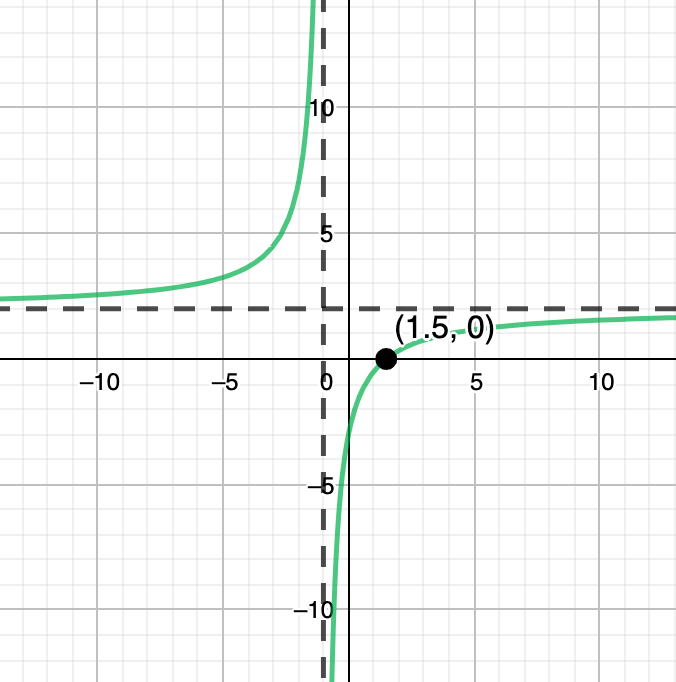
- -Intercept:
- Vertical Asymptote:
- Horizontal Asymptote:
- Missing Points/Holes: None
- Intervals of Increasing:
- Intervals of Decreasing: NA
- Domain:
- Range:

Example: Rational Functions
A graph of the function is sketched below:
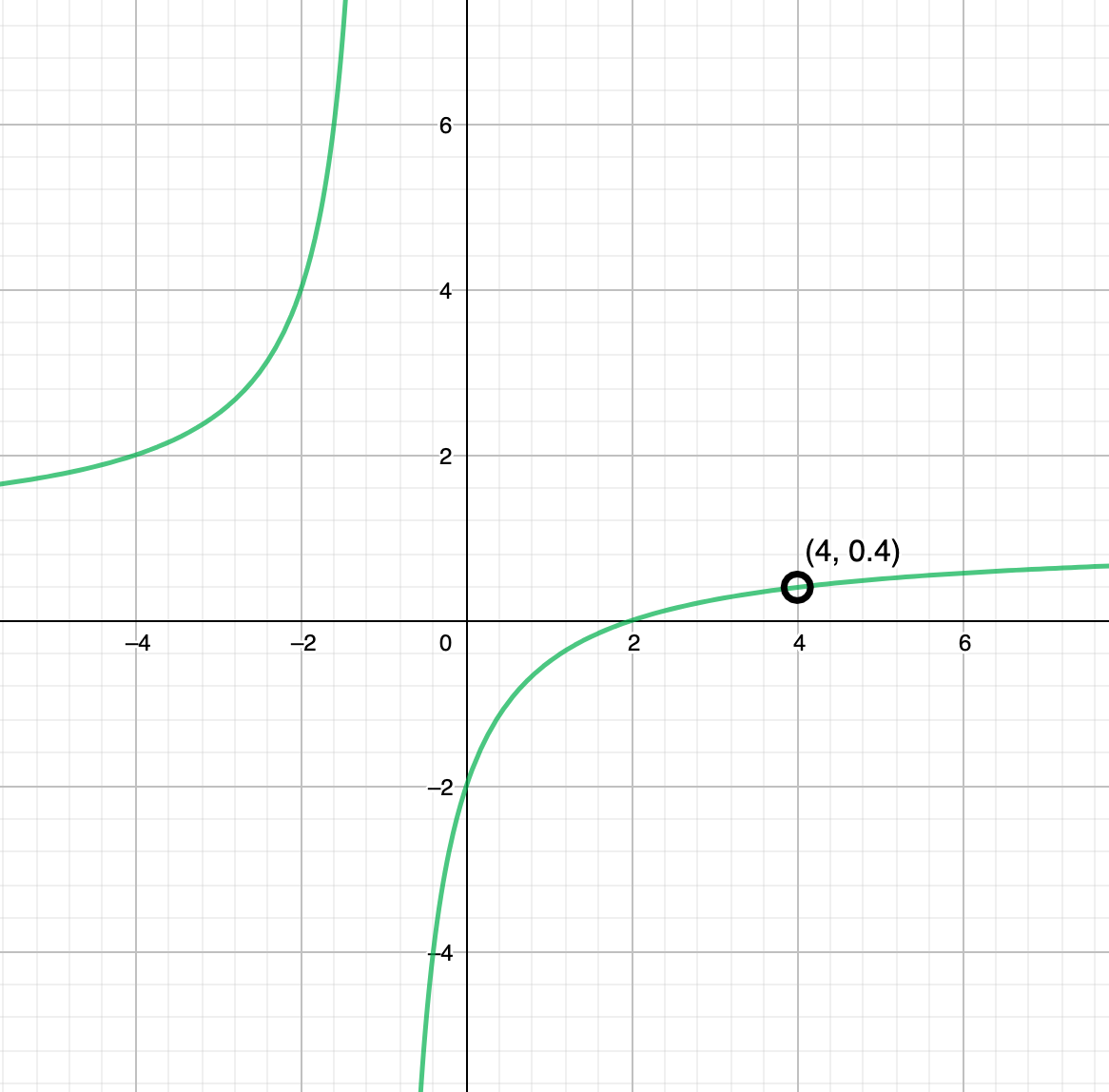
Identify the equations for any vertical & horizontal asymptotes, and missing points/holes.
Factor :
Vertical Asymptotes:
Let .
The vertical asymptote is at
Horizontal Asymptote:
The degree of the numerator is equivalent to the degree in the denominator.
Therefore, .
Missing Points/Holes
Missing points/holes exist whenever terms in the numerator and denominator cancel.
Since the term was eliminated, there is a missing point/hole at
Example: Rational Functions
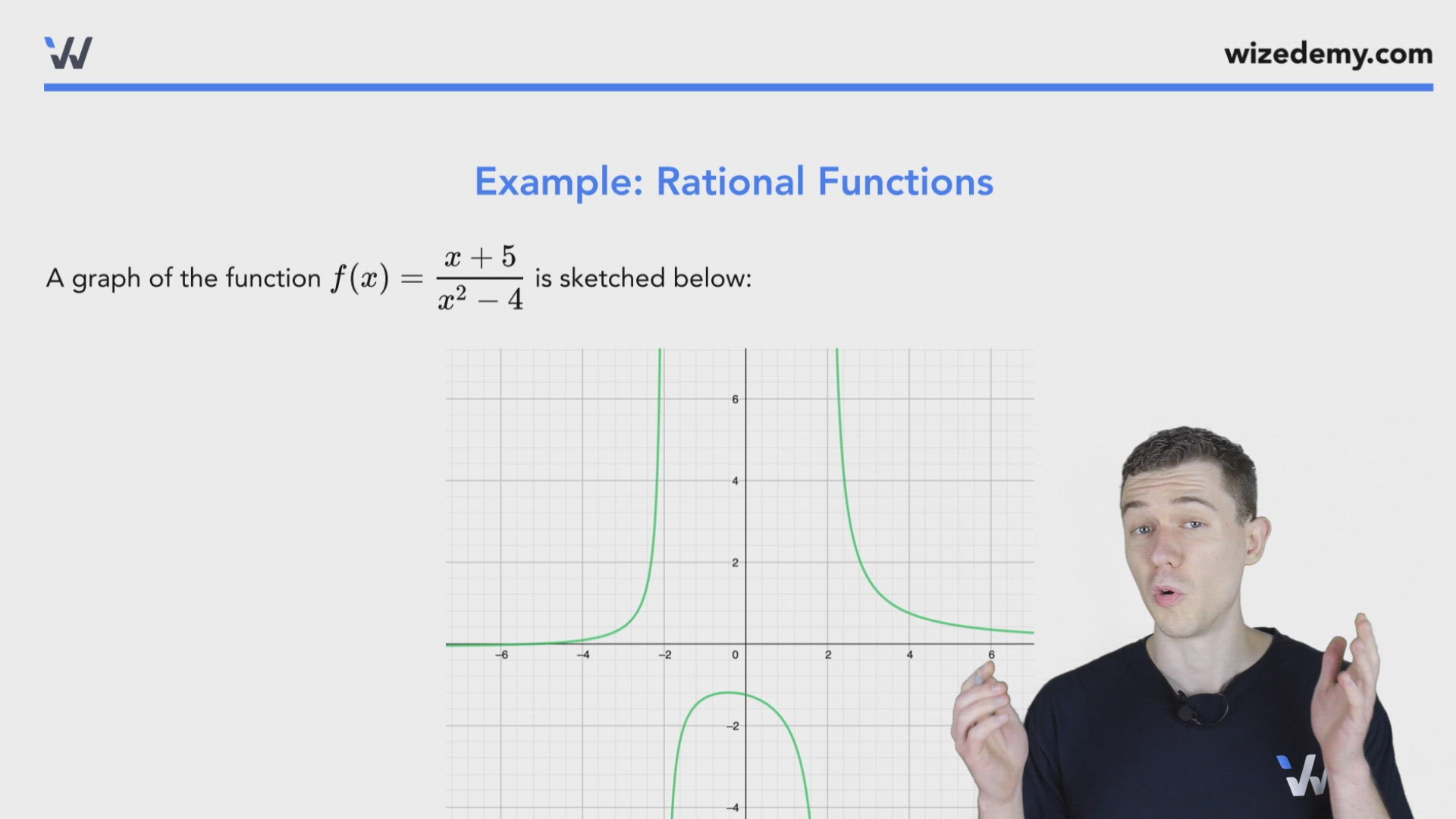
A graph of the function is sketched below:

Identify the equations for any vertical & horizontal or oblique asymptotes, and missing points/holes.
Factor :
Vertical Asymptotes:
Let and let
The vertical asymptotes are at
Horizontal Asymptote:
The degree of the numerator is less than the degree in the denominator.
Therefore, .
Missing Points/Holes
Missing points/holes exist whenever terms in the numerator and denominator cancel.
Since there are no terms the cancel out, there are no missing points/holes.
Example: Rational Functions
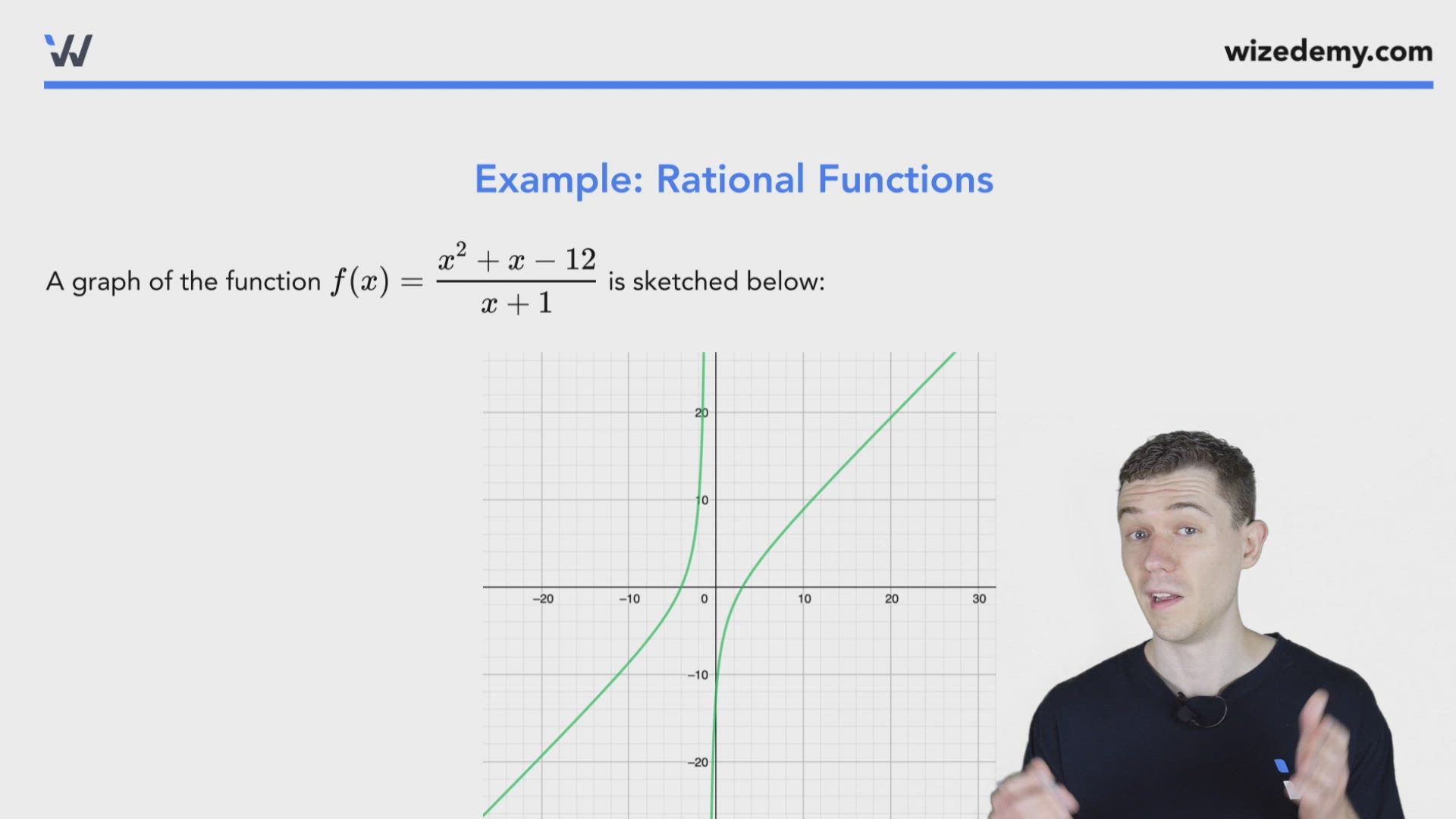
A graph of the function is sketched below:
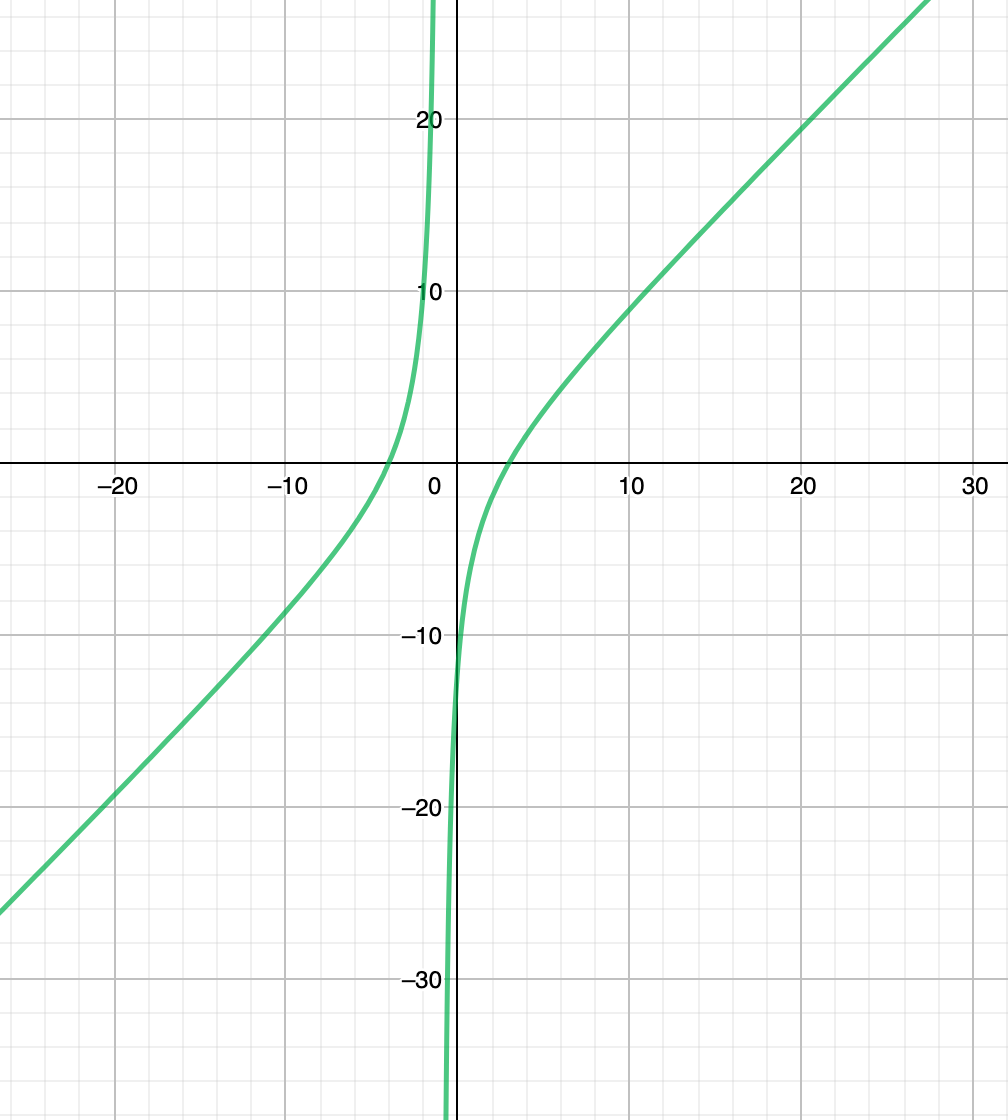
Identify the equations for any vertical & horizontal or oblique asymptotes, and missing points/holes.
Factor :
Vertical Asymptotes:
Let .
The vertical asymptote is at .
Horizontal Asymptote:
The degree of the numerator is greater than the degree in the denominator.
Therefore, there is an oblique asymptote which can be found by dividing :
The oblique asymptote does not count the remainder.
So, the oblique asymptote becomes the quotient .
Missing Points/Holes
Missing points/holes exist whenever terms in the numerator and denominator cancel.
Since there are no terms the cancel out, there are no missing points/holes.