Radical Expressions
The square root is one basic type of radical expression. In a radical expression we have
- radical symbol
- radicand
- index

The value of a radical can be found be finding the expression, which when raised to the power of the index, will equal the radicand.

For even roots, we take this value to be positive and call it the principle root of the radial.
Example 1
1.
2.
3.
Alternate Notation
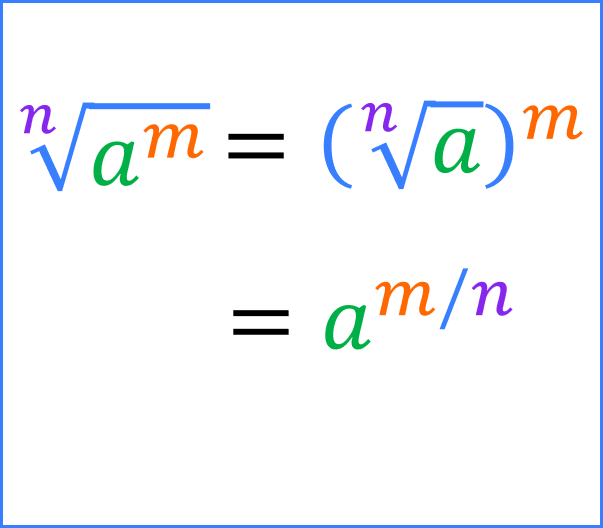
All radicals can be re-written using exponents. To write a radical as an exponent any powers on the radical are used as the numerator, and the index of the root is used as the denominator.
Example 2
1.
2.
3.
Operations with radicals
We can combine radicals in a variety of ways according to their rules

Example 1
Combine the following expressions
1.
2.
3.
Simplifying Radicals
When simplifying a radical expression we want to make sure that:
- The powers in the radicand are smaller than the index
- The powers in the radicand and the index do not have a common factor more than 1
- The powers in the radicand are not fractions
- A radical does not appear in any denominators
The process of making sure a radical is not in the denominator is called rationalizing the denominator.
Example 2
Simplify the following radical expression
1.
2.
Example: Operations with Radicals

At an assembly factory information kept on how long it takes to build machinery depending on the amount of design changes.
This information is then used to build prediction models.
For example the approximate number of months required to assemble machine A and machine B is given by
where is the number of design changes.
Create a new model that represents the total number of months for assembling both machines A and B.
Simplify as much as possible.
For this we would be begin by adding the two current models together.
Now we can simplify one of the roots since the power is larger than the index
Since the radicands are the same, we can add by combining their coefficients
This gives us a new model that now represents the total time for making both machines.