Wize High School Grade 9 Math Textbook > Data Analysis
Intro to Data & Mathematical Modelling
Popular Courses
Find My Course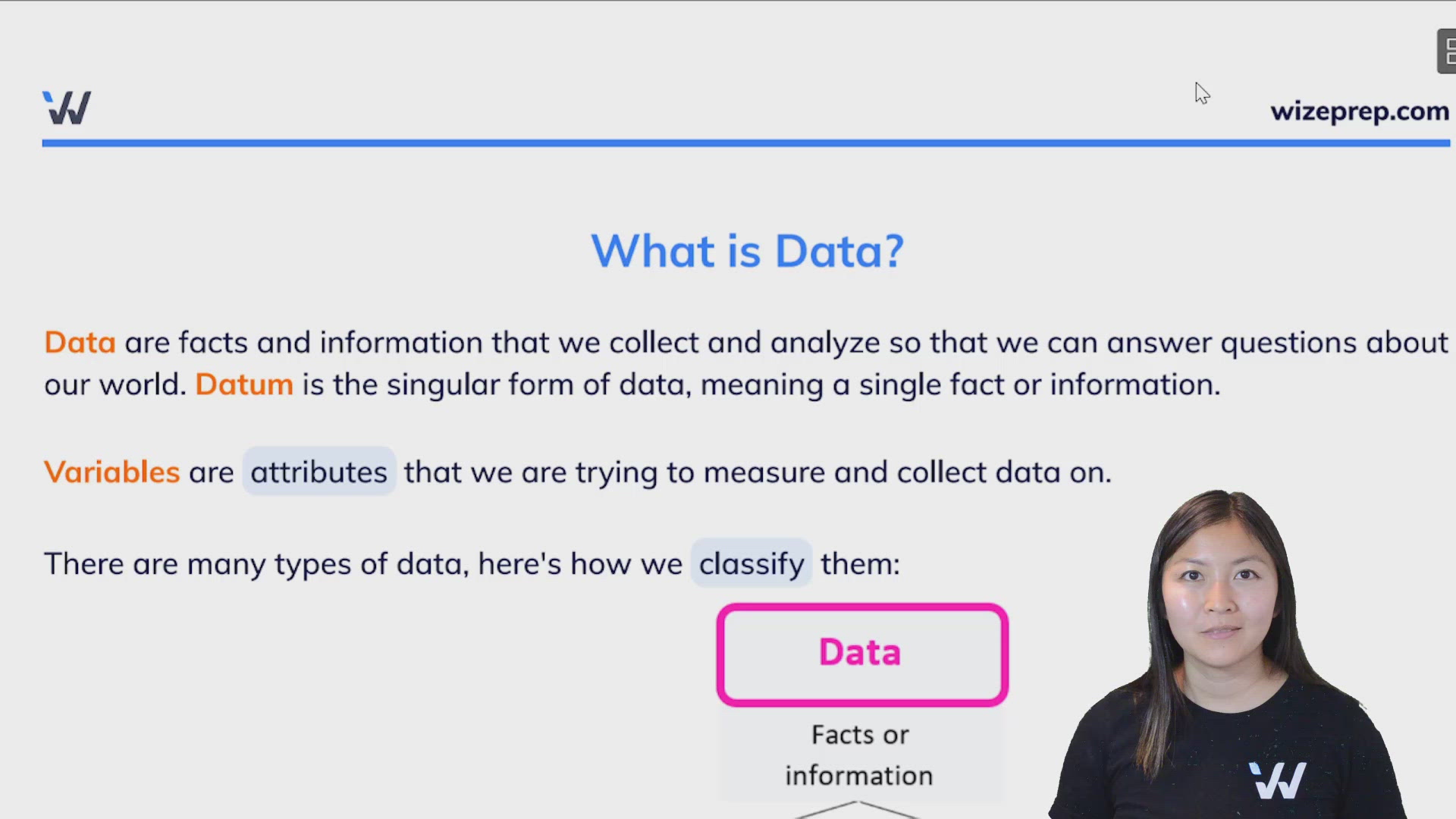
0:00 / 0:00
What is Data?
Data are facts and information that we collect and analyze so that we can answer questions about our world. Datum is the singular form of data, meaning a single fact or information.
Variables are attributes that we are trying to measure and collect data on.
There are many types of data, here's how we classify them:

Examples
Classify the following data collected from passengers at the Toronto Pearson Airport on January 1, 2000.
- The names of each passenger ➡Qualitative data
- The height of each passenger ➡Quantitative data ; Continuous data
- The year that each passenger was born ➡Quantitative data ; Discrete data
- The number of pets that each passenger has ➡Quantitative data ; Discrete data
Once we have data, we can use mathematical modelling to help us answer questions about real-world problems.
0:00 / 0:00
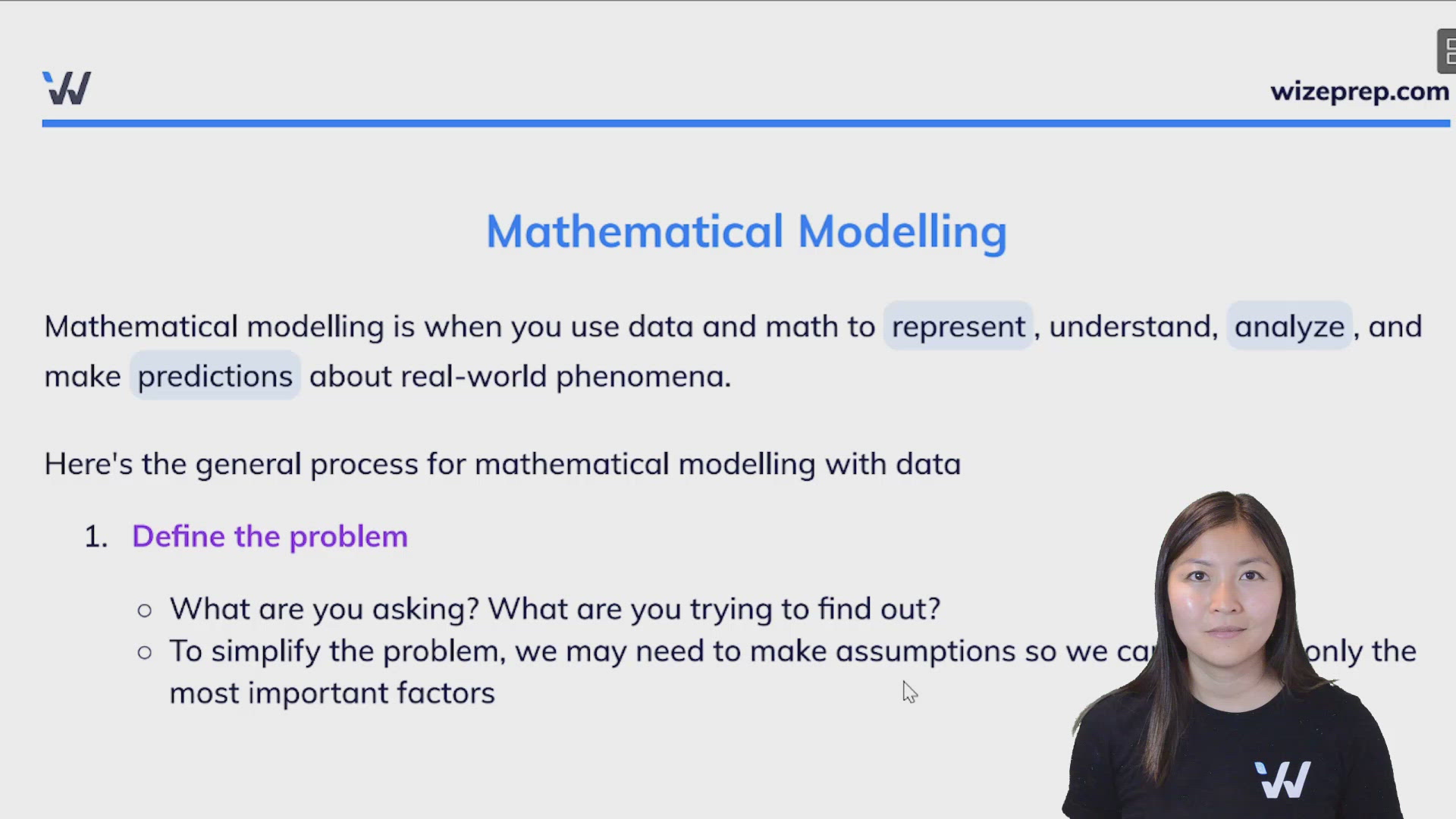
Mathematical Modelling
Mathematical modelling is when you use data and math to represent, understand, analyze, and make predictions about real-world phenomena.
Here's the general process for mathematical modelling with data
- Define the problem
- What are you asking? What are you trying to find out?
- To simplify the problem, we may need to make assumptions so we can focus on only the most important factors
- Define the relevant variables
- What factors will affect the answer to the question or our decision regarding a problem
- This will inform us about what data we need to collect
- Collect data
- How will we collect the data? What is the source, meaning, where do the data come from?
- How much data do you need? If it's historical data, how far back in time does your data have to go?
- What assumptions do we have to make about the data?
- What limitations are there with the data?
- Analyze & model the data
- Use the math you know to make sense of the data (build your model)
- Examine the model & answer the question
- Use your analysis and model to answer the question - what can I learn from my model?
- Does the answer make sense?
- Report your results
- Share your results with the relevant stakeholders using a presentation slide, infographic, report, story-telling, etc.
0:00 / 0:00
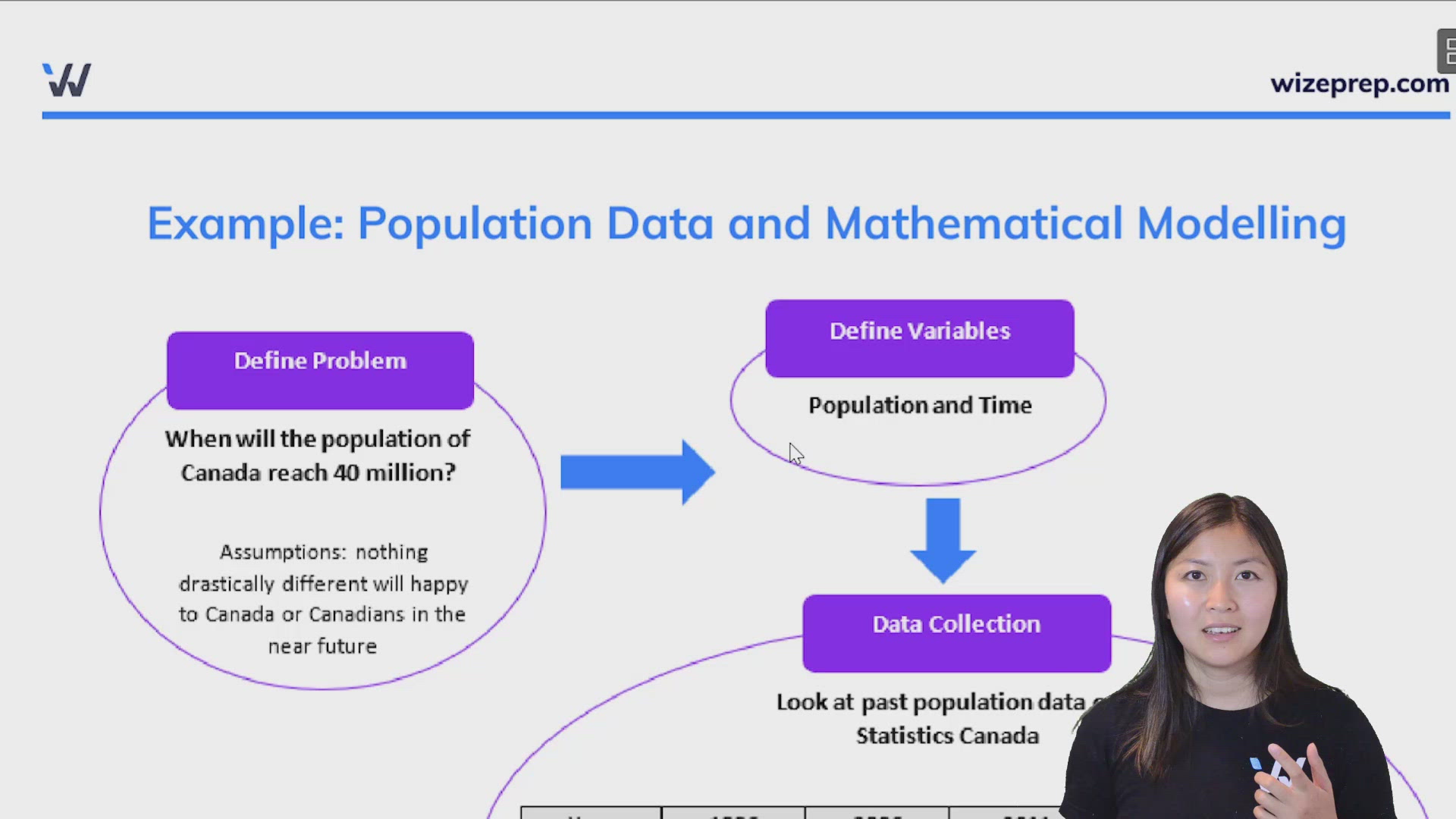
Example: Population Data and Mathematical Modelling


Mark Yourself Question
- Grab a piece of paper and try this problem yourself.
- When you're done, check the "I have answered this question" box below.
- View the solution and report whether you got it right or wrong.
Practice: Data and Mathematical Modelling
For each of the following scenarios,
- identify the data you could collect to help answer the question.
- what type of data is it?
a) Your high school cafeteria wants to start selling ice-cream. What flavours should they sell in order to maximize revenue?
b) You want to plan a beach trip for a day when the beach is least busy. How many people will be at the beach on a certain day?
Mark Yourself Question
- Grab a piece of paper and try this problem yourself.
- When you're done, check the "I have answered this question" box below.
- View the solution and report whether you got it right or wrong.
Practice: Asking the Right Question
Choose a topic that you are interested in. Create a question you want to answer using data and mathematical modelling.