Wize Grade 11 Mathematics Textbook > Introduction to Functions
Inverse Functions
0:00 / 0:00
Inverse Functions
Functions can be thought of as machines that take in an input and produce an output. If we reverse the roles of input and output we might again create a function.
Inverse Functions
An inverse function is a function that is able to undo, or is the reverse, of another function.
The notation is used to show it's the inverse of .
Example 1
Find the inverse for the following relations by reversing inputs and outputs.
Then check to see if the inverse is also a function.
1.
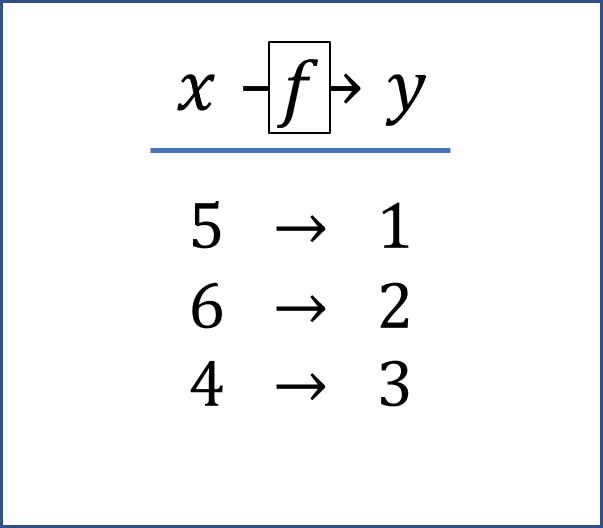
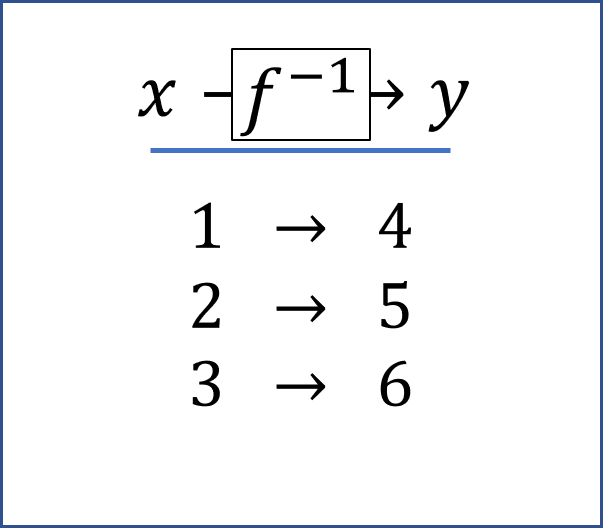
This relation is an inverse function since every input is connected to exactly one output.
2.
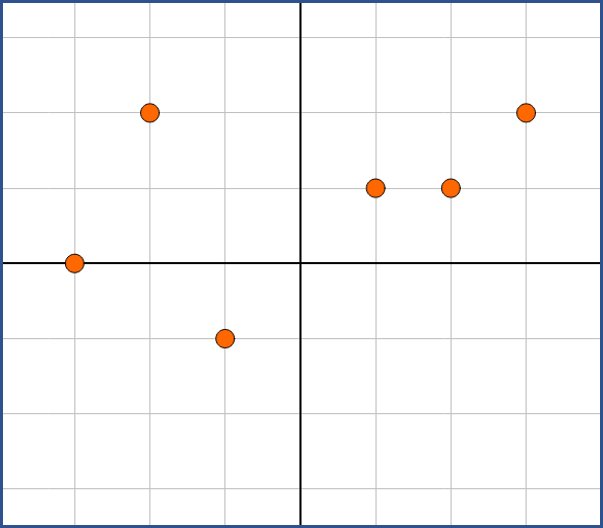
The inverse relation contains the points
It is not a function since the input of 1 goes to both 1 and 2.
One-to-one Functions
If every value of is connect to a unique value of then we can say the function is a one-to-one function.
- In a one-to-one function no two values of can be connected to the same value of .
- The inverse of a one-to-one function will always be an inverse function.
Wize Tip
If a function is represented using a graph, you can use the horizontal line test to see if it is a one-to-one function. The graph of a one-to-one function will only cross a given horizontal line once.
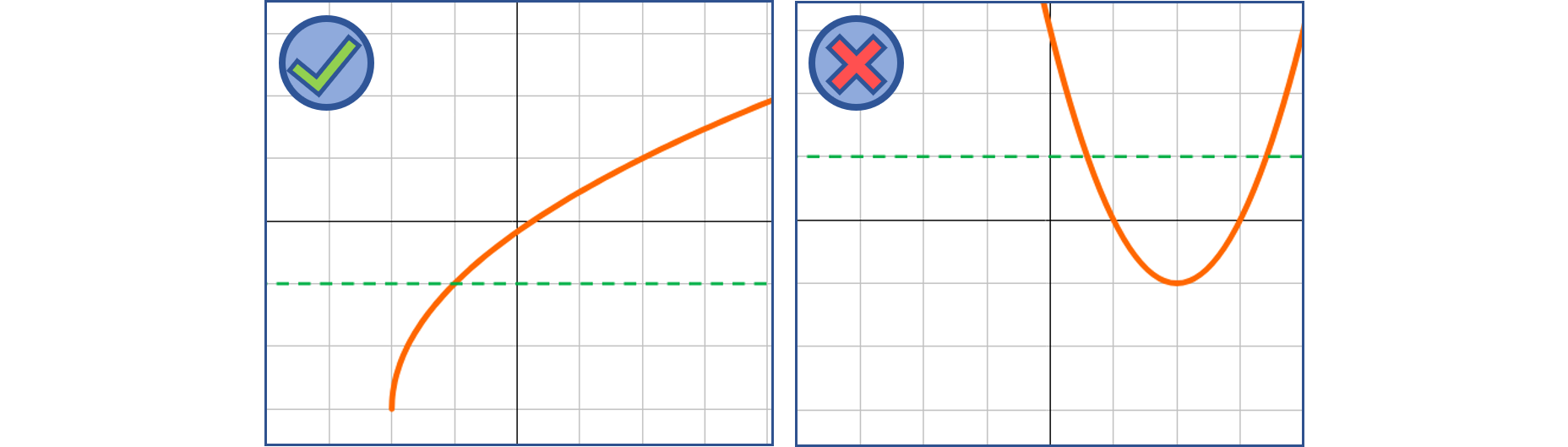
Example 2
Determine if the function is one-to-one.
1.
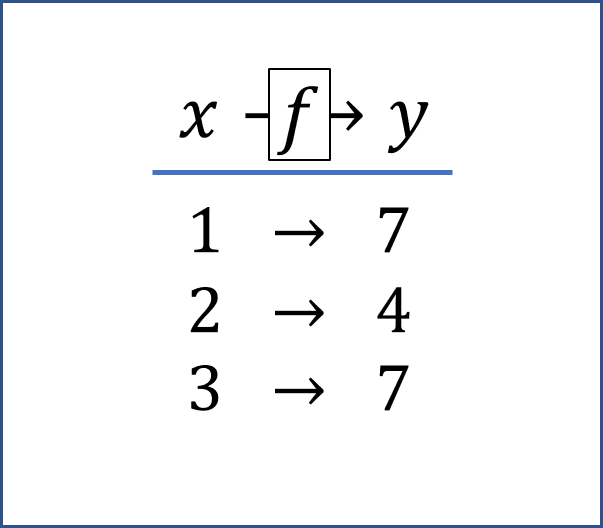
Although this is a function, it is not one-to-one. 1 and 3 are both connected to 7.
2.
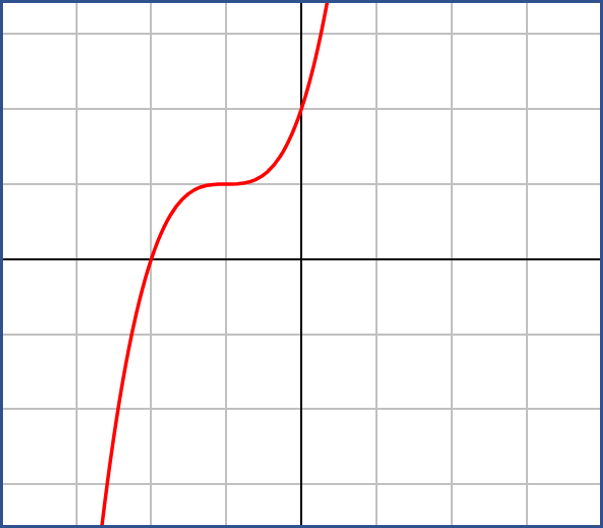
This is one-to-one. Any given horizontal line will only cross the graph once.
3.
This is not one-to-one. The absolute value of -2 and 2 are both connected to 2.
0:00 / 0:00
Finding an Inverse Function
Inverse Function from an Equation
To calculate an inverse function from a given equation we can
- Reverse the variables
- Solve for the new output variable
- Use the notation to indicate its an inverse
Example 1
Find the inverse function of
\begin{array}{lrcl}
\underline\text{1. Reverse the variables}&x &=& 3f(x) + 5 \\\\
\underline{\text{2. Solve for }f(x)}&x - 5 &=& 3f(x) \\\\
&\frac{1}{3}(x-5) &=& f(x) \\\\
\underline{\text{3. Use the }f^{-1}\text{ notation}}&f^{-1}(x) &=& \frac{1}{3}(x-5)
\end{array}
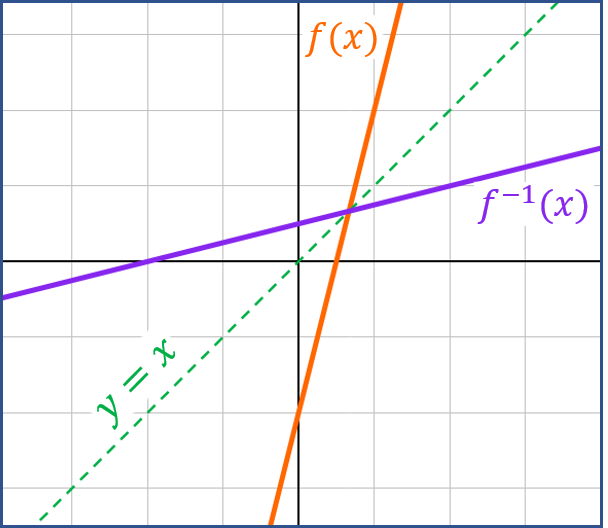
Inverse Function from a Graph
To find the inverse function from a given graph you can reflect it over the line
0:00 / 0:00
Example: Inverse Functions
The gym teacher had just ordered some new dumbbells for the gym when they noticed all of the weights were in pounds. Fortunately they remembered there was a way to convert all of these weights into kilograms.

To convert pounds to kilograms the weights need to be multiplied by 2.2.
1. Express this process using function notation.
where
- is the weight in pounds
- is the weight in kilograms
2. Evaluate and interpret what in means in this context.
This means a 15 pound dumbbell weighs 33 kilograms
3. Write an equation for the inverse function.
where
- is the weight in kilograms
- is the weight in pounds
4. What information does the inverse function give you?
The inverse function tells us how many pounds something weights if we know its weight in kilograms.
This would be useful if we wanted to convert kilograms to pounds.
Practice: Inverse Functions
Match each operation with its inverse operation.
A.
Multiply by 5 and then subtract 3
B.
Subtract 6
C.
Take the square root and then add 2
D.
Multiply by 4
Divide by 4
Add 6
Add 3, and then divide by 5
Subtract 2 and then square the result
Practice: Inverse Functions
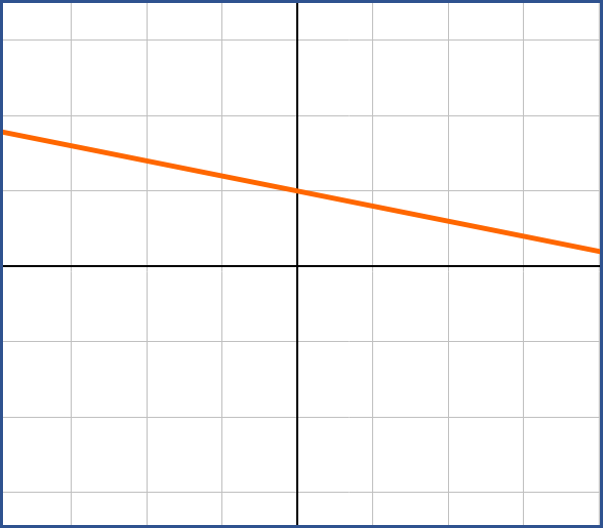
On the graph is the function .
Which graph represents ?
Practice: Inverse Functions
Given the following function , find its inverse