Wize Grade 11 Mathematics Textbook > Transformations on Functions
Stretches and Compressions

0:00 / 0:00
Stretches and Compression
Stretches and Compressions
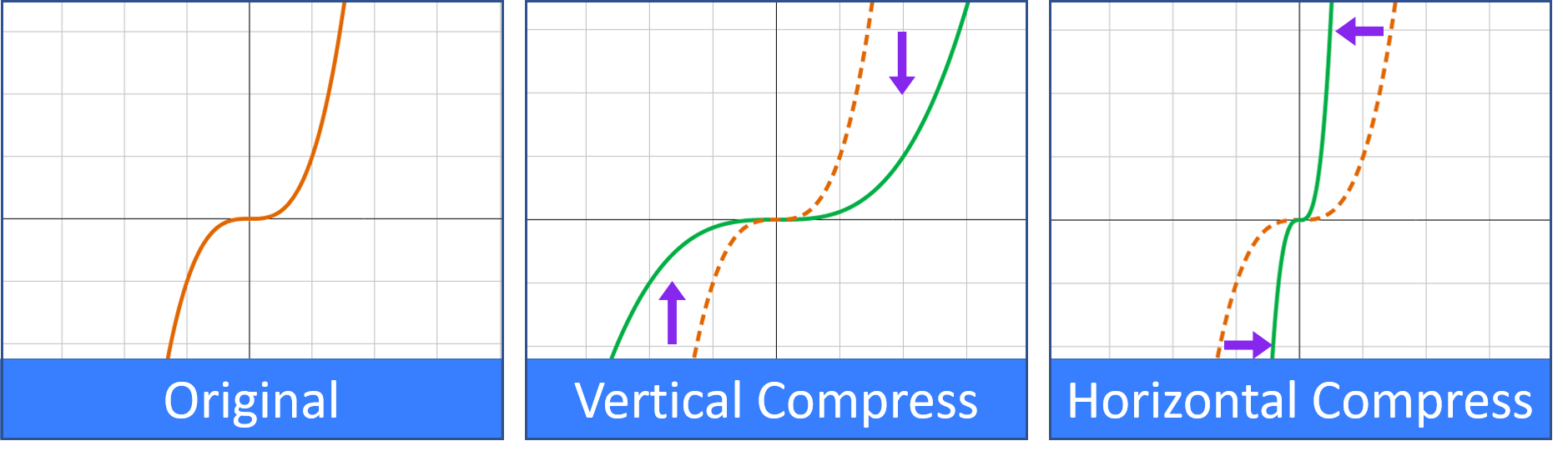
A stretch on a function is when it has been elongated in either the vertical or horizontal direction. Similarly a compression on a function is when it has been shrunk.
Example 1

Stretches and Compressions from the equation
To stretch a function we can multiply it by a number. Both the size of the number and where we apply it effect the type of stretching that happens.
Stretching
- Vertically - Multiply the entire function by whose absolute value is larger than 1
- Horizontally - Multiply the input variable by whose absolute value is between 0 and 1
Compressing
- Vertically - Multiply the entire function by whose absolute value is between 0 and 1
- Horizontally - Multiply the input variable by whose absolute value is larger than 1
Watch Out!
If you multiply by a negative number this is actually two transformations. The negative will cause a reflection, and the absolute value of the number will cause a stretch or compression.
Example 2
For each equation, describe the original function, and the type of transformation.
1.
- Function:
- Transformation: Vertical stretch by a factor of 4
2.
- Function:
- Transformation: Horizontal stretch by a factor of
3.
- Function:
- Transformation: Horizontal compression by a factor of
4.
- Function:
- Transformation: Vertical compression by a factor of
Wize Tip
Interpreting a transformation as a stretch or compression can depend on how you decide to write a function.
These represent the same function and so they have the same graph. The first one can be interpreted as a horizontal compression, while the second can be interpreted as a vertical stretch.
0:00 / 0:00
Example: Stretches and Compressions
In basketball the path of the ball can make a huge difference on whether the ball will go in the hoop or not.
Two players Chloe and Mark are working on their throws. Chloe has a tendency to throw the ball much higher than mark.
Despite this both have the ball start in the same place ending up making a basket.
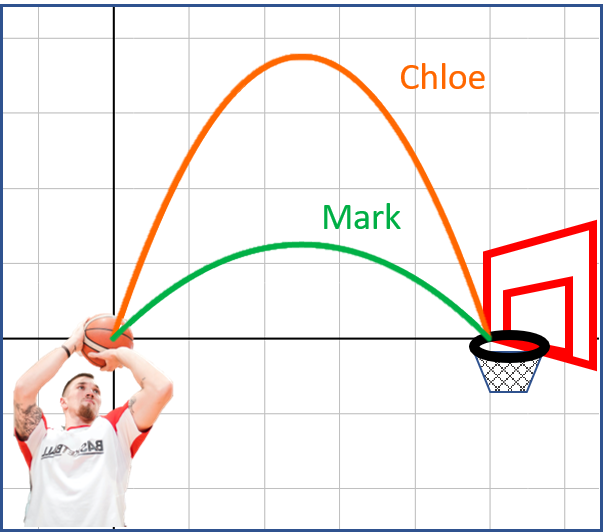
Let represent the path of Chloe's ball.
1. Use function notation to write an equation that represent the path of Mark's ball.
We can describe the path of Mark's ball as
2. Describe how the vertex of Mark's ball is different from Chloe's. How does this relate to what we see in the equation?
- The vertex of Chloe's ball appears to be at on the diagram, where as Mark's is at .
- They are the same except for the y-values. Mark's appears to be the value of Chloe's.
- This is the same value that we use to make the vertical compression transformation.
Practice: Stretches and Compressions
The original function is
Describe the direction (vertical or horizontal) and type (stretch or compression) of transformation in each equation.
1.
2.
3.
4.
Practice: Stretches and Compressions
The given table represents the inputs and outputs of a given function. If we apply a horizontal stretch by a factor of 2, what will be the new input and output values?
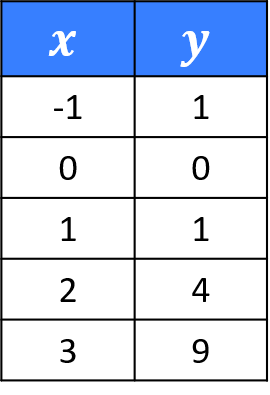
Complete the table with these new values transformed values.
| x | y |
| 1 | |
| 0 | 0 |
| 4 | |
| 6 |
Practice: Stretches and Compressions
The graph of a function is given as well as its transformed graph.
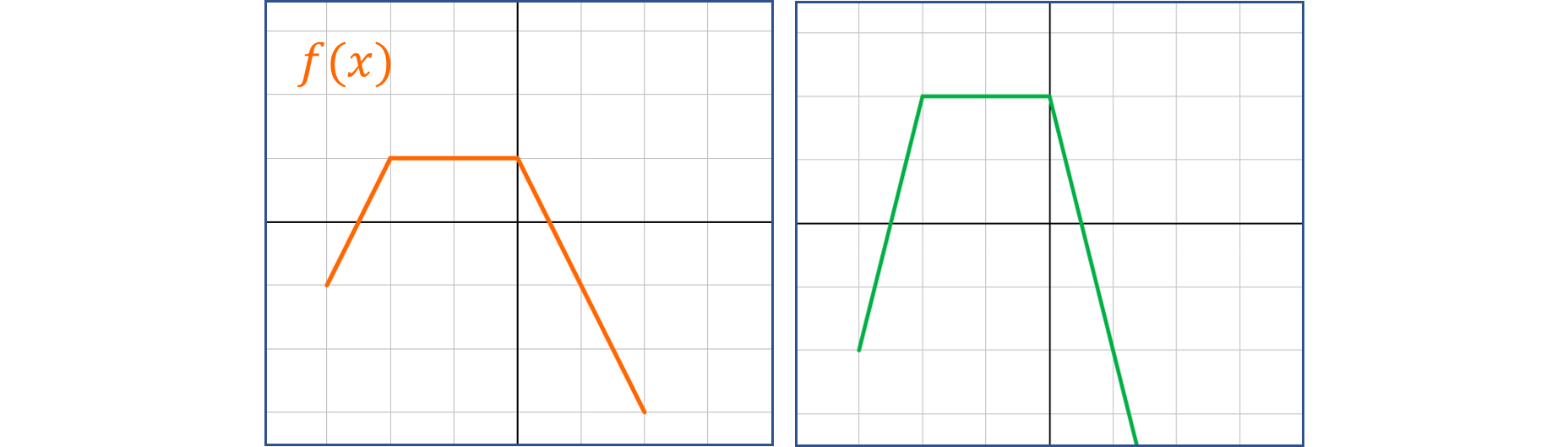
Write the equation of the transformed graph.