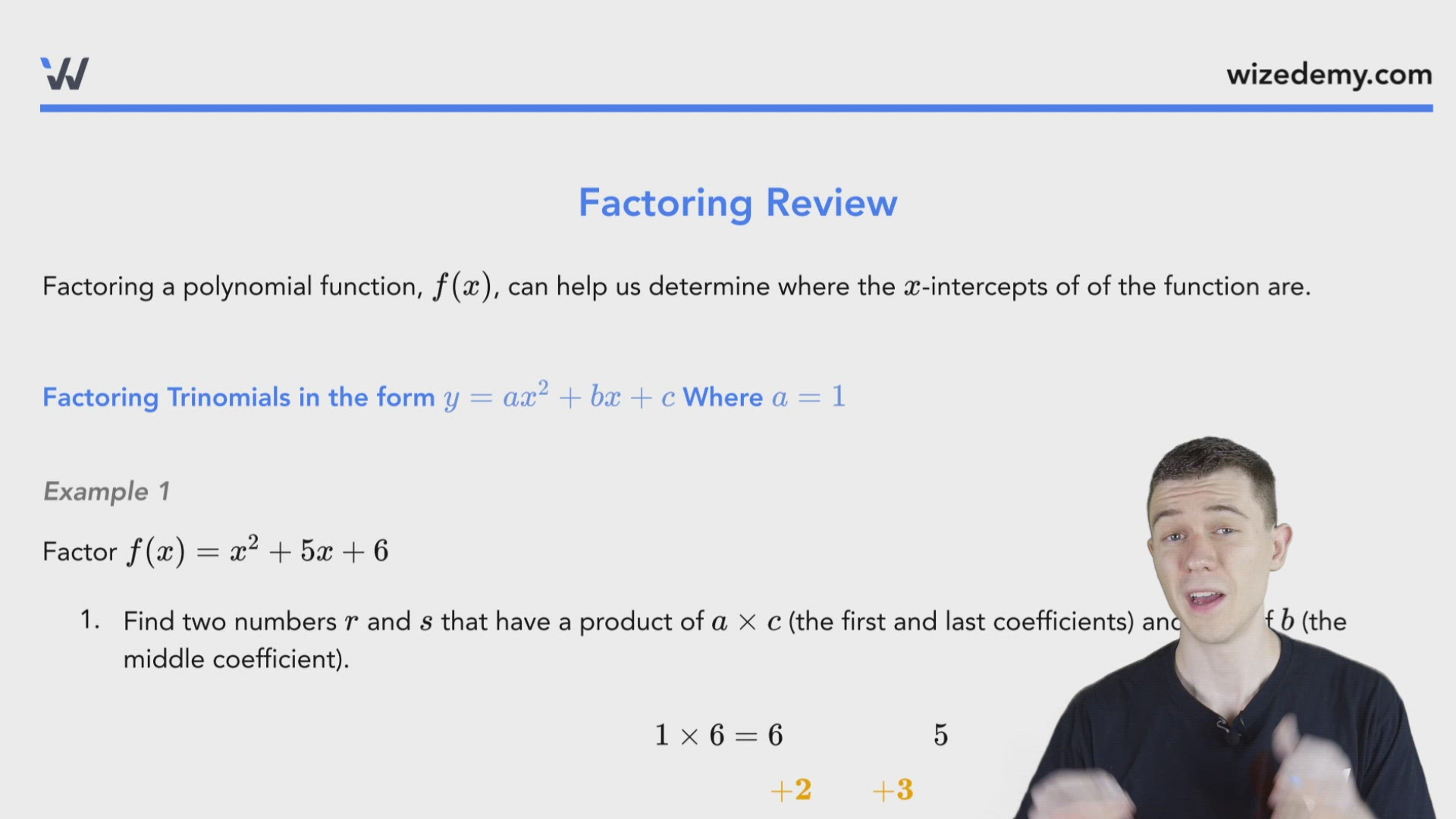
Factoring Review
Factoring a polynomial function, , can help us determine where the -intercepts of of the function are.
Factoring Trinomials in the form Where
Example 1
Factor
- Find two numbers and that have a product of (the first and last coefficients) and sum of (the middle coefficient).
Product of and Sum of
The numbers are and
- Rewrite as a product of two binomials
Therefore,
Factoring Trinomials in the form Where
Example 2
Factor
- Find two numbers and that have a product of (the first and last coefficients) and sum of (the middle coefficient).
Product of and Sum of
The numbers are and
- Rewrite up the middle term as
- Group the terms together in pairs then factor out the common factors
Factoring a Difference of Squares
If then is in factored form.
Example 3
Factor
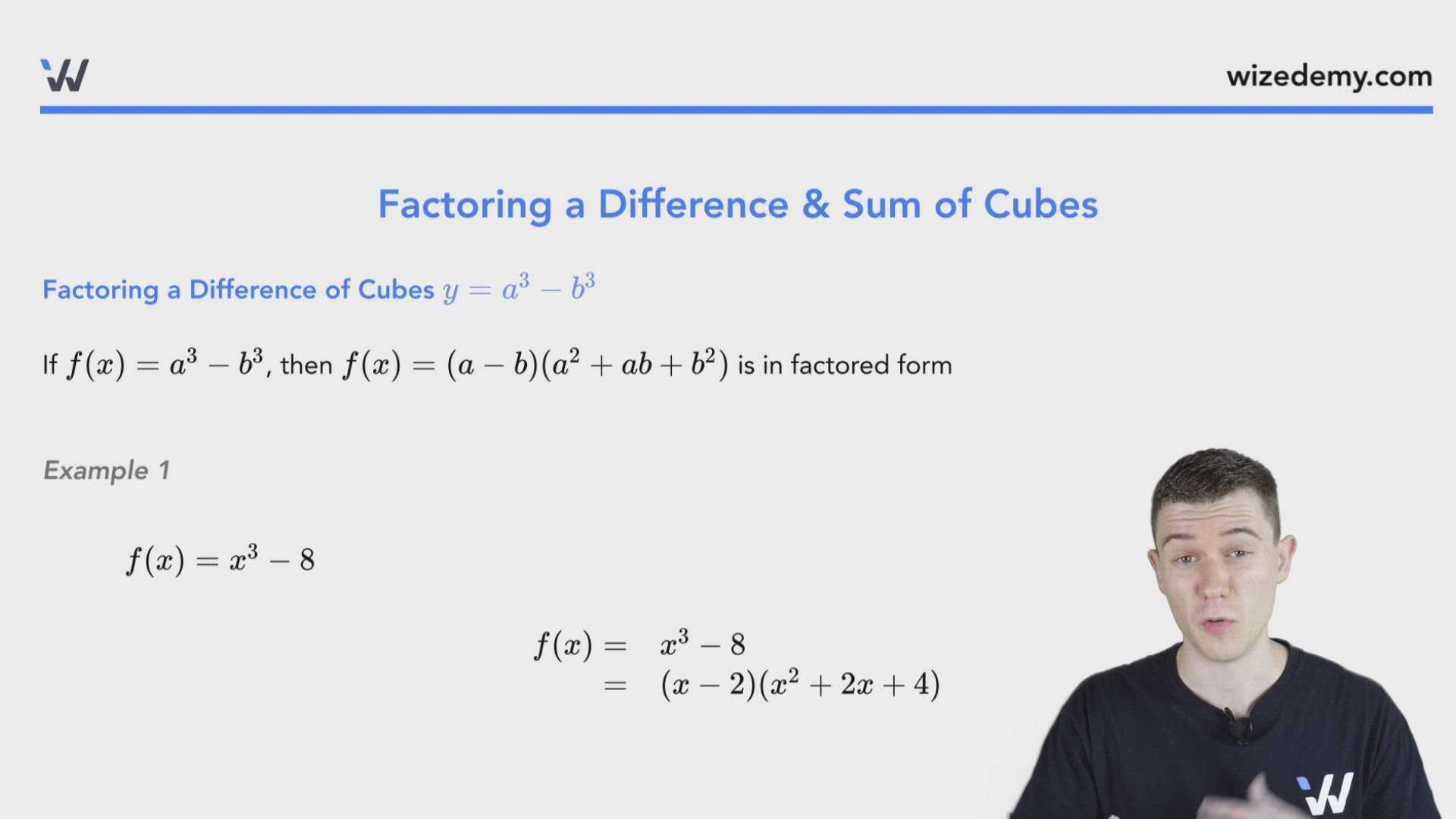
Factoring a Difference & Sum of Cubes
Factoring a Difference of Cubes
If , then is in factored form
Example 1
Factor
Factoring a Sum of Cubes
If then is in factored form
Example 2
Factor

Example: Factoring
Factor