Popular Courses
MCAT
General Course
Intro to Physics
University Study Guides
PHYSICS 1D03
McMaster University
AP Physics C: Mechanics Exam Prep Course
AP Exam Prep
Physics
General Course
PHYS 115
Queen's University
PCS 211
Toronto Metropolitan University
PHYS 204
Concordia University
PHYS*1300
University of Guelph
Intro to Physics
University Study Guides
PHYS*1080
University of Guelph
PHY 1321
University of Ottawa
PHYS 131
McGill University
APSC 111
Queen's University
PCS 120
Toronto Metropolitan University
PHYS 110
University of Victoria
LE/PHYS 1800 3.00
York University
PHYS-1400
University of Windsor
PHY131H1
University of Toronto
PHY 1331
University of Ottawa

0:00 / 0:00
Free Fall
- Near the Earth's surface, all objects experience the same acceleration due to gravity (neglecting air resistance). This acceleration has magnitude and points downward, to the center of the Earth.
- Note that this value changes if you are extremely far away from Earth's surface, or if you are on another planet (or moon)!
- To solve problems with freely falling objects, we simply use g in the kinematic equations in place of the acceleration, a. If you define the downwards direction to be negative, then you will use -g. Even if the object is thrown upward, the gravitational acceleration still points downward.

0:00 / 0:00
Example: Free Fall
I drop a ball off of a 100m tall building.
a) What is its velocity just before it hits the ground?
b) What is its average velocity?
c) What is the instantaneous velocity when the ball is halfway down the building?
Use g=9.81 m/s2.
Solutions:
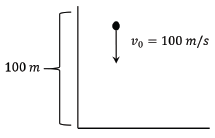
Part a)
I choose downward direction to be positive. So, any vector pointing downward is positive and any vector pointing upward is negative. (Alternatively you can choose upward direction to be positive. As long as you remain consistent, you should get the same answer at the end)
Use the full distance, 100 meters.
Part b)
When acceleration is constant, the average velocity can be determined simply by averaging the initial and final velocities:
Note: we are defining the downward direction as positive, so we leave all answers as positive. If you picked the frame of reference pointing upward, your answers would need to be answered as negative. (If instead we asked for SPEED instead of velocity, then you would enter all positive values because speed is a scalar.)
Part c)
Use half of the distance (50 meters).
A boy decided to estimate the height of a two-storey building by throwing a stone up and measuring the time it takes for the stone to reach the top of the building. Assume he throws the stone from 1 meter above the ground, such that the stone stops and turns back just when it reached the top of the building.
If the stone takes 2s to reach the top of the building, what is the initial velocity of the stone? (Pick upward direction to be positive)