Wize University Physics Textbook (Master) > Motion in 1/2/3D: Kinematics
One-Dimensional Kinematic Equations
Popular Courses
MCAT
General Course
Intro to Physics
University Study Guides
PHYSICS 1D03
McMaster University
AP Physics C: Mechanics Exam Prep Course
AP Exam Prep
Physics
General Course
PHYS 115
Queen's University
PCS 211
Toronto Metropolitan University
PHYS 204
Concordia University
PHYS*1300
University of Guelph
Intro to Physics
University Study Guides
PHYS*1080
University of Guelph
PHY 1321
University of Ottawa
PHYS 131
McGill University
APSC 111
Queen's University
PCS 120
Toronto Metropolitan University
LE/PHYS 1800 3.00
York University
PHY131H1
University of Toronto
PHY 1331
University of Ottawa
PHYS 142
McGill University
PHYS 117
University of British Columbia
0:00 / 0:00
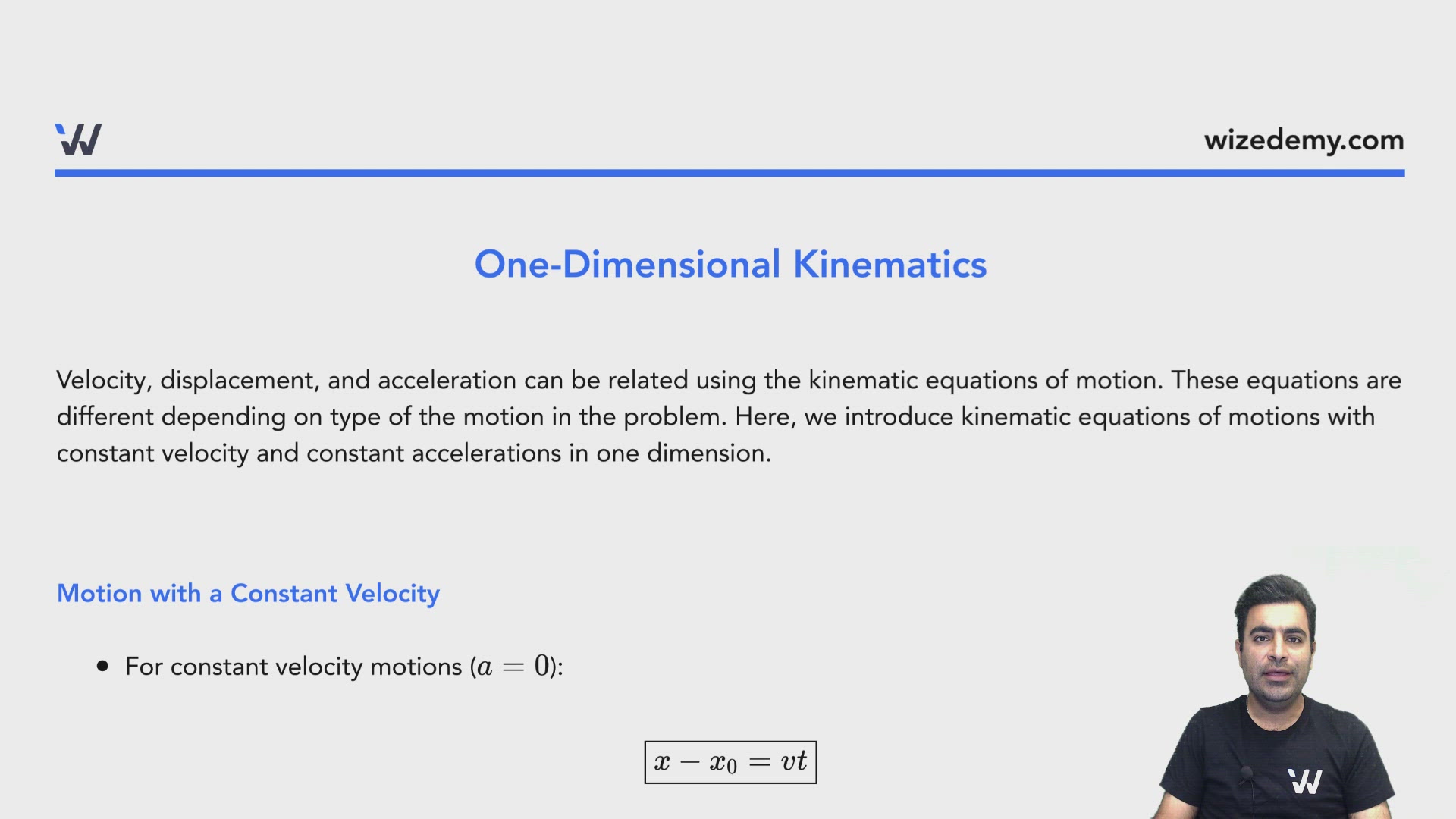
One-Dimensional Kinematics
Velocity, displacement, and acceleration can be related using the kinematic equations of motion. These equations are different depending on type of the motion in the problem. Here, we introduce kinematic equations of motions with constant velocity and constant accelerations in one dimension.
Motion with a Constant Velocity
- For constant velocity motions ():
Motion with a Constant Acceleration
- For constant acceleration motions, there are three useful formulas:
- When solving a problem, we can use any of the above equations depending on the information given and asked for in the problem.
Wize Tip
- Kinematic equation can be used when acceleration is constant i.e a does not change with particle motion.
- In order to find the right equation to use, look for the missing variable.
Watch Out!
It is crucial to pick an appropriate sign for each of the variables in above equations since they are all vectors!
Steps to Take to Solve Any Kinematics Problem:
- Draw and label a diagram.
- Define the coordinate system (doesn't matter what you choose, as long as you are consistent).
- Identify the known values with units.
- Pick the right equation. Notice how if you know any 3 of , you can entirely solve the question!
- Solve for the quantity you want. Write down all your steps!
- Think about the final answer you got. Do the signs and value make physical sense?
0:00 / 0:00
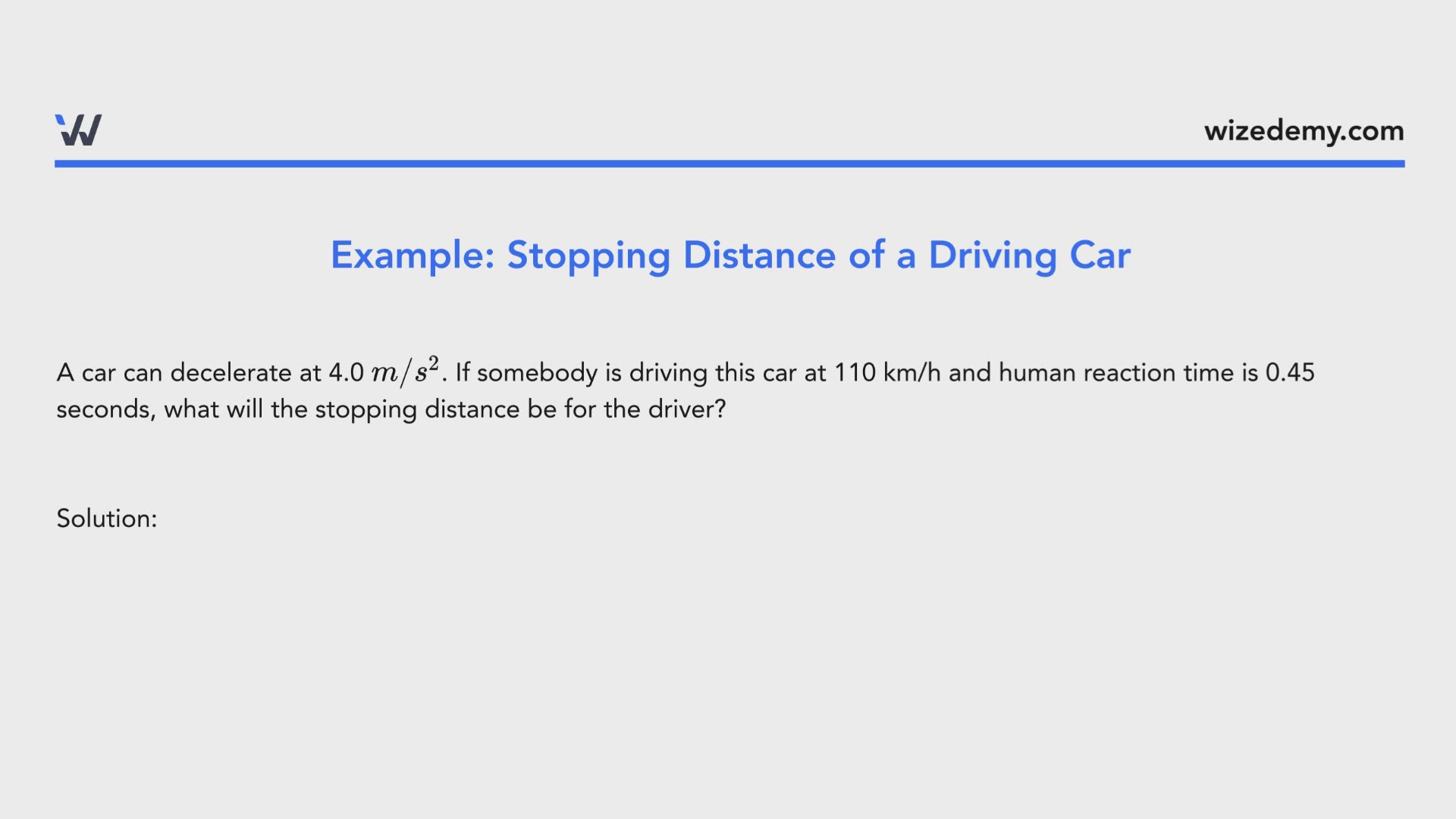
Example: Stopping Distance of a Driving Car
A car can decelerate at 4.0 . If somebody is driving this car at 110 km/h and human reaction time is 0.45 seconds, what will the stopping distance be for the driver?
Solution:
First, let's convert the speed: 110 km/h = 30.6 m/s.
There are two parts to the motion: first, we continue for 0.45 seconds at the current speed. Then, we continue to move forward while decelerating.
First part: constant speed, time is known, we want distance.
Second part: the acceleration is in the opposite direction of the velocity, so it needs to be negative. We know the final speed, initial speed, and acceleration, but not time. We want distance.
We add these two distance together now:
A vehicle travelling 130 km/h passes a police car at rest. As soon as the vehicle passes the police car, the police car turns its lights on and begins to accelerate to its maximum speed of 140 km/h.
If the police car accelerates at a constant acceleration for 12 seconds, how far will it have traveled before reaching its maximum speed?