Wize University Physics Textbook (Master) > Newton's Laws of Motion: Forces and Dynamics
Newton's Laws of Motion
Popular Courses
MCAT
General Course
Intro to Physics
University Study Guides
PHYSICS 1D03
McMaster University
AP Physics C: Mechanics Exam Prep Course
AP Exam Prep
Physics
General Course
PHYS 115
Queen's University
PCS 211
Toronto Metropolitan University
PHYS 204
Concordia University
PHYS*1300
University of Guelph
Intro to Physics
University Study Guides
PHYS*1080
University of Guelph
PHY 1321
University of Ottawa
PHYS 131
McGill University
APSC 111
Queen's University
PHYS 111
University of Waterloo
PCS 120
Toronto Metropolitan University
PHYS 110
University of Victoria
LE/PHYS 1800 3.00
York University
PHYS-1400
University of Windsor
PHY131H1
University of Toronto

0:00 / 0:00
Newton's Laws of Motion
Dynamics helps us to identify forces acting on an object and calculate the acceleration caused by those forces. It focuses on the application of Newton's Laws and the creation of Free Body Diagrams.
Newton's First Law
- A system in equilibrium will maintain its velocity as long as no net force acts upon it.
- This is also known as the law of inertia. Inertia is the property of matter to resist changes in motion.
- For two dimensional problems, net force should be zero in each dimension separately.
Watch Out!
A system can be moving (even at high velocity) and still have no net force.
Newton's Second Law
- The net force on an object is equivalent to the net acceleration applied to an object multiplied by the mass. Or conversely, the net acceleration of an object is equal to the net force divided by its mass.
- This law is used for systems that are not in static equilibrium.
Wize Tip
If you ever forget the unit formula for a Newton, think back to this law. Since it is a physical law, it must be dimensionally consistent. If force equals mass times acceleration, the unit of force must be a unit of mass times a unit of acceleration; that is: .
Newton's Third Law
- Whenever an object exerts a force on a second object, the second object exerts an equal and opposite force on the first.
- This law allows us to determine the forces that exist between coupled (joined) objects and relate normal forces between objects. The colloquial version of this law is: for every action there is an equal and opposite reaction.
- The forces are commonly referred to as an action-reaction pair.
Watch Out!
Newton's 3rd law forces always act on DIFFERENT bodies. Object's cannot exert force on itself!
1. An object with a mass of is moving on a horizontal surface with a coefficient of kinetic friction equal to . If at the speed of the object is ,
a) How long later is the object going to stop?
b) What is the distance travelled by the object before it is stopped.
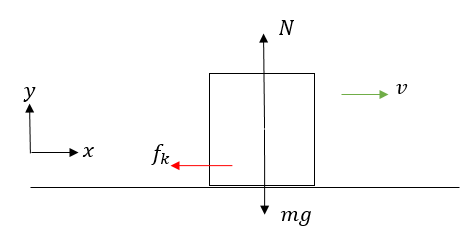
a) ,
b)
2. A mass of is stationary on the surface of an inclined surface with angle of and coefficient of kinetic friction of and coefficient of static friction of . You start increasing the angle of the inclines surface.
a) At what angle the mass starts to slide down?
b) If you set the system at an angle which is 5 degrees more than the angle you found in part a), how long later is the speed of the mass equal to ?
a) When driving force exceeds the max of static friction, the mass start to slide down!
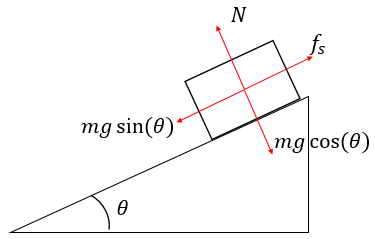
b)
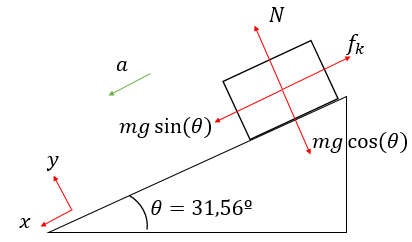
From (eq. 1) & (eq. 2):
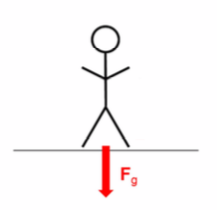
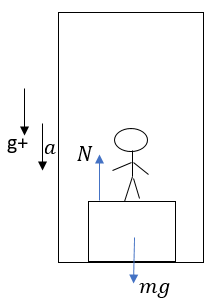
3. A person with a mass is standing on a scale in an elevator which moving upward.
a) What is the reading on the scale when the elevator moves upward with a constant velocity of ?
b) The elevator is going to stop with an acceleration of . What is new reading on the scale?
a)
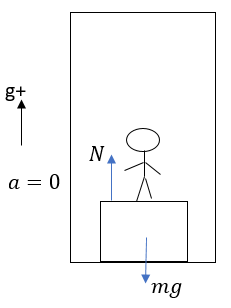
Reading on scale
b)
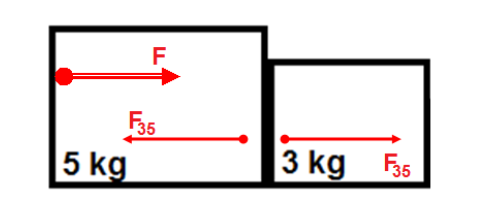
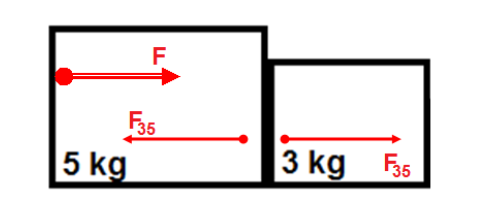
Two blocks with masses of 5 and 3 kg are lined up in a row on a frictionless flat air track. A horizontal push force of 16 N is applied to the 5-kg block which pushes it against the 3-kg block. How much is the interacting force between blocks (How much is the push force of the 5-kg block on the 3-kg block)?

Mark Yourself Question
- Grab a piece of paper and try this problem yourself.
- When you're done, check the "I have answered this question" box below.
- View the solution and report whether you got it right or wrong.
Three books are sitting at rest on a table.
a) Draw a sketch.
b) Draw a complete free-body diagram for each book.
c) Identify the forces that are paired by Newton's 3rd law. Also, identify the forces that are paired by Newton's 2nd law.
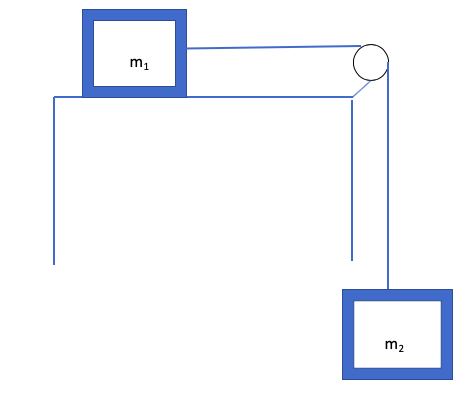
Two blocks of mass and linked by a string through a pulley, where the block of mass m1 slides on the frictionless table. We assume that the string is massless and the pulley is massless and frictionless
a) Find the magnitude of the acceleration of the two masses
b) Find the tension in the string