Popular Courses
MCAT
General Course
Intro to Physics
University Study Guides
PHYSICS 1D03
McMaster University
AP Physics C: Mechanics Exam Prep Course
AP Exam Prep
Physics
General Course
PHYS 115
Queen's University
PHYS 101
McGill University
PCS 211
Toronto Metropolitan University
PHYS 204
Concordia University
Intro to Physics
University Study Guides
PHYS*1300
University of Guelph
PHYS*1080
University of Guelph
PHYS 124
University of Alberta
PHY 1321
University of Ottawa
PHYS 131
McGill University
APSC 111
Queen's University
PCS 120
Toronto Metropolitan University
PHYS 110
University of Victoria
LE/PHYS 1800 3.00
York University
PHY131H1
University of Toronto

0:00 / 0:00
Gravitational Force
When we talk about gravity, we always talk about it as a force that comes from the Earth equal to your mass multiplied by "g". But this is actually a specific case of a more general law: Newton's Law of Universal Gravity.
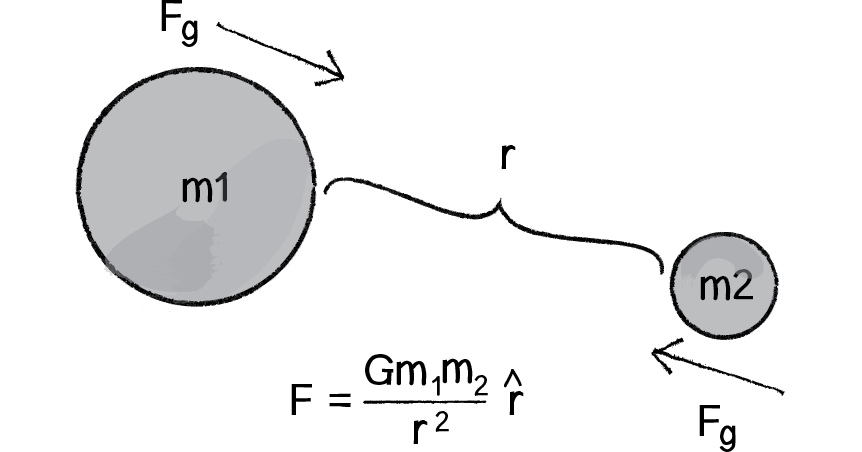
Gravity is an attractive force between every pair of massive object. The full form of Newtonian gravity is
- where G is the Gravitational constant
- r is the distance between the centres of mass of the two objects
- This is an example of an Inverse Square Law: The force is inversely proportional to the square of the distance between objects
- If we used Newton's second law, we can get a general form for the gravitational acceleration from some mass M.
Several notes
- This is a force, which is a vector. By Newton's third law, the forces on the two objects must have equal magnitudes but opposite directions. For example, the Earth is pulling down us as much as we are pulling up on it (same force)! But because of how big Earth is, that force doesn't accelerate it at all.
- Look at how ridiculously small G is. That's why for everyday objects, the gravitational force is negligible.
Watch Out!
It's very common for students to just use the radius of the planets/stars for r. This is wrong! Do not do that. The radius here is the distance between centres of masses (m1 and m2).
0:00 / 0:00
The Special Case of Earth
Let's look at the special case, right on the surface of the Earth.
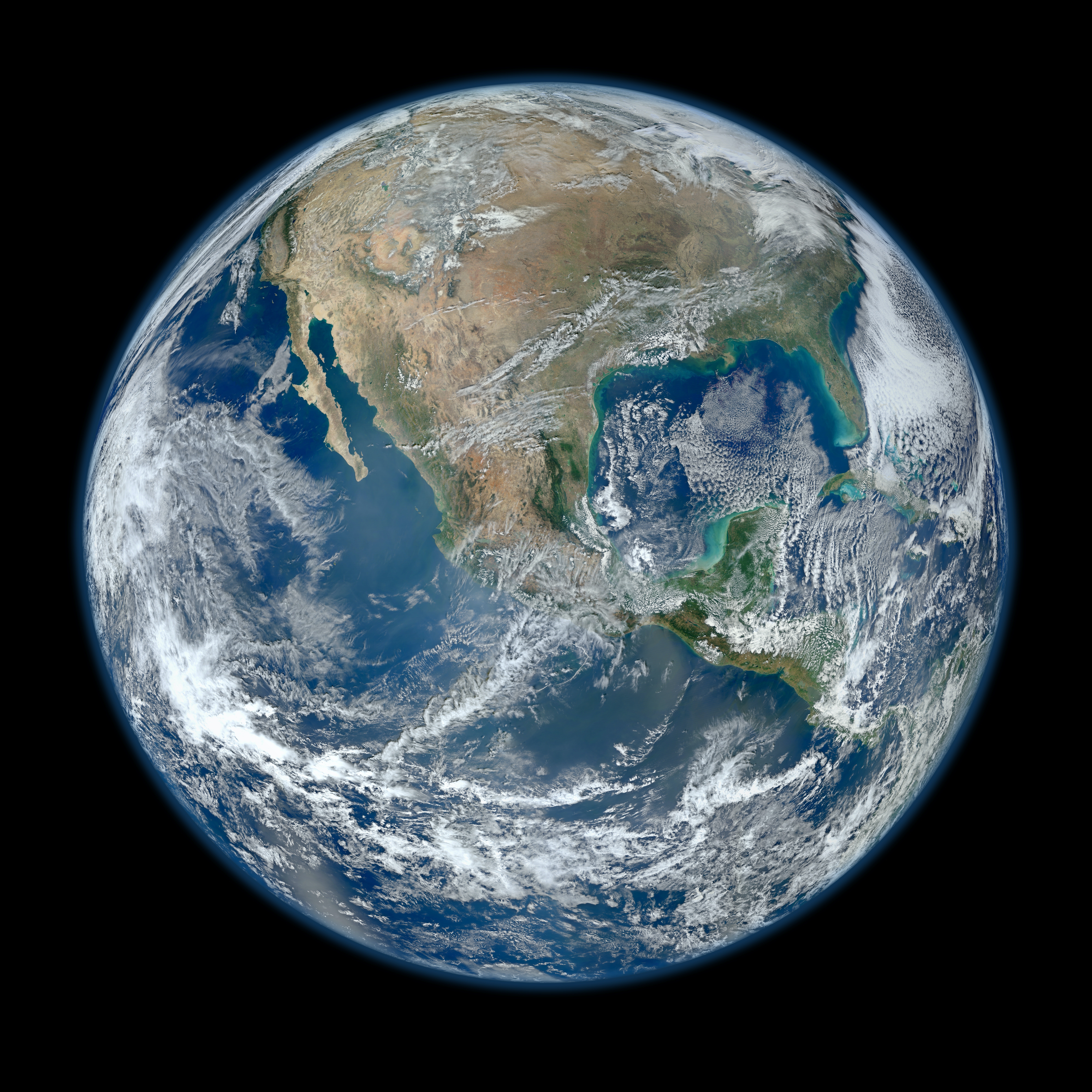
We need the radius () and the mass of the Earth ( ). Let's say you are mass , then the force on you is
Good thing the dimensions all work out here! Newton divided by kilogram is just an acceleration (m/s2). We have recovered .
Wize Tip
In general, you can always use this general form for gravitational force/acceleration. But if you are "close enough" to the surface, just use the constant "g". It's usually obvious when you need to use the general form, but I would say 9.81m/s2 is good up to about 10,000 m above the surface.
0:00 / 0:00
Example: Losing Weight at High Altitudes!
The Earth has mass 5.927 x 1024 kg and radius 6371 km. How far above the Surface of the Earth would a 50 kg person have to go in order for his weight to be 15 % less than it is at the surface?
Solution:
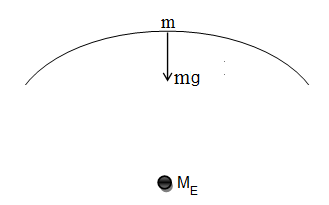
Let's find the weight (Force of gravity) right on the surface and at some new distance from the center of earth
Based on the question stem information, weight at the new position should be 15 percent less than the weight on the surface of earth. So, it should be 85 percent of the weight on the surface of earth:
Now we can find the height respect to the Earth surface by subtracting what we found by the radius of Earth:
Three identical point masses, each of 3.41 kg are located at the corners of an equilateral triangle of side length 1.5 m. What is the net force on one of the masses?