Wize University Physics Textbook (Master) > Circular Motion
Uniform Circular Motion
Popular Courses
PHYSICS 1201A/B
Western University
Intro to Physics
University Study Guides
PHYSICS 1D03
McMaster University
AP Physics C: Mechanics Exam Prep Course
AP Exam Prep
Physics
General Course
PHYS 115
Queen's University
PHYSICS 1401A/B
Western University
PHYS 101
McGill University
PCS 211
Toronto Metropolitan University
PHYS 204
Concordia University
PHYS*1300
University of Guelph
Intro to Physics
University Study Guides
PHYS*1080
University of Guelph
PHY 1321
University of Ottawa
PHYS 131
McGill University
APSC 111
Queen's University
PHYS 102A
University of Victoria
PHYS 111
University of Waterloo
PCS 120
Toronto Metropolitan University
LE/PHYS 1800 3.00
York University

0:00 / 0:00
Uniform Circular Motion
When an object moves uniformly around a circle, speed of the object remains constant but velocity changes. This is called uniform circular motion (UCM).

Examples of uniform circular motion:
- A vehicle moving around a circular track
- Amusement park rides, ferris wheel, merry-go-round
- The moon, or satellites orbiting the Earth in a circular orbit
- Any object moving in a circle with constant speed!
Wize Tip
We can model any motion that travels along a circular path at a constant speed with UCM. It does not have to travel the complete circle.
Watch Out!
The object is moving at constant speed (magnitude of velocity), but the object has a changing velocity (the direction constantly changes).
- Velocity vector is always tangent to the path of the motion. So, for a circular motion, it is tangent to the circle.
- The change in velocity is caused by an acceleration which is pointing into the centre of the circle and it is known as centripetal acceleration:
- Centripetal acceleration is perpendicular to velocity vector at any point

0:00 / 0:00
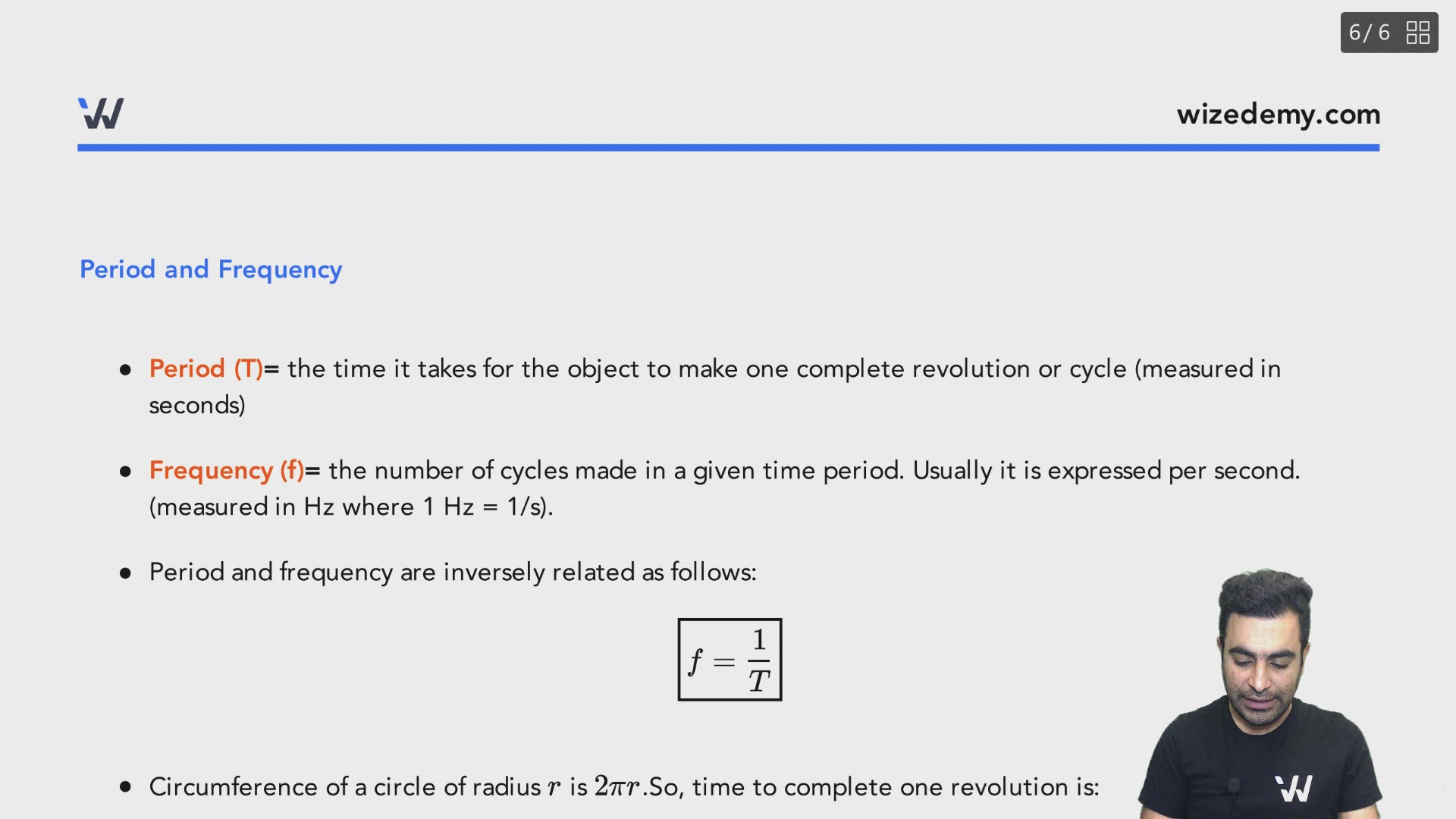
Period and Frequency
- Period (T)= the time it takes for the object to make one complete revolution or cycle (measured in seconds)
- Frequency (f)= the number of cycles made in a given time period. Usually it is expressed per second. (measured in Hz where 1 Hz = 1/s).
- Period and frequency are inversely related as follows:
- Circumference of a circle of radius is .So, time to complete one revolution is:
- Angular velocity is defined as the rate at which angles are changing in a circular motion and it could be found as:
0:00 / 0:00
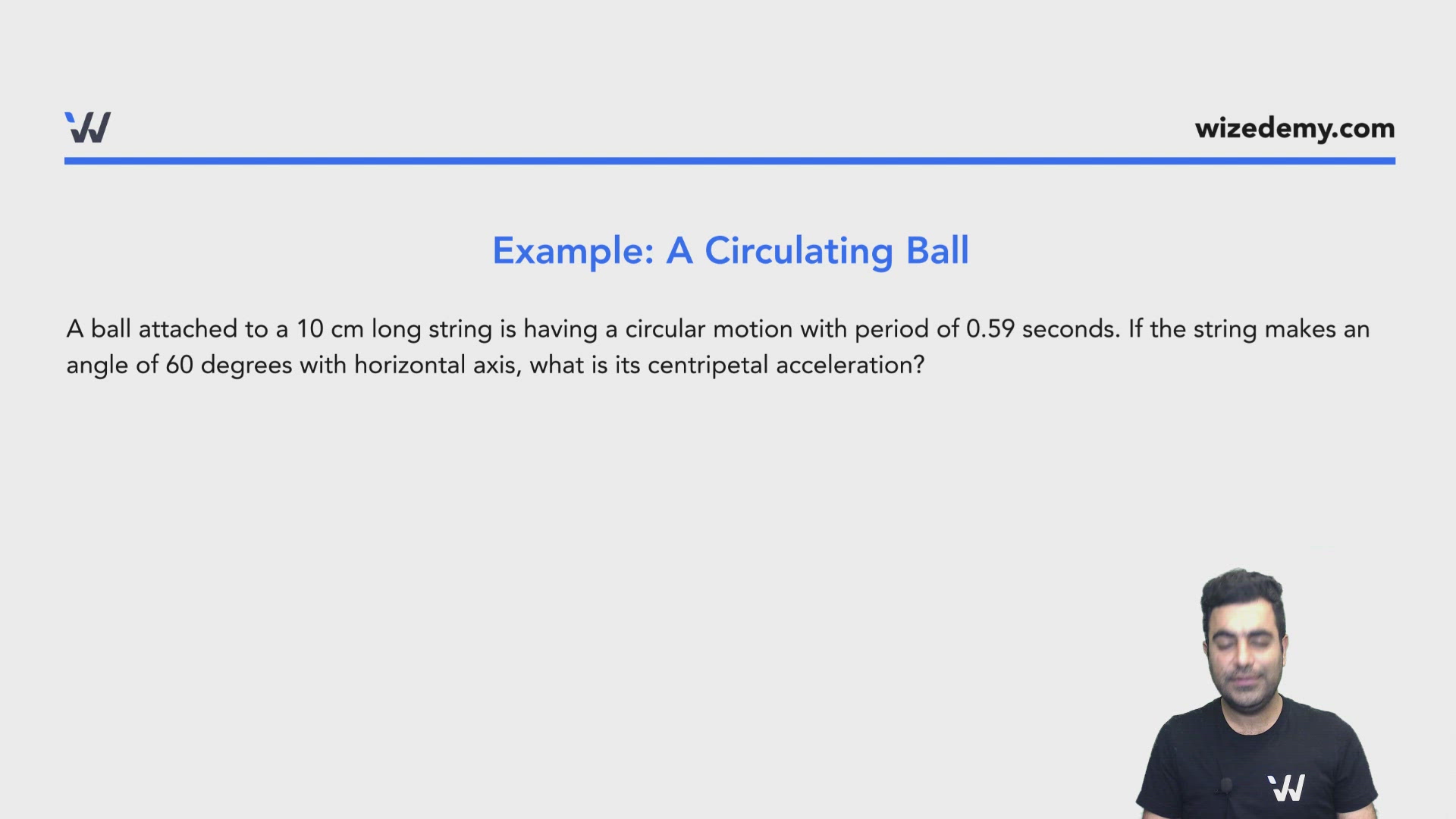
Example: A Circulating Ball
A ball attached to a 10 cm long string is having a circular motion with period of 0.59 seconds. If the string makes an angle of 60 degrees with horizontal axis, what is its centripetal acceleration?
Solution:
Note that the radius of circular path in which the ball is moving is different from the length of the string. However, we can find this radius by a little bit of trigonometry knowing the angle the string makes with the horizontal direction.
As length of string is 10 cm, the radius of circular motion is:
Now we can use the period and the radius of this motion to find the speed of the ball:
Period is 2s, hence:
Acceleration is then:
A 1000kg car rounds a circular track with radius 10m. If what is the maximum speed the car can travel?
A 1.6kg ball is attached to a 1.8m string and is swinging in circular motion horizontally at the string's full length. If the string can withstand a tension force of 87N, what is the maximum speed the ball can travel without the string breaking?