Popular Courses
MCAT
General Course
Intro to Physics
University Study Guides
PHYSICS 1D03
McMaster University
AP Physics C: Mechanics Exam Prep Course
AP Exam Prep
Physics
General Course
PHYS 115
Queen's University
PHYS 211
University of Calgary
PCS 211
Toronto Metropolitan University
PHYS 204
Concordia University
Intro to Physics
University Study Guides
PHYS*1300
University of Guelph
PHYS*1080
University of Guelph
PHY 1321
University of Ottawa
PHYS 131
McGill University
APSC 111
Queen's University
PHYS 111
University of Waterloo
PHYS 110
University of Victoria
LE/PHYS 1800 3.00
York University
PHYS-1400
University of Windsor
PHY131H1
University of Toronto
0:00 / 0:00
Friction
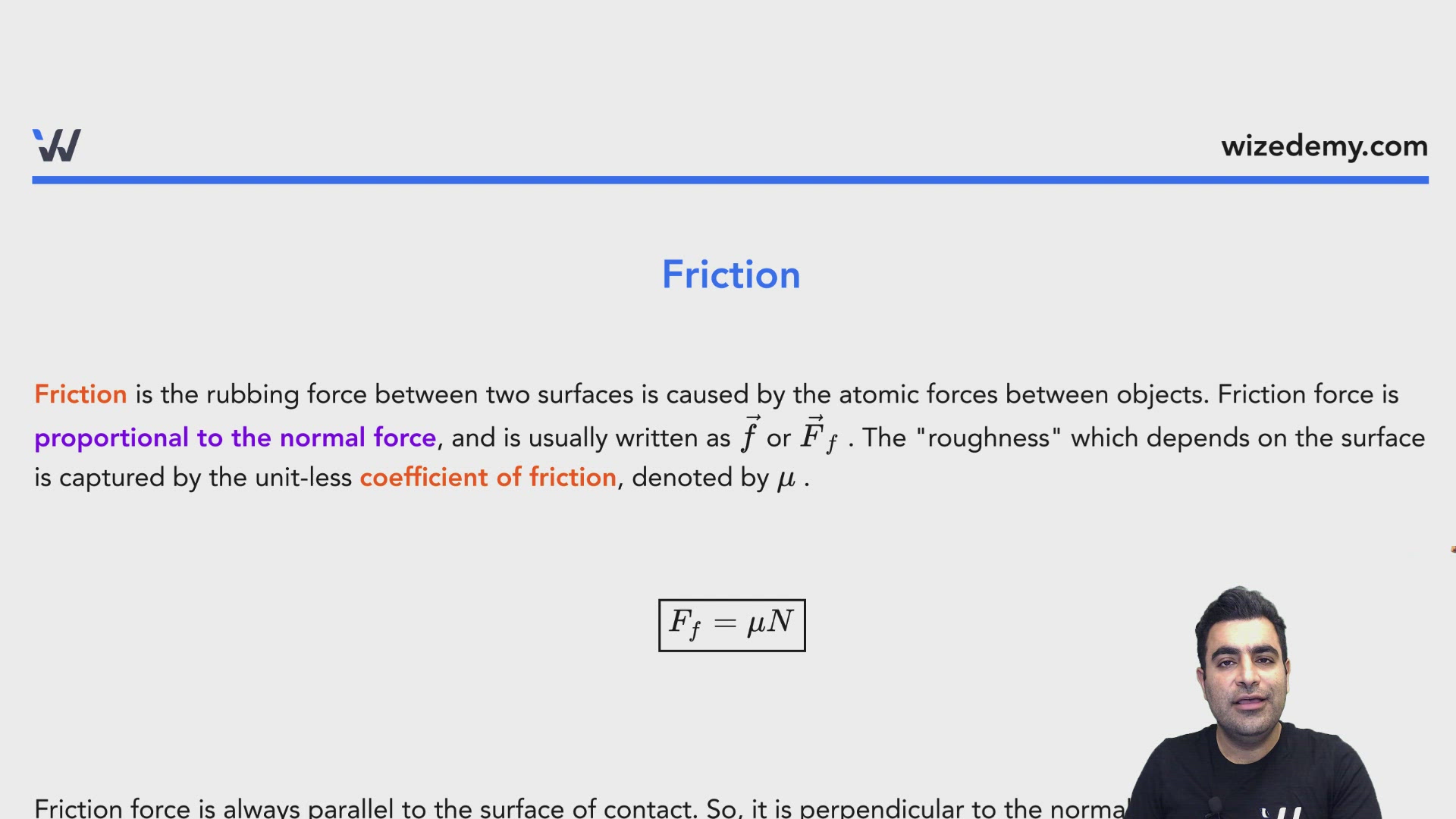
Friction is the rubbing force between two surfaces is caused by the atomic forces between objects. Friction force is proportional to the normal force, and is usually written as or . The "roughness" which depends on the surface is captured by the unit-less coefficient of friction, denoted by .
Friction force is always parallel to the surface of contact. So, it is perpendicular to the normal force acting on that surface.
Static Friction
- Static friction is the frictional force when the objects are not moving relative to each other. It is a force that opposes any applied force that tries to move the object from rest.
- The maximum static friction is proportional to the normal force and has the following equation:
- is the coefficient of static friction and it is unit-less
- The actual value of the static friction can be anything up to this value, depending on how strong the applied force is:
- If you increase the force applied to the mass a little beyond the maximum of static friction, the mass starts to move, and the friction force decreases instantly when the body begins to move. This point is known as threshold of motion or verge of motion.

Watch Out!
A common mistake students make is that they always put static friction equal to . But this is ONLY true when the object is about to move or slide. So, make sure you read the question carefully!
Kinetic Friction
- Kinetic friction is the frictional force when the objects are in motion relative to each other. It is a force that opposes this motion.
- The magnitude of this force is obtained through:
- where is the coefficient of kinetic friction and it is unit-less
- is less than , so,
Wize Concept
You always need more force to start an object moving than when it's already moving.
0:00 / 0:00
Rolling Friction
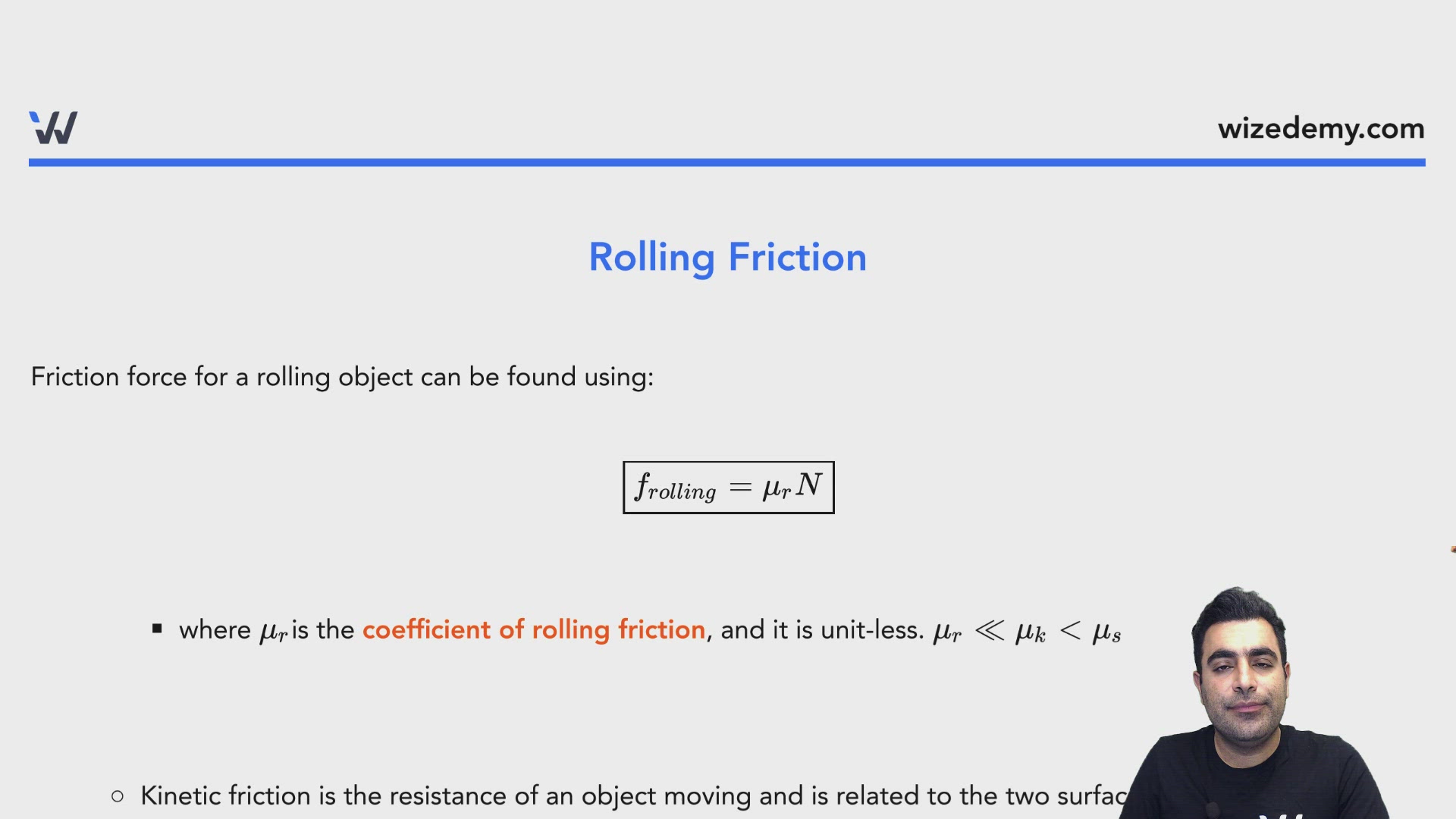
Friction force for a rolling object can be found using:
- where is the coefficient of rolling friction, and it is unit-less.
- Kinetic friction is the resistance of an object to move and is related to the two surfaces.
- Rolling friction is the resistance of an object to roll and is related to deformation.
0:00 / 0:00
Example: Motion of an Object on a Rough Surface
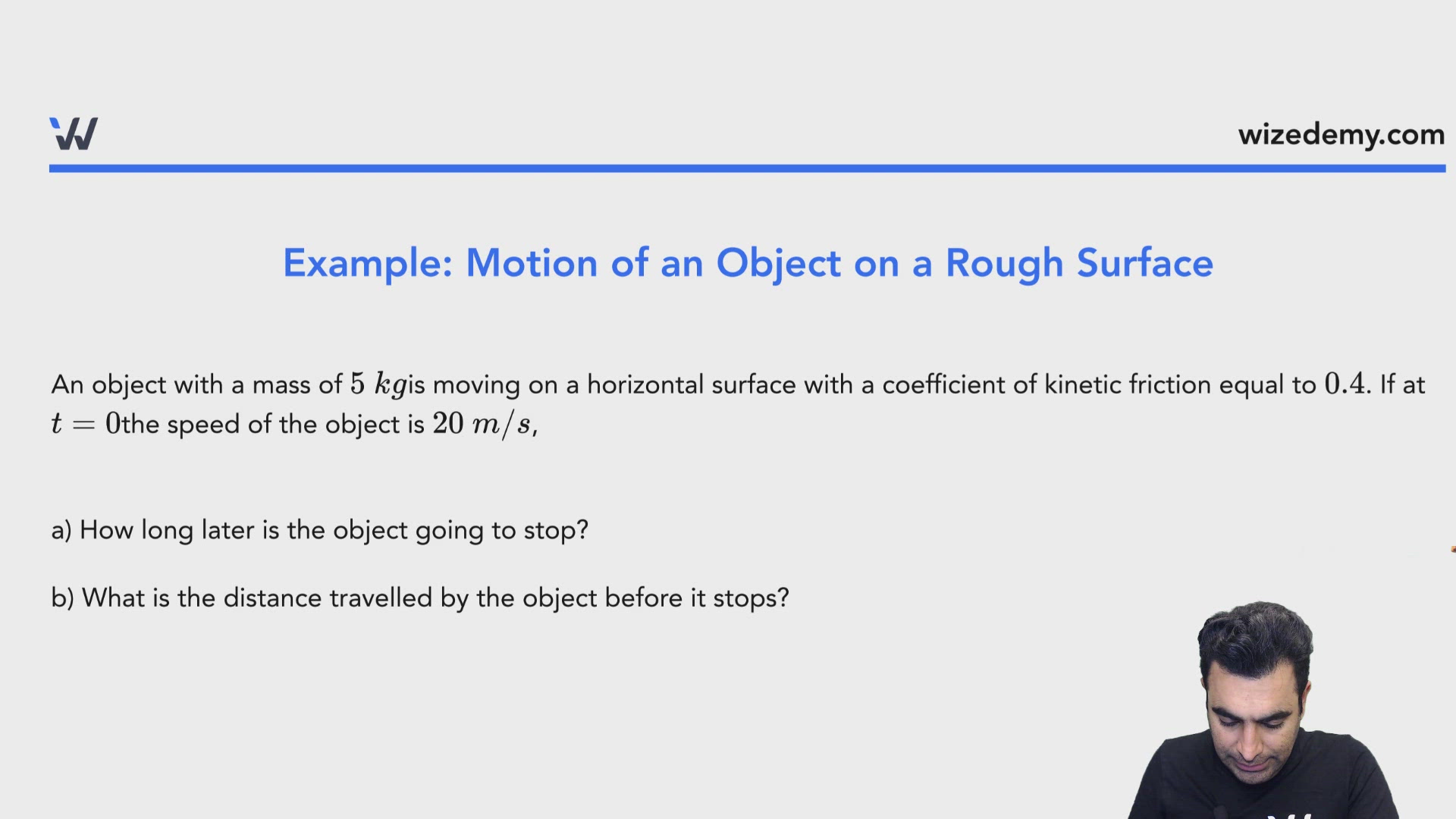
An object with a mass of is moving on a horizontal surface with a coefficient of kinetic friction equal to . If at the speed of the object is ,
a) How long later is the object going to stop?
b) What is the distance travelled by the object before it stops?
Solution:
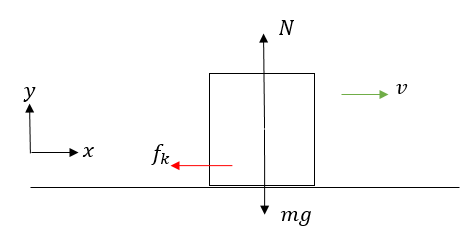
First. let's look at the free body diagram of the object:
Part a)
,
acceleration can be found by looking at the second law of Newton:. Note that since the object is moving we are talking about kinetic friction.
Now we can use kinematic equations to find the time of this motion:
Part b)
Again using kinematic equations we have:
A 10-kg box is initially at rest on a flat surface. A horizontal force of 28 Newtons is applied on it. The static and kinetic coefficient of friction between the box and the floor are 0.32 and 0.18 respectively. What is the magnitude of the friction force?