Popular Courses
Intro to Physics
University Study Guides
PHYSICS 1D03
McMaster University
AP Physics C: Mechanics Exam Prep Course
AP Exam Prep
Physics
General Course
PHYS 115
Queen's University
PHYS 101
McGill University
PCS 211
Toronto Metropolitan University
PHYS*1300
University of Guelph
Intro to Physics
University Study Guides
PHY 1321
University of Ottawa
PHYS 131
McGill University
APSC 111
Queen's University
PHYS 111
University of Waterloo
PCS 120
Toronto Metropolitan University
LE/PHYS 1800 3.00
York University
PHYS-1400
University of Windsor
PHY131H1
University of Toronto
PHY 1331
University of Ottawa
PHYS 142
McGill University
PHYS 117
University of British Columbia

0:00 / 0:00
Car Turning Around a Circular Section of Road
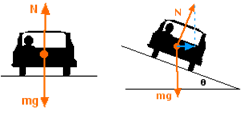
- If the road is flat, then the centripetal force is equal to the force of friction on the car.
- If there is no friction, there is no force that can supply the centripetal force required to make the car move in a circular path - there is no way that the car can turn!
- If the road is banked, the horizontal component of the normal force provides the centripetal force.
Wize Concept
If a car is turning around a curve without friction, then the curve must be banked at some angle (in radians) in order for the car to not slide out of the turn.
0:00 / 0:00
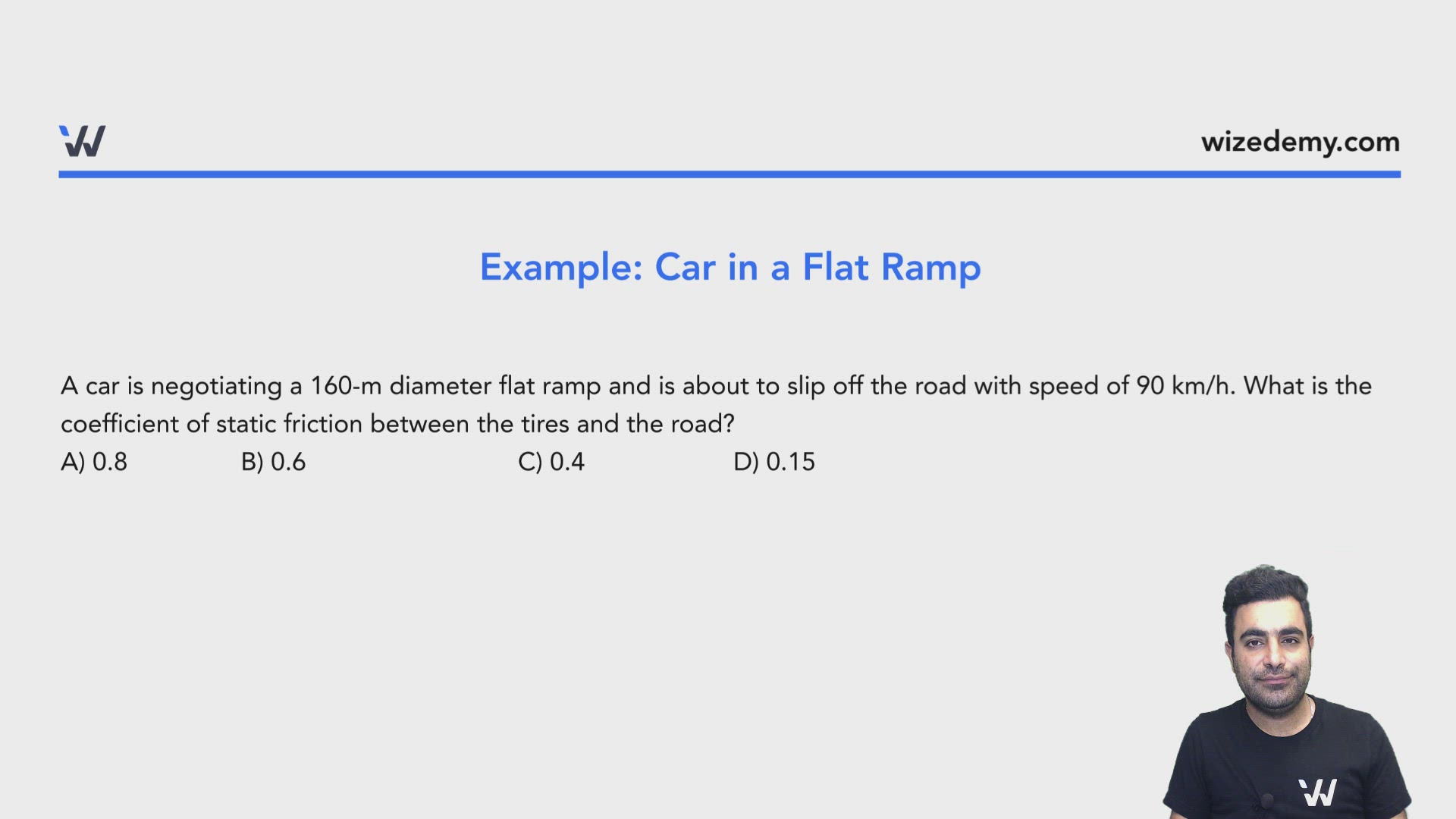
Example: Car in a Flat Ramp
A car is negotiating a m diameter flat ramp and is about to slip off the road with speed of km/h. What is the coefficient of static friction between the tires and the road?
A) B) C) D)
First, let's convert the speed:
The only force toward the centre of this circular path is the static friction between tires and the road.
Since the car is about to slip off, it means that we are talking about the maximum static friction (the car is on the verge of sliding).
So, the centripetal force is equal to maximum static friction:
Horizontal direction:
Vertical direction: since there is no motion along this direction
Combining the equations we get:
A racing car is moving on a circular banked track with radius of m at a constant speed. The driver feels a normal force percent heavier than his true weight. What are the angle of the bank and the speed of the racing car?