Wize University Physics Textbook (Master) > Geometric Optics
Lenses Equation
Popular Courses
MCAT
General Course
PHYSICS 1201A/B
Western University
Grade 12 Physics
Canada High School
Physics 30
Alberta High School
PHY 1122
University of Ottawa
PHYS 142
McGill University
ENGG 212
University of Calgary
PHY132H1
University of Toronto
PHY132H1
University of Toronto
PHYS 102B
University of Victoria
PHYS 111
University of Victoria
PHYS-1300
University of Windsor
PHY 1121
University of Ottawa
PHYS 121
University of Waterloo
PHYSICS 1102A/B
Western University
PHYS 206
Concordia University
PHYS 227
University of Calgary
SC/PHYS 2020 3.00
York University
PHYS 116
Queen's University
PHY 9B
University of California - Davis

0:00 / 0:00
Lenses Equation
The distance of the image in relation to the object is described by the mirrors & lenses equation:
- is the distance between the object and the lens
- is the distance between the image and the lens
- is the focal length of the lens
The magnification of the lens is given by:
- is the magnification
- is the height of the object
- is the height of the image
Note: you might see different notations for the distances ( and , and , and ).
Wize Concept
- is positive for convex lenses, and negative for concave lenses
- and are always positive
- is positive if the image is on the other side of the lens, and negative if it's on the same side
- is positive if the image is upright, and negative if inverted
- is positive if the image is upright, and negative if inverted
- real images are inverted, virtual images are upright
Exam Tip
Using these equations we can answer the following questions:
- Where is the image?
- Is it real or virtual?
- Is it upright or inverted?
- How big is the image (relative to the object)?
0:00 / 0:00
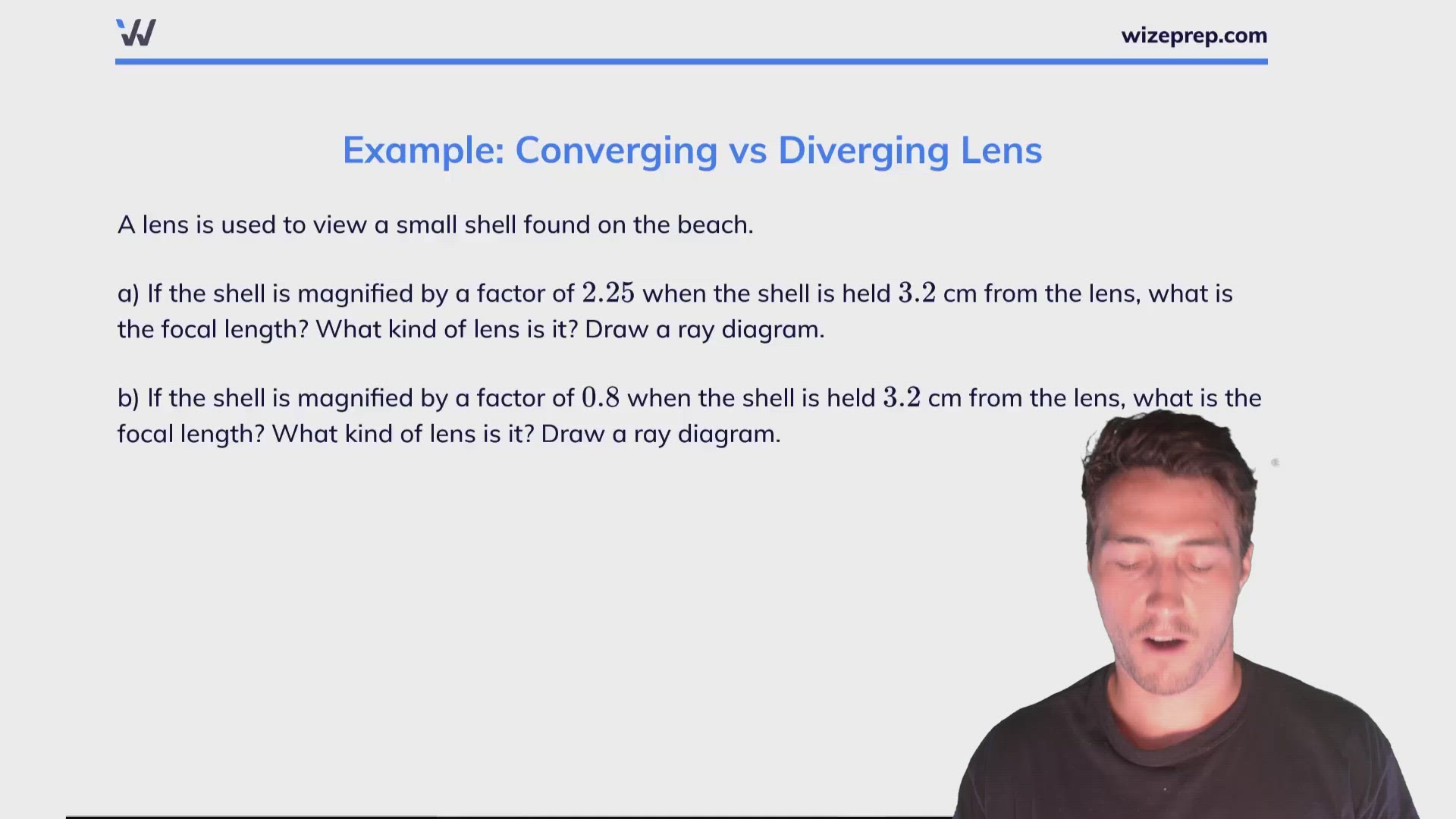
Example: Converging vs Diverging Lens
A lens is used to view a small shell found on the beach.
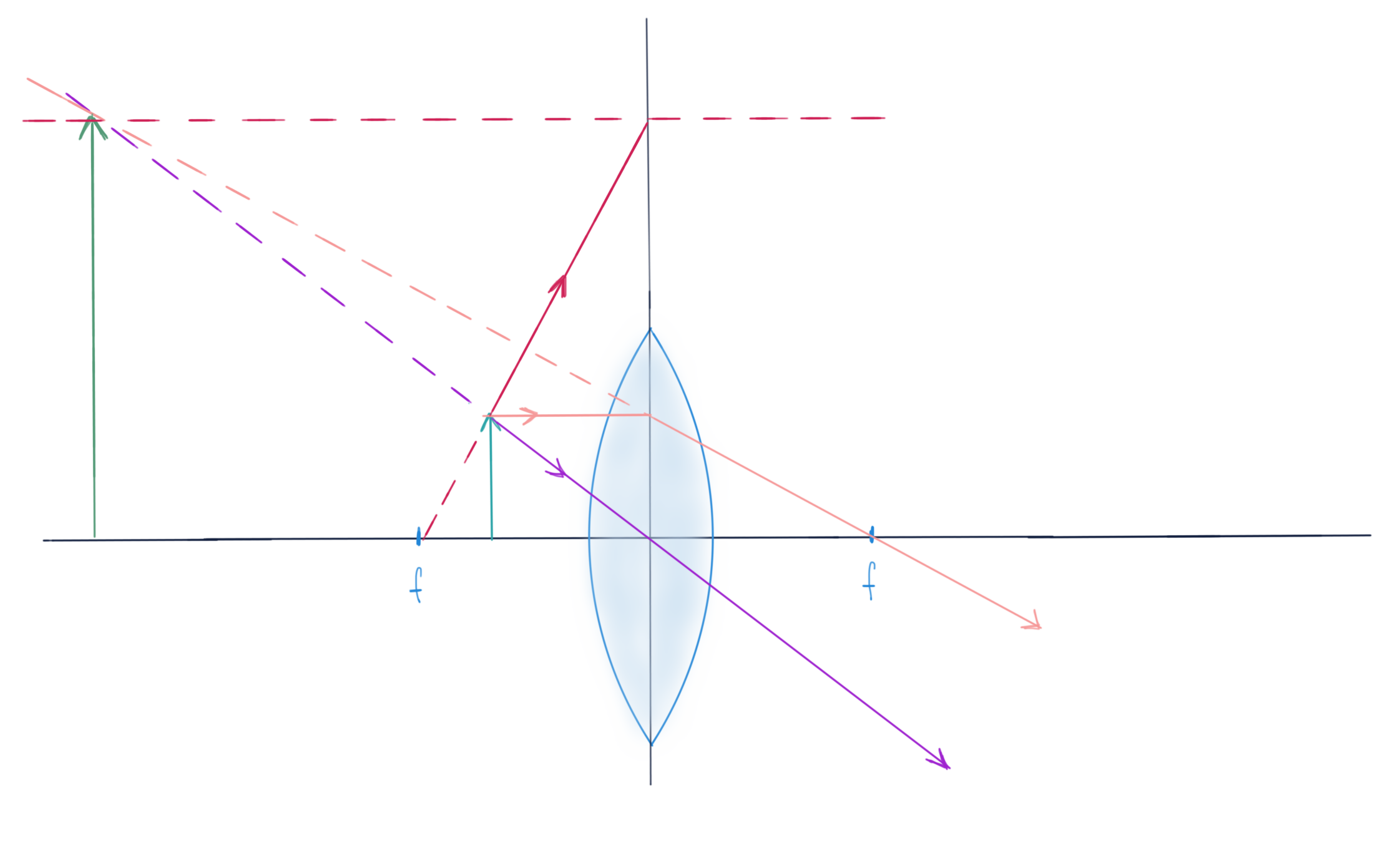
a) If the shell is magnified by a factor of when the shell is held cm from the lens, what is the focal length? What kind of lens is it? Draw a ray diagram.
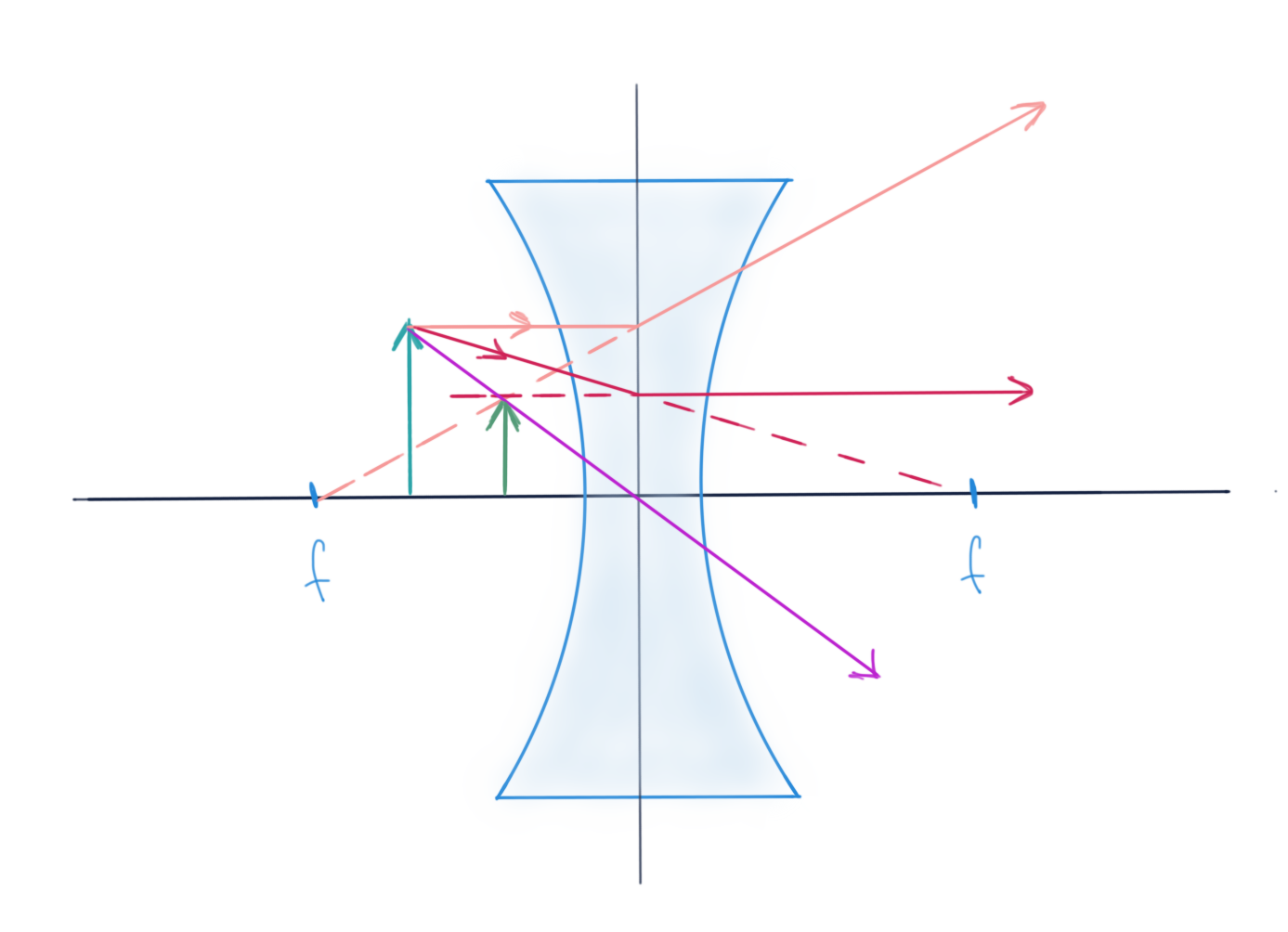
b) If the shell is magnified by a factor of when the shell is held cm from the lens, what is the focal length? What kind of lens is it? Draw a ray diagram.
Part a)
Let's use the magnification equation to get the image distance:
Putting this into the lens equation we get:
Using and we get:
Taking the reciprocal of both sides, the focal length is:
(cm)
Since the focal length is positive, the lens is a convex (converging) lens.
Part b)
Using the same equation as before but with and we get:
Taking the reciprocal of both sides, the focal length is:
(cm)
Since the focal length is negative, the lens is a concave (diverging) lens.
An object is placed cm in front of a converging lens of focal length cm. A second converging lens of the same focal length is placed cm behind the first. Where is the final image located? What is the magnification of the final image? Draw a ray diagram illustrating the situation.
Location of final image: