Wize University Physics Textbook (Master) > Wave Optics
Double Slit Diffraction
Popular Courses
MCAT
General Course
PHYSICS 1201A/B
Western University
Intro to Physics
University Study Guides
Grade 12 Physics
Ontario High School
Physics
General Course
High School Physics
US High School
Grade 12 Physics
Canada High School
PHYSICS 1A03
McMaster University
PHYS 130
University of Alberta
PHYS 101
McGill University
PHYS 131
University of British Columbia
Intro to Physics
University Study Guides
Physics 30
Alberta High School
PHYS 124
University of Alberta
PHY 1122
University of Ottawa
PHYS 142
McGill University
ENGG 212
University of Calgary
PHYS 102B
University of Victoria
PHYS 111
University of Victoria
PHYS 1050
University of Manitoba
Double-Slit Interference
The principle of double-slit interference is similar to the interference of sound waves from two speakers.

Bright fringes on the screen correspond to constructive interference. The path difference is given by:
- is the distance between the two slits
- is the angle that the rays make with the horizontal
Wize Concept
The formula above is valid only when .
Dark fringes on the screen correspond to destructive interference. The path difference is given by:
An equivalent way of writing this would be:
Exam Tip
The zero order maximum occurs in the middle, so you begin labeling on either side of it the alternating bright and dark fringes, as increases.
Let's define the following quantities:
- is the distance on the screen between the point of interference and the central bright spot
- is the distance between the slits and the screen
Then we have a triangle in which:
Wize Tip
When we can use the small angle approximation:
Example: Number of Fringes
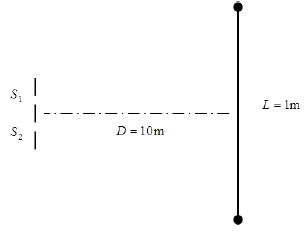
A double-slit configuration is shown below, with mm. Light with a wavelength of nm is used.
a) How many (bright) fringes are displayed on the screen?
b) How many (bright) fringes would be displayed on the screen if we double its length (m)?
c) What if the length of the screen is unlimited?
Part a)
For bright fringes we have constructive interference, so we use:
Since we can use the small angle approximation: to get:
The maximum distance on the screen is half the length of the screen, so we'll use to find the maximum that can be:
But this means we have fringes on either side, and we also have to add the central bright fringe (corresponding to ), so we have a total of:
bright fringes
Part b)
If the length of the screen doubles, the doubles, and the we solved for also doubles (because they are directly proportional in the equation), so we get .
Again, we have bright fringes on either side, and if we also count the central bright fringe, the total is:
bright fringes
Part c)
When the length of the screen is infinite, we could have a maximum angle of , and . Therefore our equation becomes:
And we get:
We have bright fringes on either side, so the total is:
bright fringes
Practice: Argon Laser
A two-slit diffraction grating, with slits at distance of mm apart is illuminated by an Argon laser (wavelength nm).
a) What is the angle between the two second brightest points on a screen placed cm away from the slits? (i.e. between the first bright spot immediately above the central max, and the first bright spot immediately below the central max)
b) What is the corresponding distance between these two points?
c) What is the distance between the third and fourth brightest points on the screen?
Double-Slit Interference
Bright fringes on the screen correspond to constructive interference.
- is the distance between the two slits
- is the angle that the rays make with the horizontal
Dark fringes on the screen correspond to destructive interference. The path difference is given by:
Exam Tip
The zero order maximum occurs in the middle, so you begin labeling on either side of it the alternating bright and dark fringes, as increases.
Let's define the following quantities:
- is the distance on the screen between the point of interference and the central bright spot
- is the distance between the slits and the screen
Then we have a triangle in which:
Wize Tip
When we can use the small angle approximation:
A diffraction grating has multiple slits located the same distance apart. But same principle and same formulas work as of the double-slit.
If you're given number of lines per unit length () , the distance between each two slits could be found from:
Exam Tip
Just remember that and are reciprocals of each other.
Watch Out!
Often you're given the number of lines per or . This means the reciprocal will give you in those units as well, so you'll have to convert it to meters.