Popular Courses
PHYSICS 1201A/B
Western University
Intro to Physics
University Study Guides
Grade 12 Physics
Ontario High School
Physics
General Course
High School Physics
US High School
Grade 12 Physics
Canada High School
PHYS 101
McGill University
PHYS 131
University of British Columbia
Intro to Physics
University Study Guides
Physics 30
Alberta High School
PHY 1122
University of Ottawa
PHYS 142
McGill University
ENGG 212
University of Calgary
PHYS 102B
University of Victoria
PHYS 111
University of Victoria
PHYS 1050
University of Manitoba
PHYS 101
Simon Fraser University
PHYS-1300
University of Windsor
PHY 1121
University of Ottawa
PHYS 121
University of Waterloo
Thin Film Interference
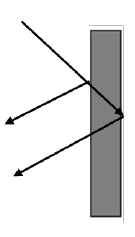
Imagine a lens made of glass is coated with a thin film. If we assume that the incident angle is very close to we can neglect refraction and look at the interference of two reflected waves as shown in the picture below.
Let's look at what happens when and .

The path difference comes from the different lengths traveled by the two rays. The thickness of the thin film is traveled by the second ray twice. Therefore we have and the phase difference is given by:
- is the path difference between the two interfering rays
- is the wave number of light in the thin film
- is the wavelength of light in the thin film
- is the thickness of the thin film
Wize Concept
You have to consider the potential phase shift of the reflected waves.
Let's look at the phase shifts that are happening for the two rays:
- When ray #1 reflects off the material into the material, there is no phase shift since we have a soft boundary condition.
- When ray #2 reflects off the material into the material, there is a phase shift since we have a hard boundary condition.
Therefore we have a net phase shift of and we need to swap the constructive / destructive equations once.
Constructive interference:
The phase shift is for . This can also be written as for (odd only).
Combining this with the equation at the top we get:
(odd only)
Destructive interference:
The phase shift is for .
Combining this with the equation at the top we get:
Watch Out!
In all these equations, the wavelength has to be in the thin film, so it will be .
Example: Oil Film on Water
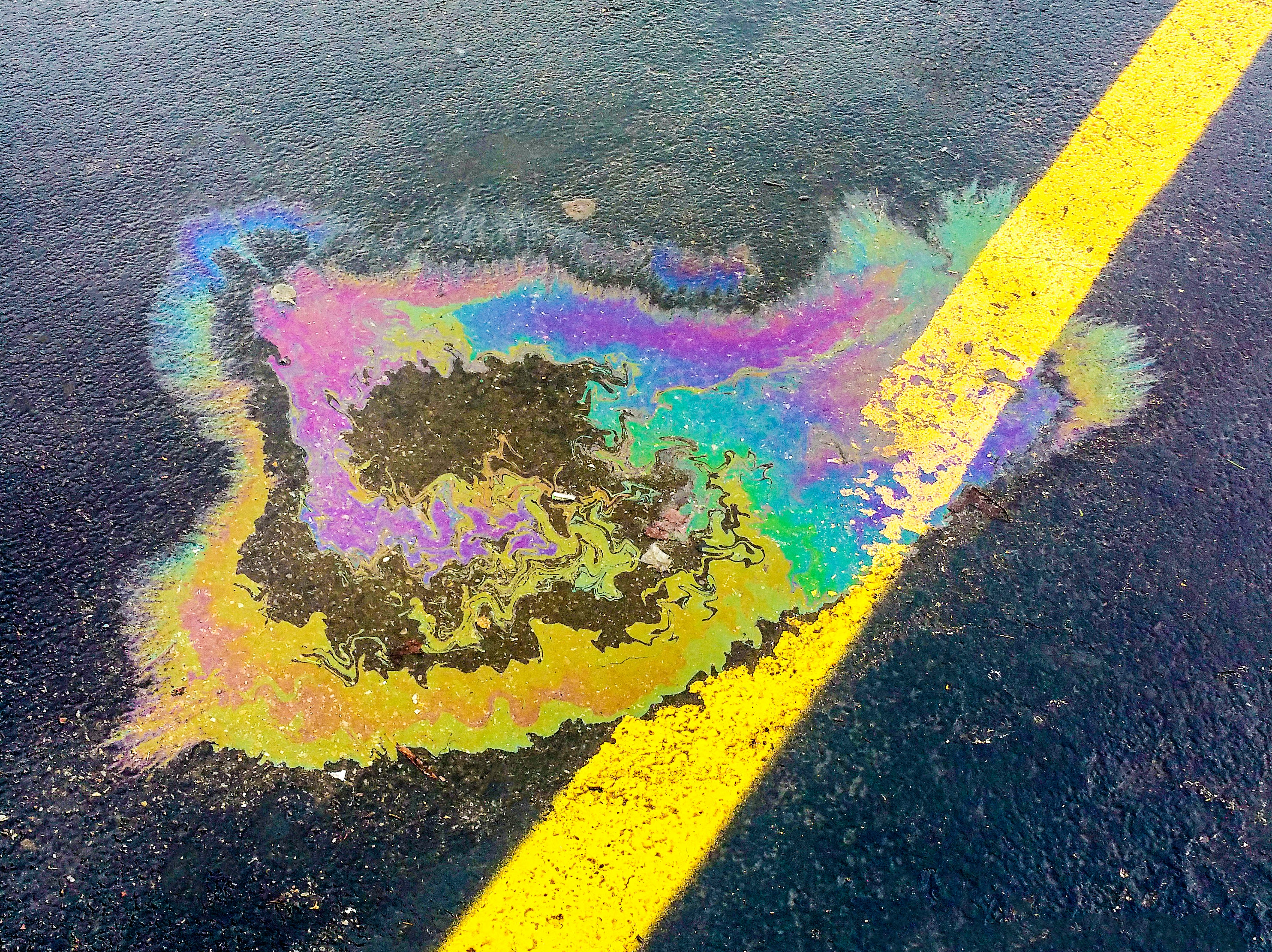
Visible light is incident on a beaker of water () with a thin film of oil on top (, nm).
a) For which wavelengths will the reflection be the brightest?
b) For which wavelengths will there be no reflected light?
The visible wavelengths range from 400 nm (purple) to 700 nm (red).
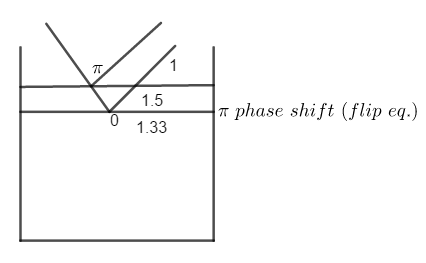
The ray that reflects off the layer of oil into air has a phase shift of since oil has a higher index of refraction (hard boundary condition).
The ray that reflects off the water into oil has no phase shift, because water has a smaller index of refraction (soft boundary condition). So the two reflected beams are out of phase by pi.
Therefore we have a phase shift overall, and have to swap the equations once.
Part a)
Constructive interference:
with
The possible wavelengths are given by:
Part b)
Destructive interference:
with
The possible wavelengths are given by:

Mark Yourself Question
- Grab a piece of paper and try this problem yourself.
- When you're done, check the "I have answered this question" box below.
- View the solution and report whether you got it right or wrong.
Practice: Hanging Film
A thin film of thickness and refractive index is hanging from the ceiling.
a) Write the equations for constructive and destructive interference of the two reflected beams.
b) What is the minimum thickness required so that the two wavelengths nm and nm both reflect with maximum intensity?