0:00 / 0:00
Introduction to Buffers
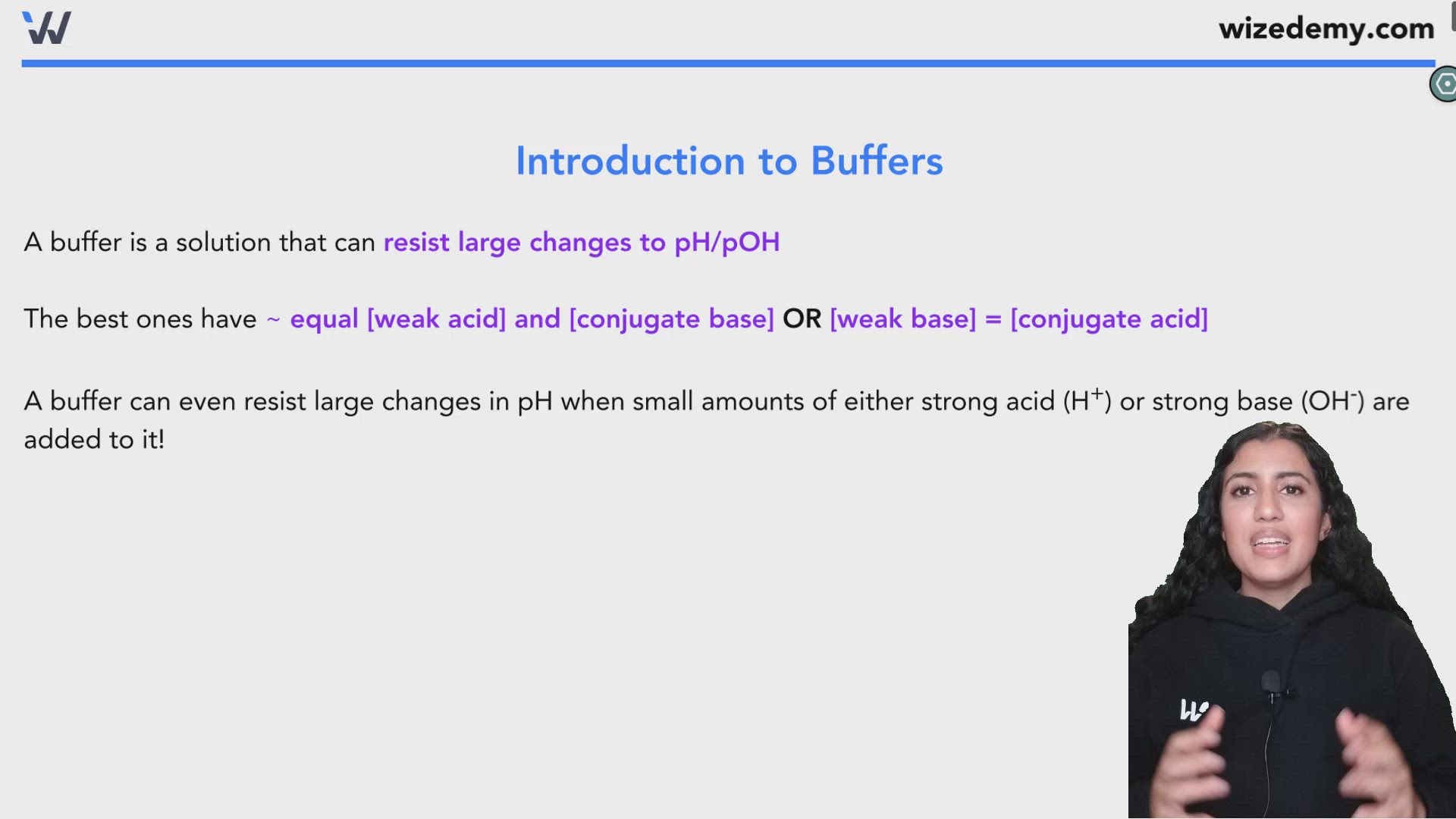
A buffer is a solution that can resist large changes to pH/pOH
The best ones have ~ equal [weak acid] and [conjugate base] OR [weak base] = [conjugate acid]
A buffer can even resist large changes in pH when small amounts of either strong acid (H+) or strong base (OH-) are added to it!
Example:

Buffer Capacity – the extent to which a buffer can resist changes in pH when an acid or base is added.
- A solution with more weak base, [A-], has a higher buffer capacity for addition of strong acid.
- A solution with more weak acid, [HA], has a higher buffer capacity for addition of strong base.
- When all of HA or A- has been consumed and only one conjugate exists, the mixture is no longer a buffer and therefore the buffering capacity has been exceeded.
0:00 / 0:00
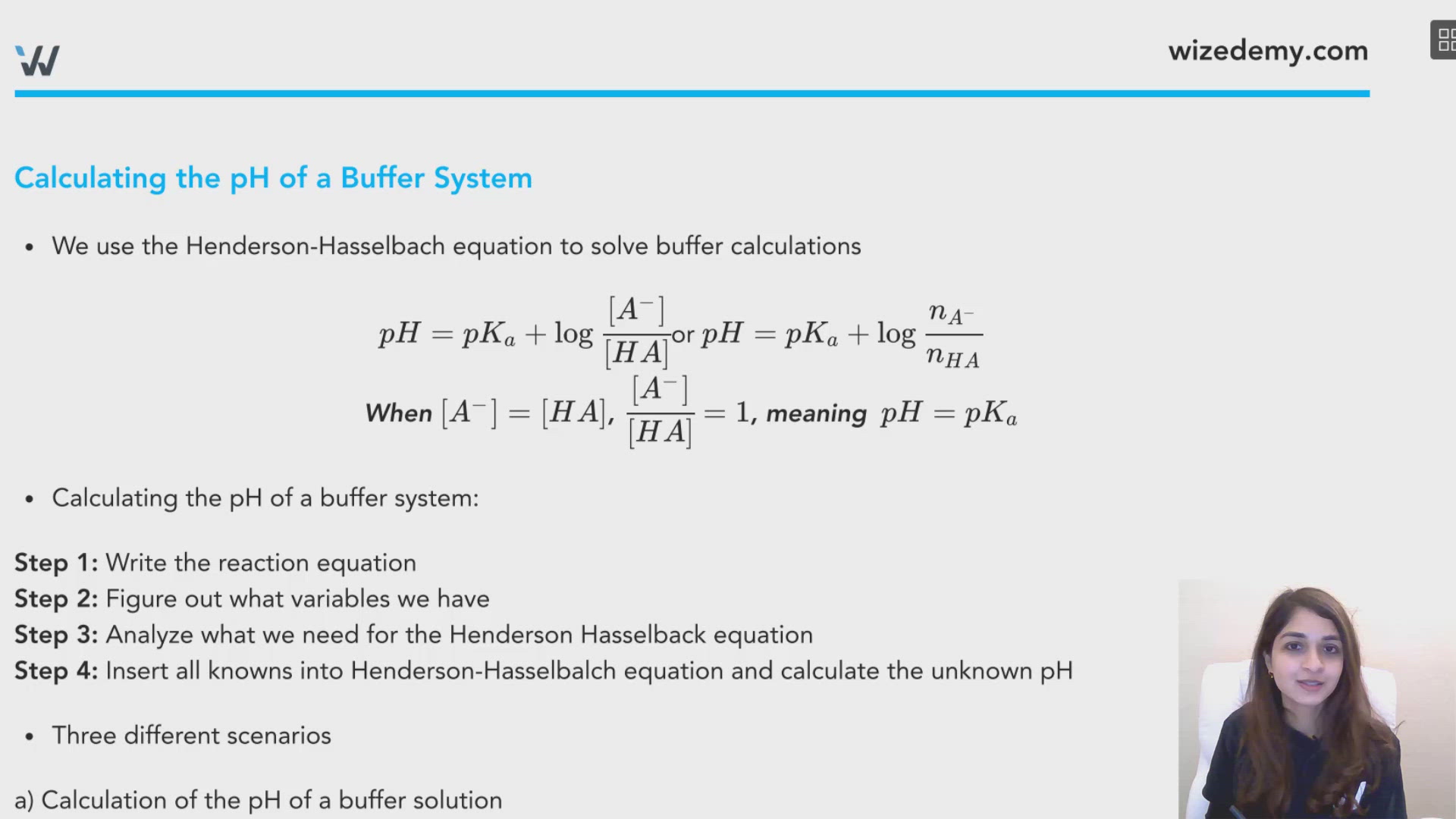
Calculating the pH of a Buffer System
- We use the Henderson-Hasselbach equation to solve buffer calculations
or
When , , meaning
- Calculating the pH of a buffer system:
Step 1: Write the reaction equation
Step 2: Figure out what variables we have
Step 3: Analyze what we need for the Henderson Hasselback equation
Step 4: Insert all knowns into Henderson-Hasselbalch equation and calculate the unknown pH
- Three different scenarios
a) Calculation of the pH of a buffer solution
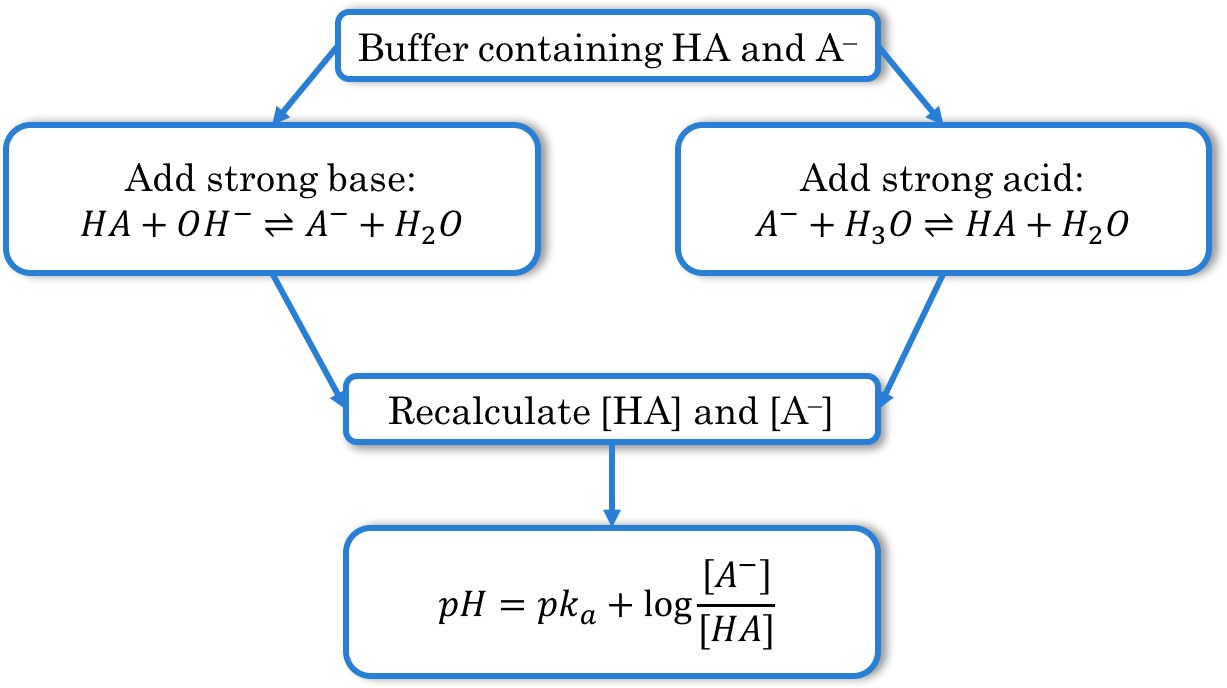
b) Calculation of the pH of a buffer solution after addition of a small amount of strong acid
c) Calculation of the pH of a buffer solution after addition of a small amount of strong base

0:00 / 0:00
Buffers Problem Type 1
1) Calculate the pH of a buffer solution
You can do this using the way we learned before:
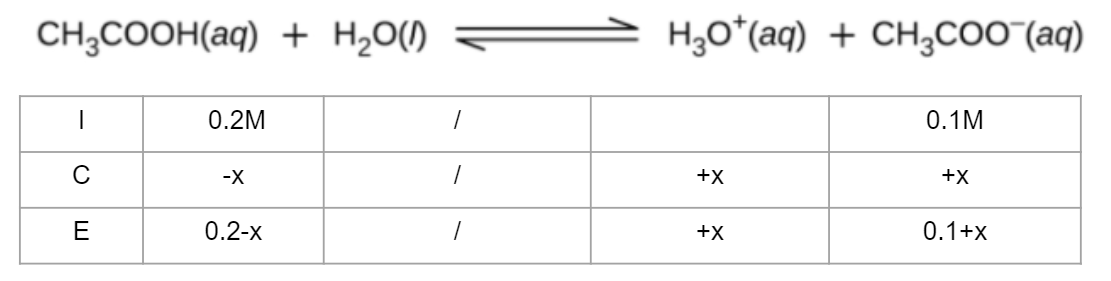
Given Ka you will be able to solve for x, x=[H+], then plug in the [H+] to pH=-log[H+] and solve for pH!
1) Calculate the pH of a buffer solution
The good news is that for buffers we can use equations to make this much simpler!
Henderson-Hassalbalch Equation
pH is the pH of solution
We can get the pKa of the buffer from the Ka of the buffer that will be provided
[A-] is the concentration of the conjugate base part of the buffer
[HA] is the concentration of the weak acid part of the buffer
Wize Tip
When we are given the Ka of the buffer we can solve for pKa and then plug in the concentrations of the weak acid and its conjugate base directly into the HH equation to solve for pH of the buffer solution!
Henderson-Hassalbalch Equation
We said that in a buffer we want ~ equal concentrations of a weak acid and its conjugate base...
Looking at the HH equation, what would happen to that equation if we let [HA]=[A-]?
log1=0 so pH=pKa
Wize Concept
A 1:1 ratio of [A-]: [HA] will always make pH=pKa .
This is why we want to build a buffer with a pKa close to the desired pH
Note: There is another form of the HH equation we can use if the buffer is made of a weak base and its conjugate acid (this one is used much less commonly).
0:00 / 0:00
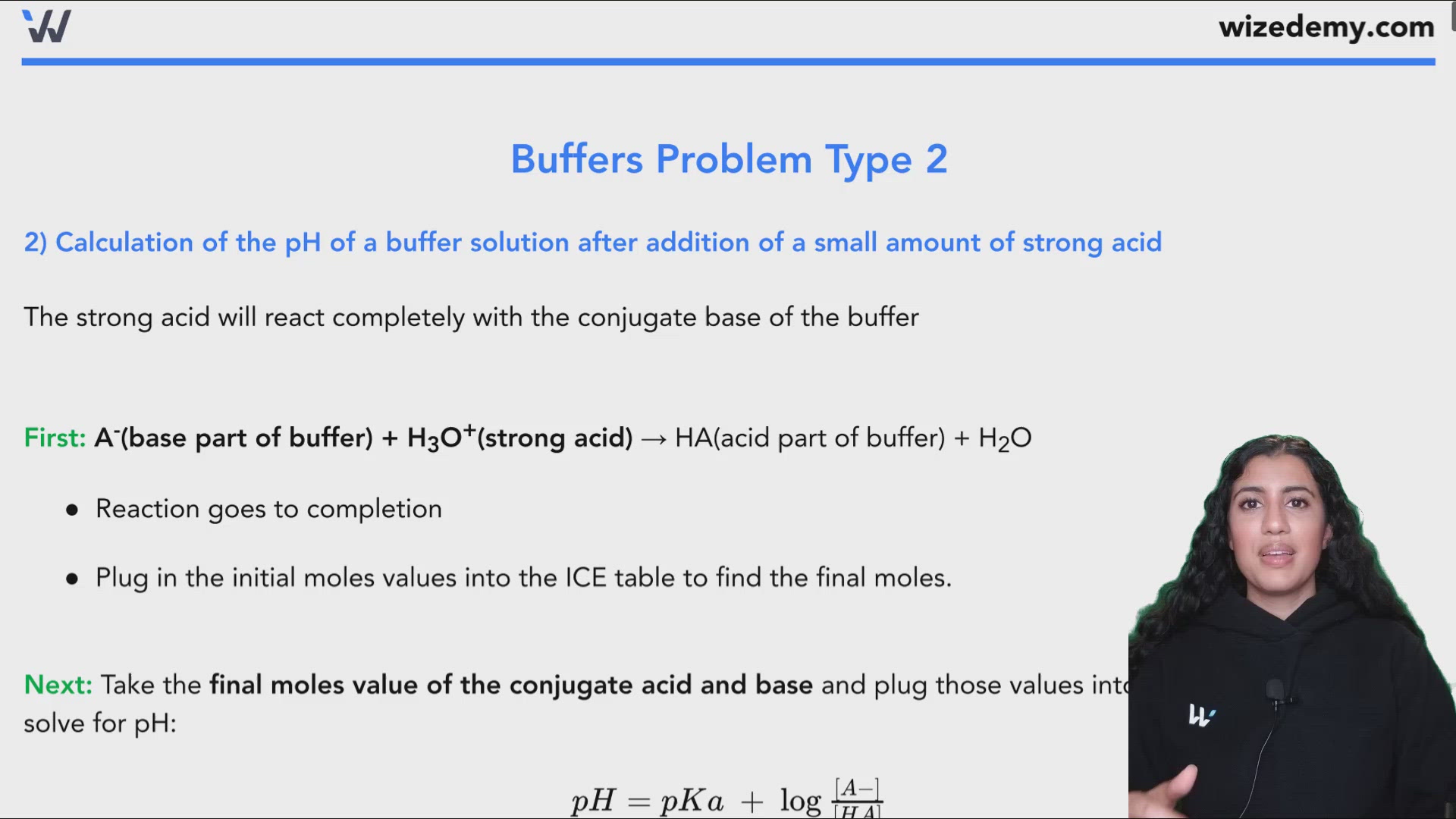
Buffers Problem Type 2
2) Calculation of the pH of a buffer solution after addition of a small amount of strong acid
The strong acid will react completely with the conjugate base of the buffer
First: A-(base part of buffer) + H3O+(strong acid) → HA(acid part of buffer) + H2O
- Reaction goes to completion
- Plug in the initial moles values into the ICE table to find the final moles.
Next: Take the final moles value of the conjugate acid and base and plug those values into the HH equation to solve for pH:
0:00 / 0:00
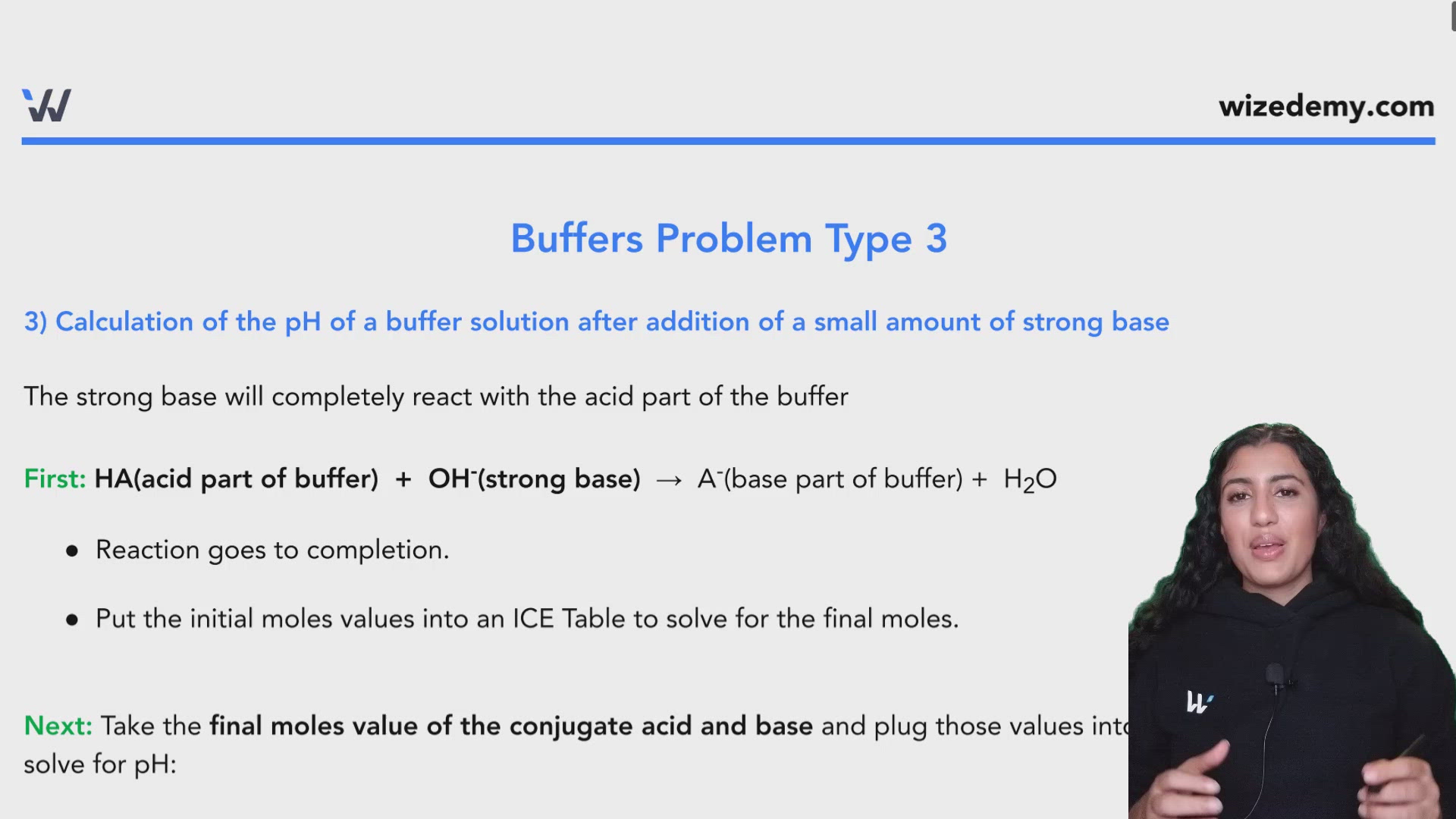
Buffers Problem Type 3
3) Calculation of the pH of a buffer solution after addition of a small amount of strong base
The strong base will completely react with the acid part of the buffer
First: HA(acid part of buffer) + OH-(strong base) → A-(base part of buffer) + H2O
- Reaction goes to completion.
- Put the initial moles values into an ICE Table to solve for the final moles.
Next: Take the final moles value of the conjugate acid and base and plug those values into the HH equation to solve for pH: