Wize University Biochemistry Textbook > Carbohydrate Metabolism
Oxidative Phosphorylation
0:00 / 0:00
Electron Carriers
Donors
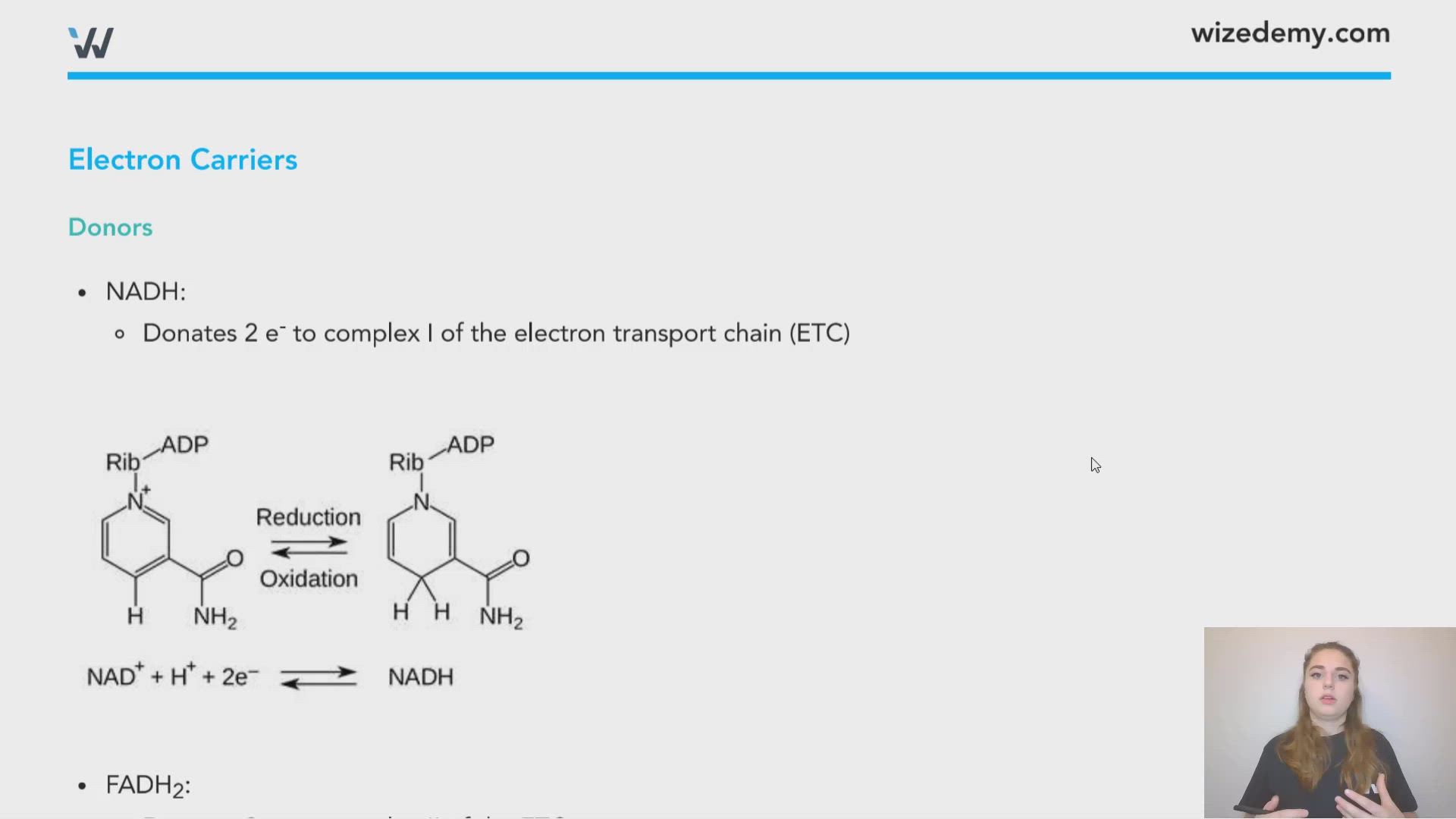
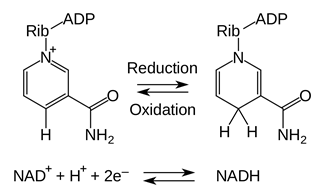
- NADH:
- Donates 2 e- to complex I of the electron transport chain (ETC)
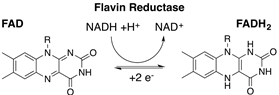
- FADH2:
- Donates 2 e- to complex II of the ETC
Prosthetic groups
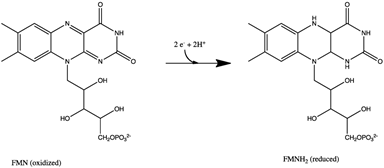
- FMN:
- Found in complex I of the ETC
- Accepts 2 e-
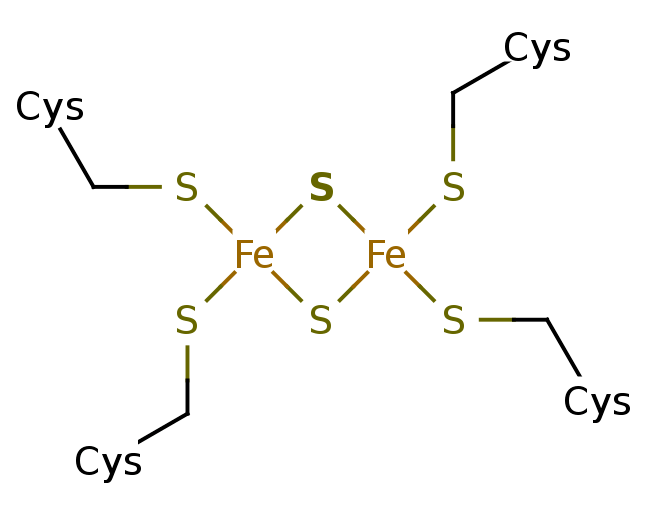
- Iron-sulfur clusters:
- Found in Complexes I, II, and III
- Accept 1 e-
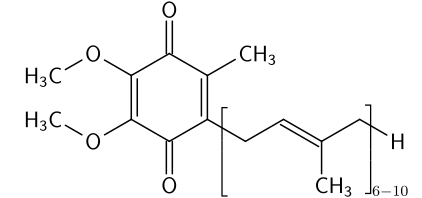
- Coenzyme Q (ubiquinone):
- Shuttles electrons form complexes I & II to Complex III
- Accepts 2 e-
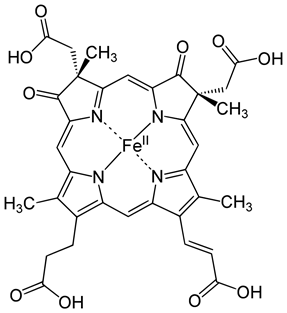
- Cytochromes:
- Heme-containing proteins (possess protoporphyrin IX moiety)
- Can accept 1 e-
- Cytochrome a – Complex IV
- Cytochrome b – Complex III
- Cytochrome c – Complex III
- Copper ions:
- Protein bound in complex IV
- Can accept 2 e-
- Oxygen:
- The final Electron acceptor (from complex IV)
- One O2 accepts 4 e- form 4 cytochrome c proteins
Wize Tip
Carry 1 e-
- Iron-sulfur clusters
- Cytochromes
- Copper ions
Carry 2 e-
- NADH
- FADH2
- FMN
- Coenzyme Q
- O2

0:00 / 0:00
The Electron Transport Chain
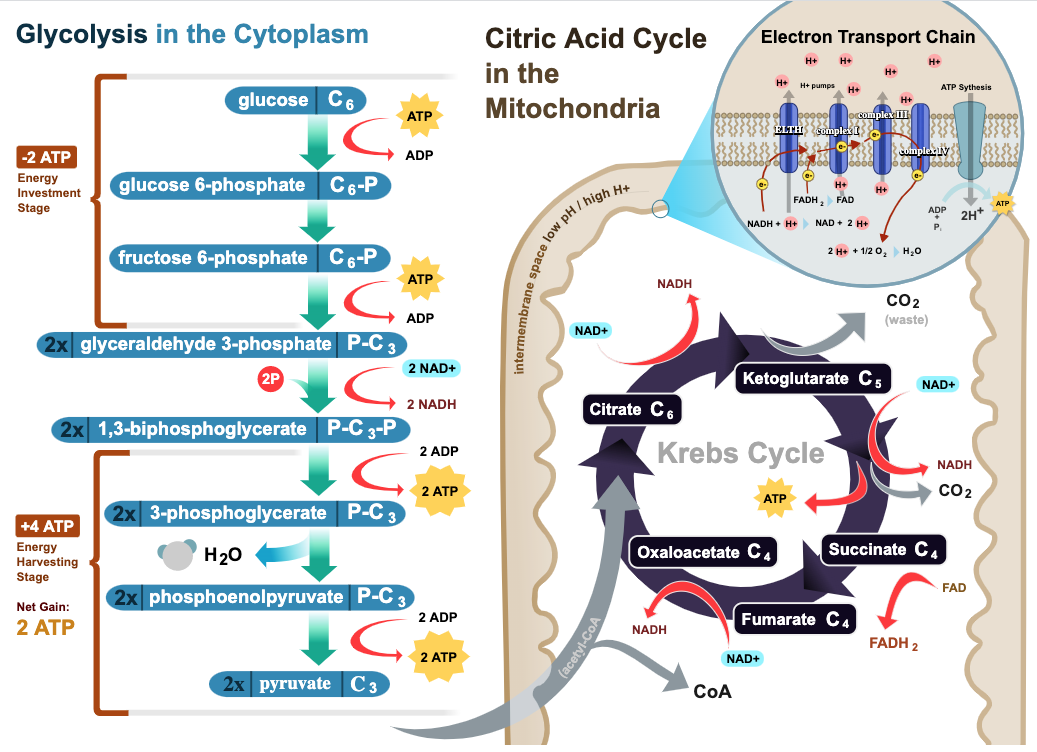
Glycolysis, pyruvate processing, and the citric acid cycle transferred energy from glucose to 10 NADH and 2 FADH2 and produced 4 ATP by substrate level phosphorylation.
- The electron carriers NADH and FADH2 are then used to produce more ATP by oxidative phosphorylation by transferring electrons to the electron transport chain.
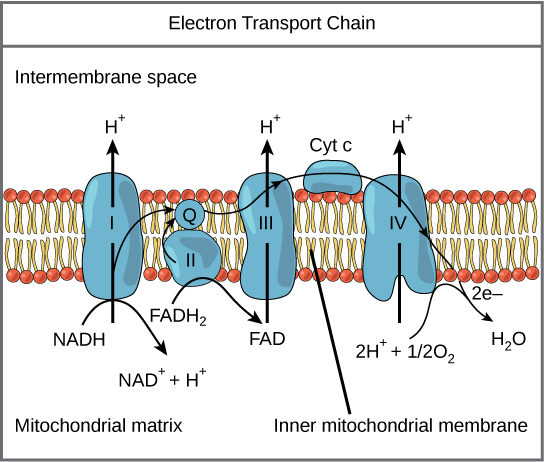
- The electron transport chain consists of a series of 4 transmembrane complexes and a transmembrane ATP synthase.
- The energy from NADH and FADH2 is used to transport H+ ions across the membrane to generate an electrochemical gradient.

The electron transport chain can be broken down into the following steps:
- NADH transfers electrons to complex I, which transports 4 H+ across the membrane. The 4 electrons (e-) are transported by coenzyme Q (CoQ) to complex III.

- FADH2 transfers electrons to complex II. The electrons (e-) are transported by coenzyme Q (CoQ) to complex III. (NOTE: no H+ are transported by complex II).

- Complex III transfers electrons to complex IV through cytochrome C. Complex III transports 4 H+ across the membrane.
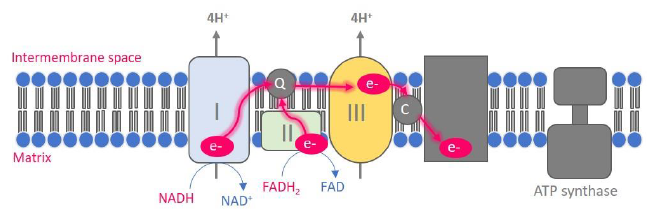
- Complex IV transfers electrons to reduce ½ O2 to H2O. Complex IV transports 2 H+ across the membrane.

- The electrochemical gradient that was generated in steps 1 through 4 is used to synthesize ATP. H+ ions flow through ATP synthase to produce ATP from ADP and Pi. This is called oxidative phosphorylation.

ATP YIELD: 30 - 32 ATP per glucose (Note: 2 ATP from glycolysis + 2 from TCA cycle)
Summary
0:00 / 0:00
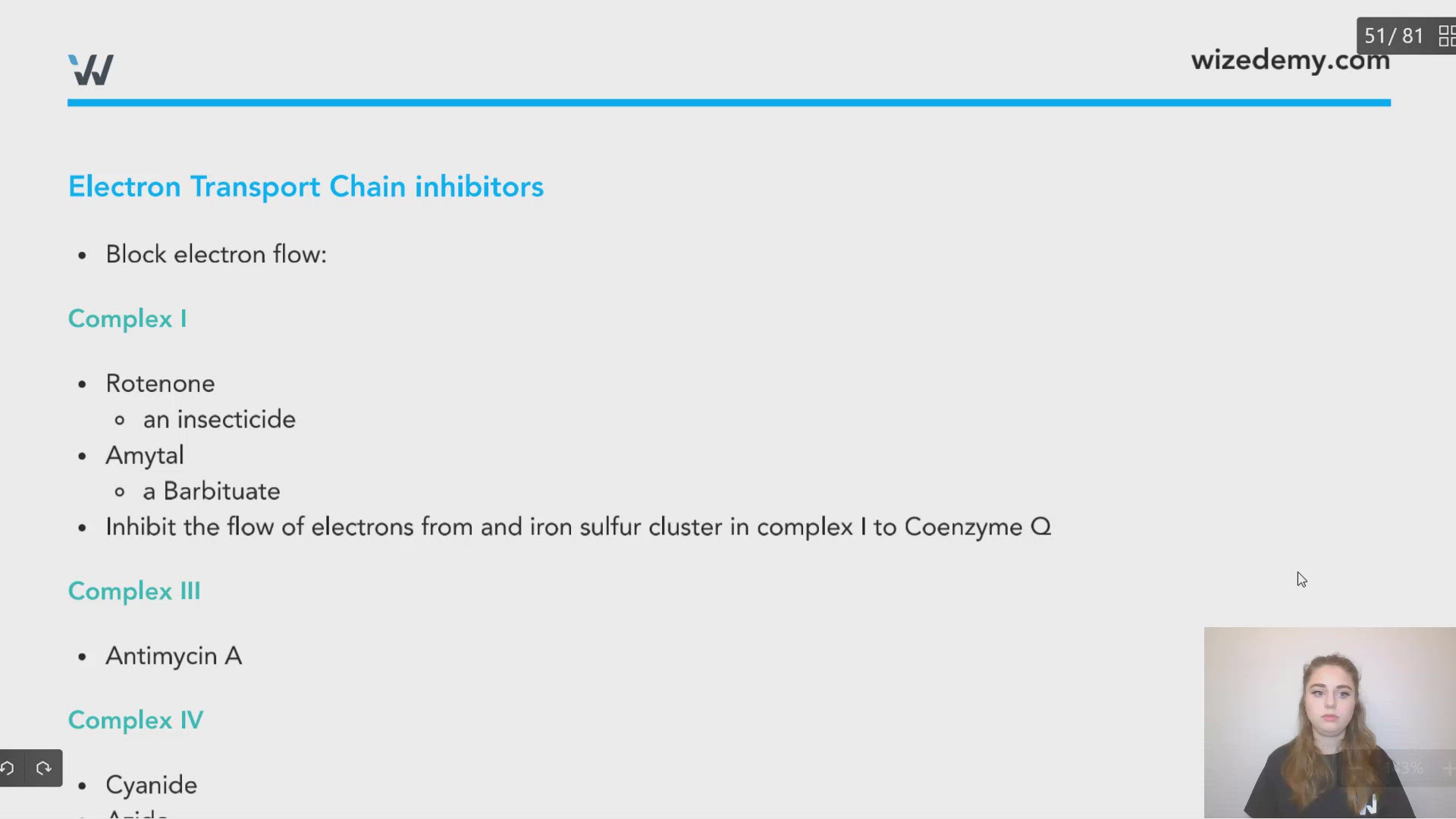
Electron Transport Chain inhibitors
- Block electron flow:
Complex I
- Rotenone
- an insecticide
- Amytal
- a Barbituate
- Inhibit the flow of electrons from and iron sulfur cluster in complex I to Coenzyme Q
Complex III
- Antimycin A
Complex IV
- Cyanide
- Azide
- CO
Uncouplers
- Disrupt the H+ gradient
- 2,4-Dinitrophenol (DNP)
- Carbonylcyanide-p-trifluoromethoxyphenylhydrazone (FCCP)
- Salicylate
https://commons.wikimedia.org/wiki/File:Figure_07_04_01.jpg. Creative Commons Attribution 4.0 International license.

0:00 / 0:00
ATP and the Proton Motive Force (PMF)
Adenosine TriPhosphate is an energy storage molecule. It stores potential energy (PE) between the negative charges of the phosphate groups.

Wize Tip
Keeping those negatively charged phosphates next to one another is like keeping three people who really hate each other locked in a small closet.
ATP hydrolysis releases free energy (negative ΔG).

How Does the Cell Create ATP?
- ATP is not the only way cells store energy. Another way is by generating an electrochemical gradient. Example: During cellular respiration in our cells, electron energy is used to pump H+ across the plasma membrane to generate an electrochemical gradient called the proton motive force (PMF).
- The PMF can then be used to synthesize ATP.

The amount of energy stored across a membrane can be calculated using the formula:
R = gas constant (8.314 J/mol K)
T = temperature in K
= molar concentration of X on the outside of the membrane
= molar concentration of X on the inside of the membrane
0:00 / 0:00
ATP Synthesis
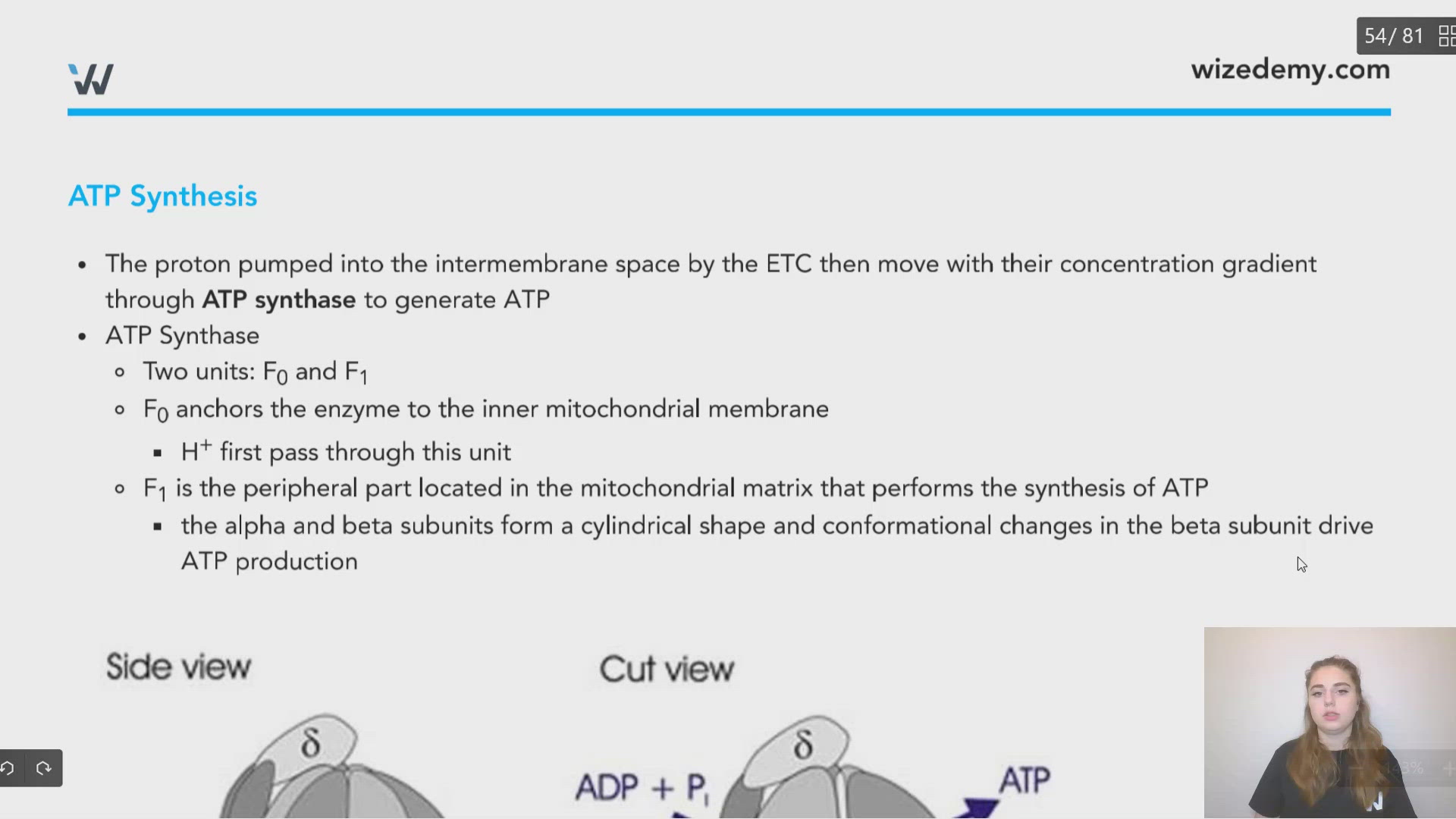
- The proton pumped into the intermembrane space by the ETC then move with their concentration gradient through ATP synthase to generate ATP
- ATP Synthase
- Two units: F0 and F1
- F0 anchors the enzyme to the inner mitochondrial membrane
- H+ first pass through this unit
- F1 is the peripheral part located in the mitochondrial matrix that performs the synthesis of ATP
- the alpha and beta subunits form a cylindrical shape and conformational changes in the beta subunit drive ATP production
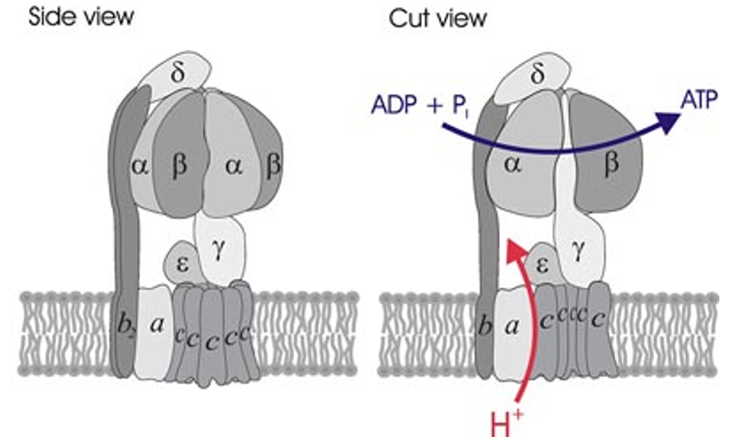
- The 3 beta subunits of F1 rotate between three stages:
- Open (empty)
- Loose (ADP + Pi)
- Tight (ATP)
- The flow of H+ drives this rotation
- 4H+ needed per ATP (3 for synthesis, 1 for export via ATP-ADP translocase)
P/O ratios
- The phosphate/oxygen ratio
For NADH:
4𝑥𝐻+ + 𝑥𝐴𝐷𝑃 + 𝑥𝑃𝑖 → 𝑥𝐴𝑇𝑃
1/2𝑂2 + 2𝑒− + 2𝐻+ → 𝐻2𝑂
Therefore, the P/O ratio = 2.5
For FADH2:
4𝑥𝐻+ + 𝑥𝐴𝐷𝑃 + 𝑥𝑃𝑖 → 𝑥𝐴𝑇𝑃
1/2𝑂2 + 2𝑒− + 2𝐻+ → 𝐻2𝑂
Therefore, the P/O ratio = 1.5
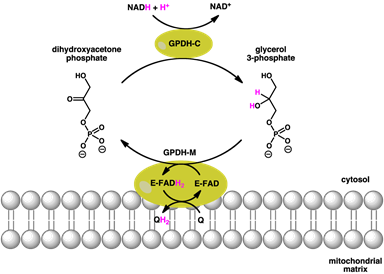
Cytosol derived NADH
- Has a P/O ratio of 1.5
- NADH can not cross the inner mitochondrial membrane so it is converted to FADH2 via the glycerophosphate shuttle
Wize Tip
Know how many ATP molecules are generated per glucose molecule, assuming 4H+/ATP made.
- Review cheat sheet at the end of this unit
0:00 / 0:00
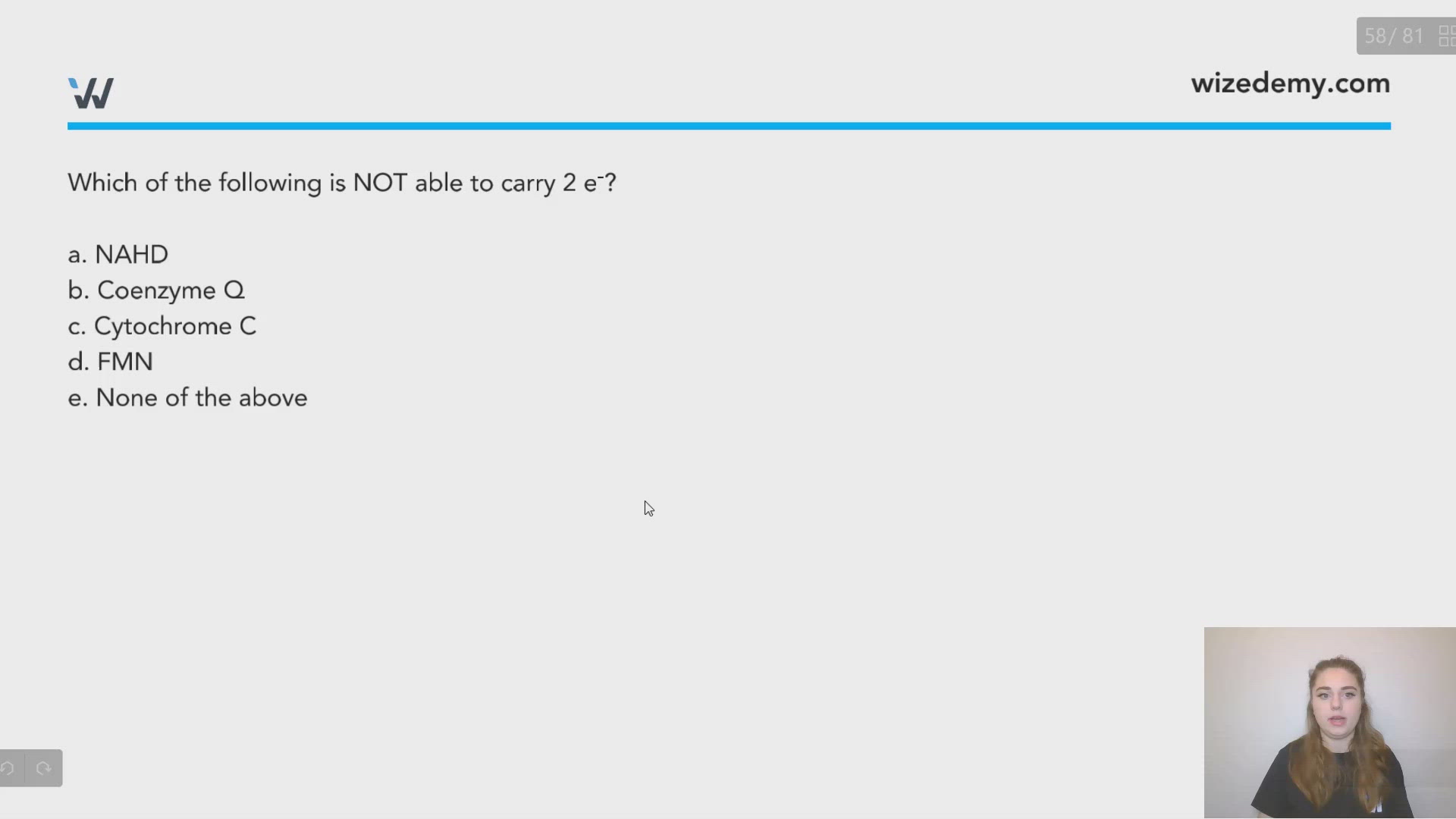
Which of the following is NOT able to carry 2 e-?
a. NAHD
b. Coenzyme Q
c. Cytochrome C
d. FMN
e. None of the above
c. Cytochrome C has a heme group and can only carry 1 e-.
0:00 / 0:00
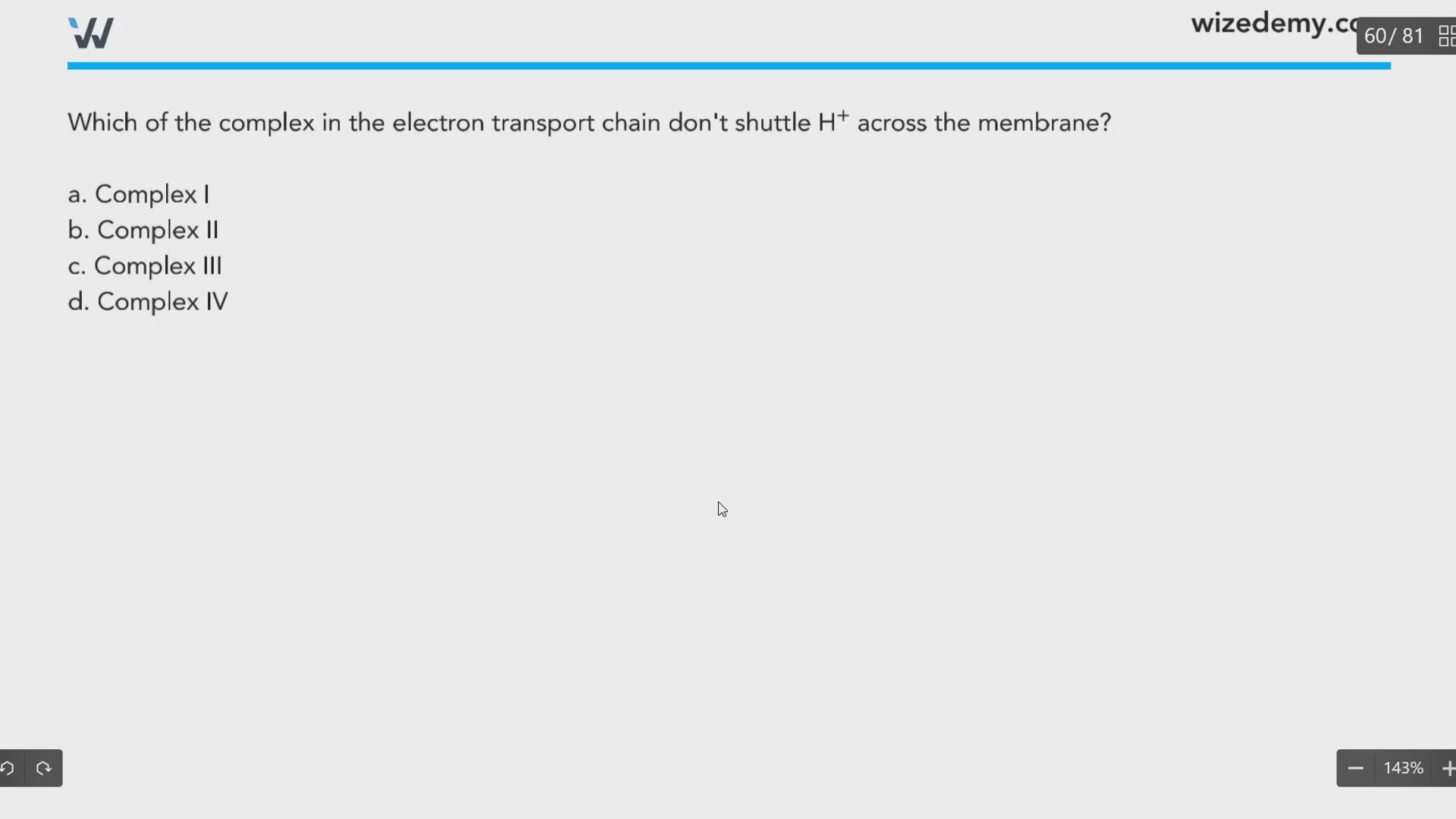
Which of the complex in the electron transport chain don't shuttle H+ across the membrane?
a. Complex I
b. Complex II
c. Complex III
d. Complex IV
b. Complex II does not transport protons across the boarder.
0:00 / 0:00
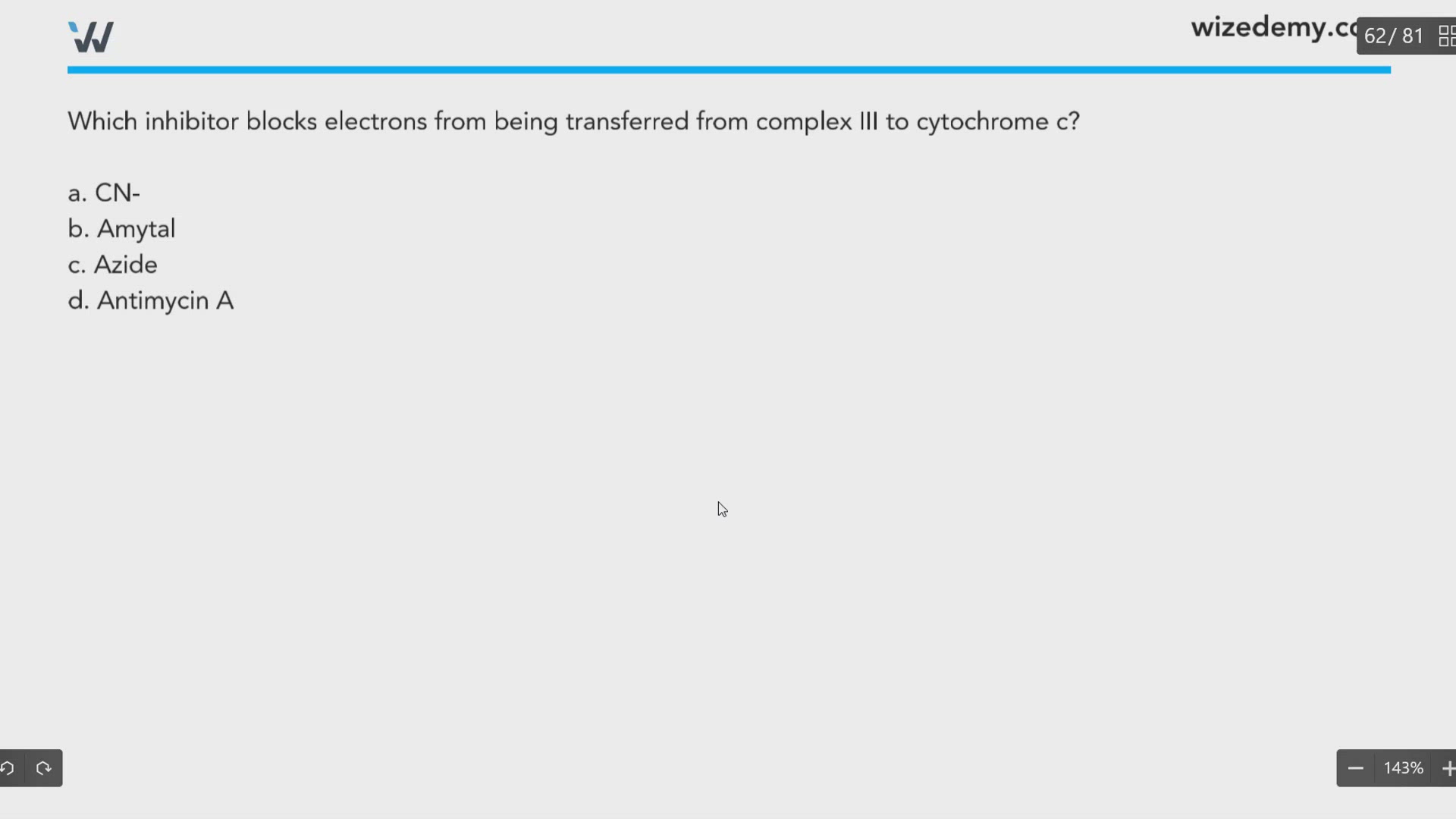
Which inhibitor blocks electrons from being transferred from complex III to cytochrome c?
a. CN-
b. Amytal
c. Azide
d. Antimycin A
d. Antimycin A
ATP Production Overview:
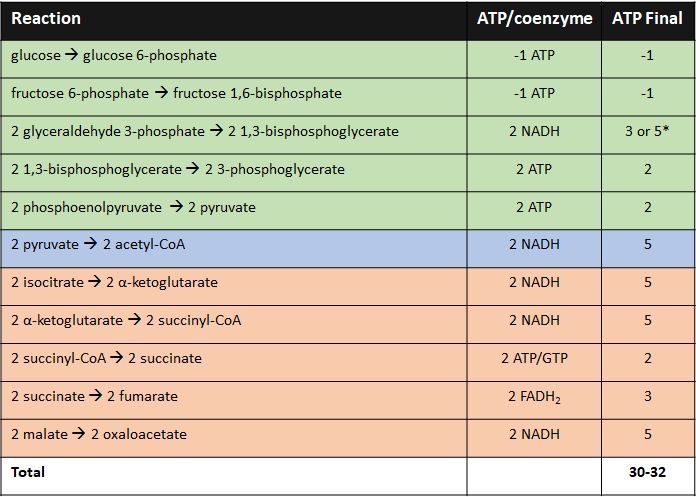
* Cytosolic NADH will only produce 3 ATP because it will be converted to FADH2 to enter the electron transport chain
Green: Gylcolysis reactions
Blue: Pyruvate Dehydrogenase Complex
Red: Citric Acid Cycle reactions