Wize University Biochemistry Textbook > DNA Replication and Repair
DNA Repair and Recombination
0:00 / 0:00
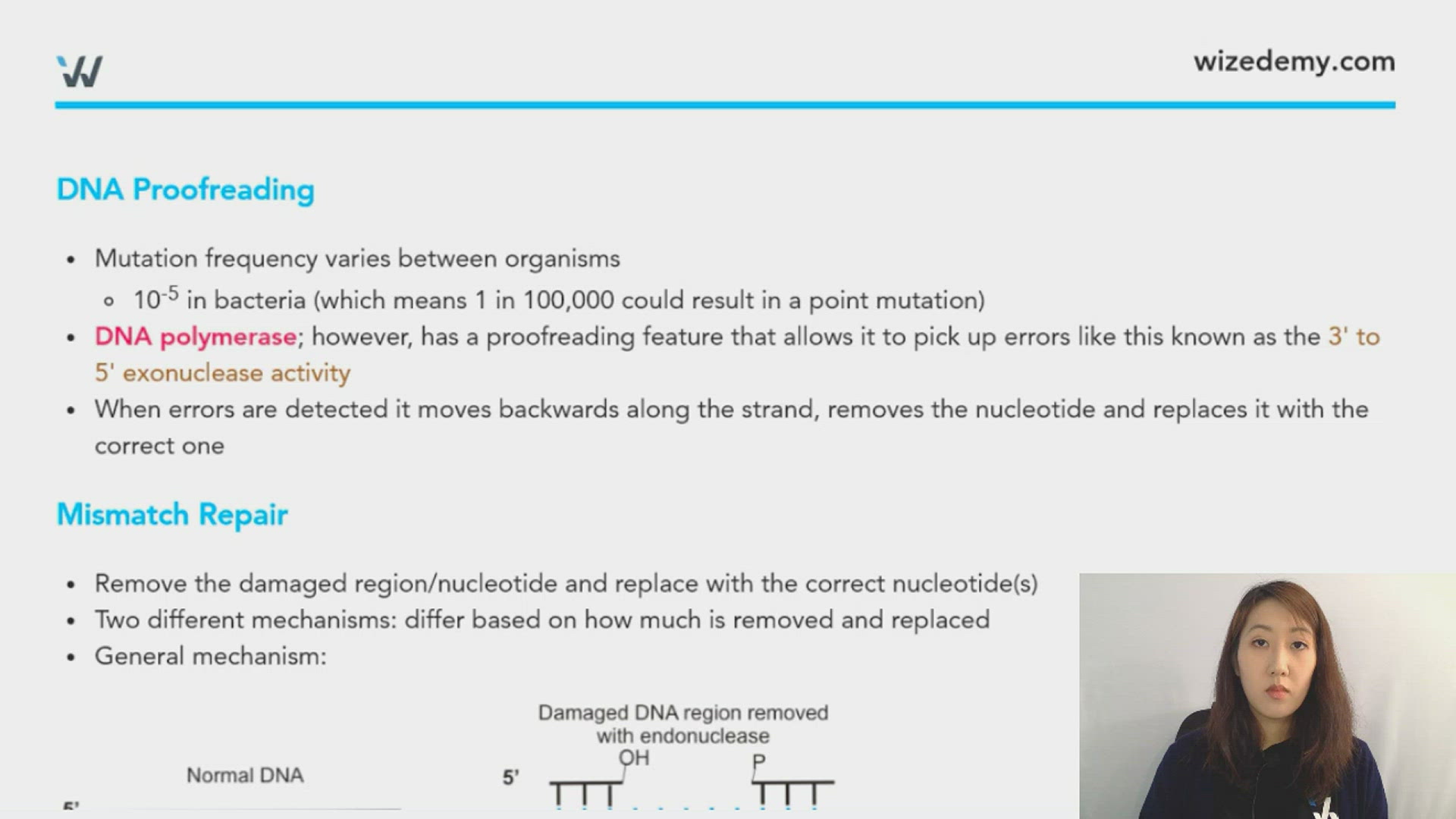
DNA Proofreading
- Mutation frequency varies between organisms
- 10-5 in bacteria (which means 1 in 100,000 could result in a point mutation)
- DNA polymerase; however, has a proofreading feature that allows it to pick up errors like this known as the 3' to 5' exonuclease activity
- When errors are detected it moves backwards along the strand, removes the nucleotide and replaces it with the correct one
Mismatch Repair
- Remove the damaged region/nucleotide and replace with the correct nucleotide(s)
- Two different mechanisms: differ based on how much is removed and replaced
- General mechanism:
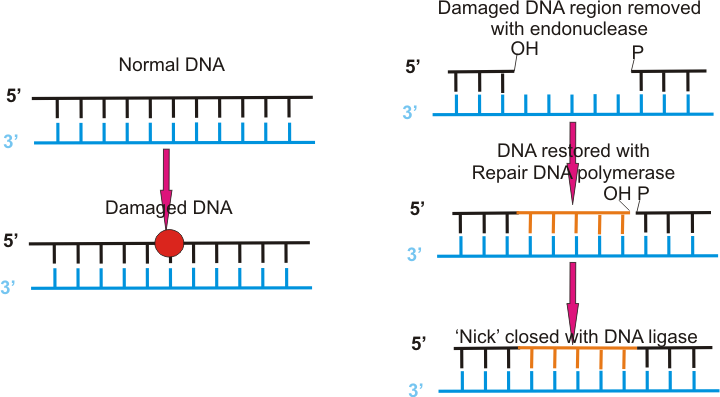
- Involves endonuclease enzyme: cleaves DNA
- DNA polymerase: synthesizes new portion of DNA or adds correct nucleotide
- DNA ligase closes the gap
Base Excision Repair
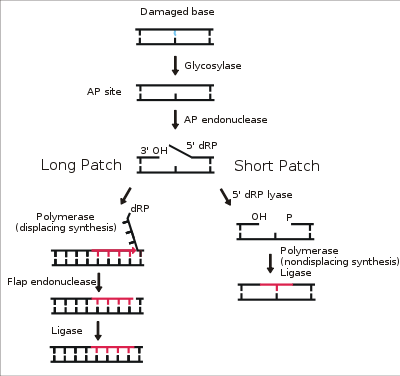
- This is performed by a glycosylase enzyme which detects the incorrect nucleotide
- Cleaves the bond between the base and the sugar at the position to remove the base
- Removes one nucleotide at a time
- An endonuclease enzyme then makes a nick on the DNA backbone to remove the region using 5' to 3' exonuclease activity
- Synthesis of the correct strand is made by DNA polymerase
- DNA ligase then comes in to close the gaps
Nucleotide Excision Repair (NER)
- Repairs environmental damage to DNA structure (eg. UV light causes a distortion in the helix structure)
- Uses endonuclease to cleave the whole region (12-24 nucleotides) out
- DNA polymerase makes a non-damage strand
- Ligase closes the gap
0:00 / 0:00
Repair of DNA Strand Breaks
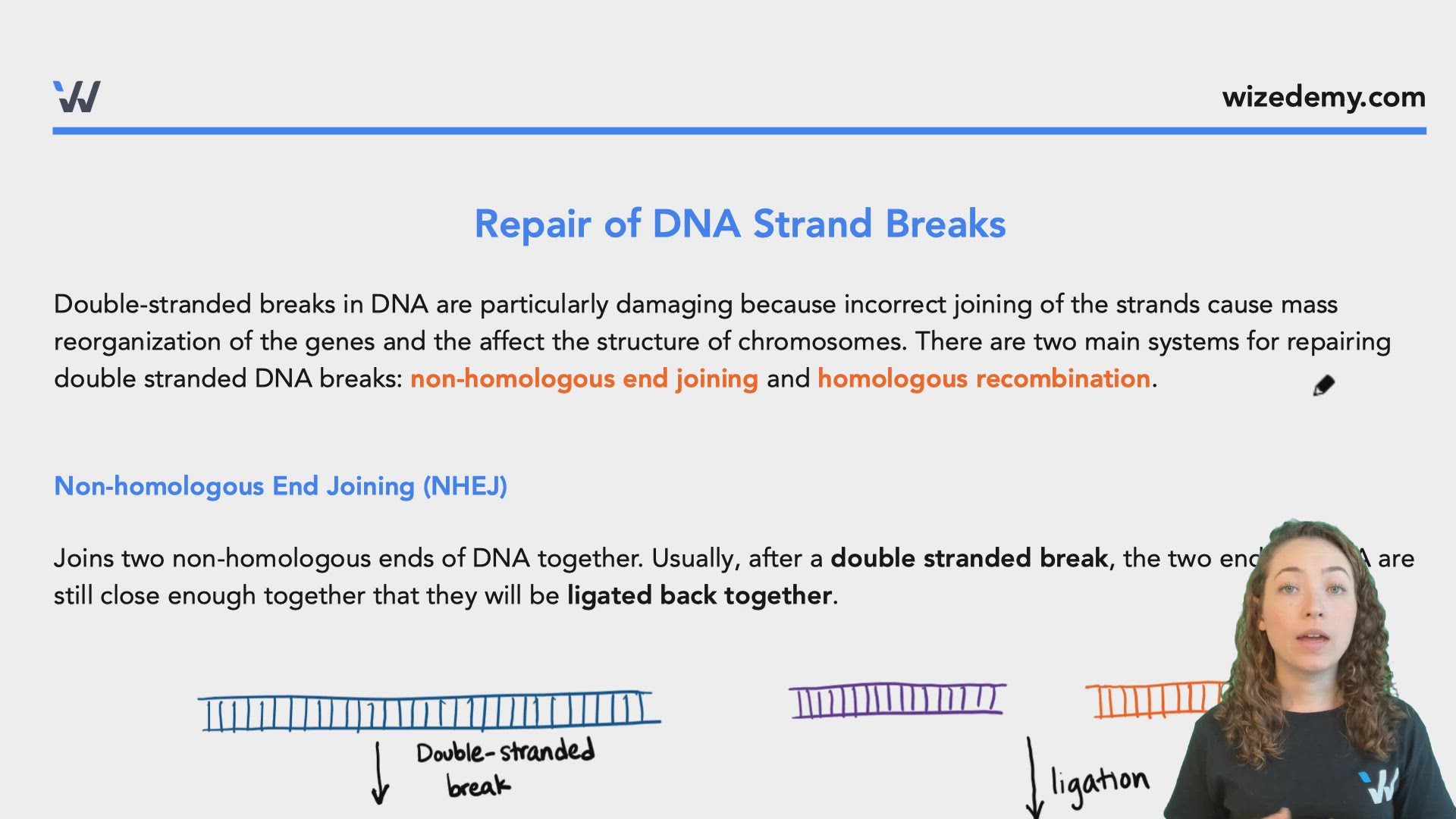
Double-stranded breaks in DNA are particularly damaging because incorrect joining of the strands cause mass reorganization of the genes and the affect the structure of chromosomes. There are two main systems for repairing double stranded DNA breaks: non-homologous end joining and homologous recombination.
Non-homologous End Joining (NHEJ)
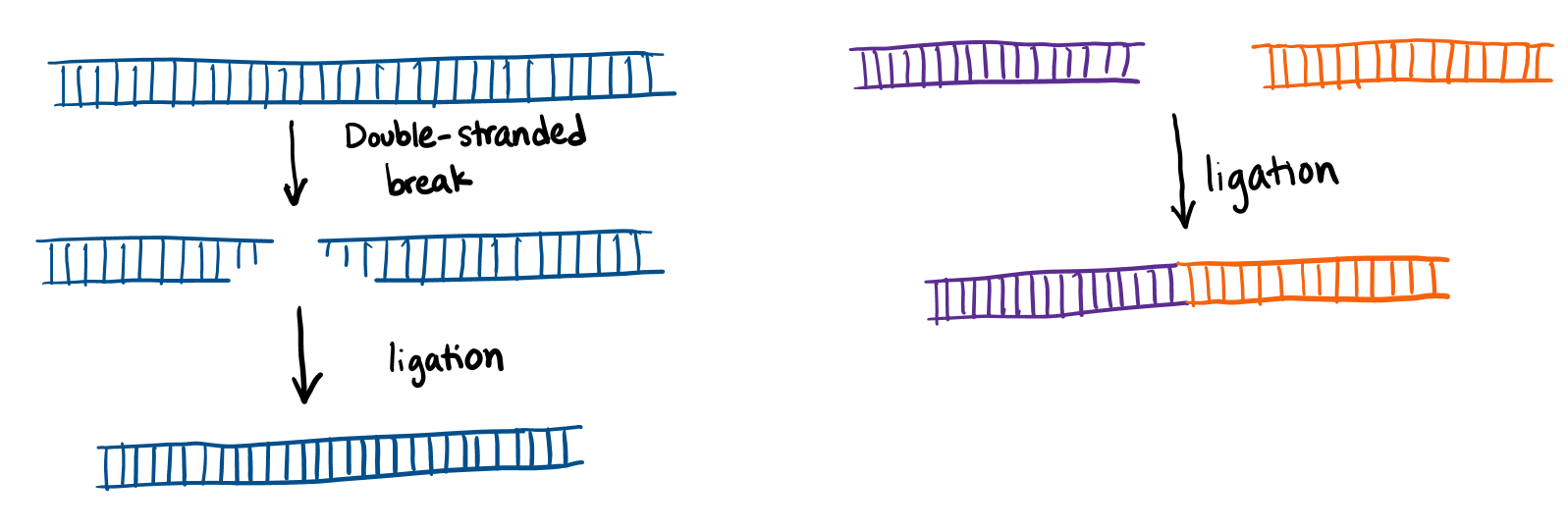
Joins two non-homologous ends of DNA together. Usually, after a double stranded break, the two ends of DNA are still close enough together that they will be ligated back together.
Problems with Non-homologous End Joining:
- Causes minor deletions as base pairs from either ends of the DNA fragments are lost (usually this is not harmful as the majority of DNA is non-coding or intronic DNA).
- Genes can end up joined together resulting in a chimeric genes. This can in turn result in changes to cell function or even cancer.
Homologous Recombination
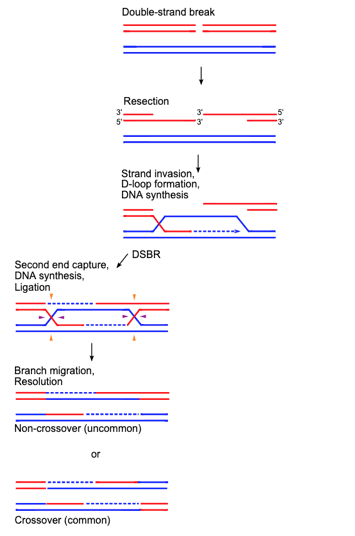
The damaged DNA sequence is copied from an undamaged or highly similar (homologous) copy of the DNA. The break is repaired by an exchange of two different DNA strands, referred to as recombination.
- Homologous recombination can be used to repair nicks in replication forks as well as double stranded breaks in DNA and is error free!
- The Holliday structure can be resolved in two different ways, yielding two different products. Therefore, double-stranded breaks repaired through homologous recombination has potentially FOUR different outcomes.
- Homologous recombination also provides a mechanism for creating genetic diversity in the offspring of two parents.
0:00 / 0:00
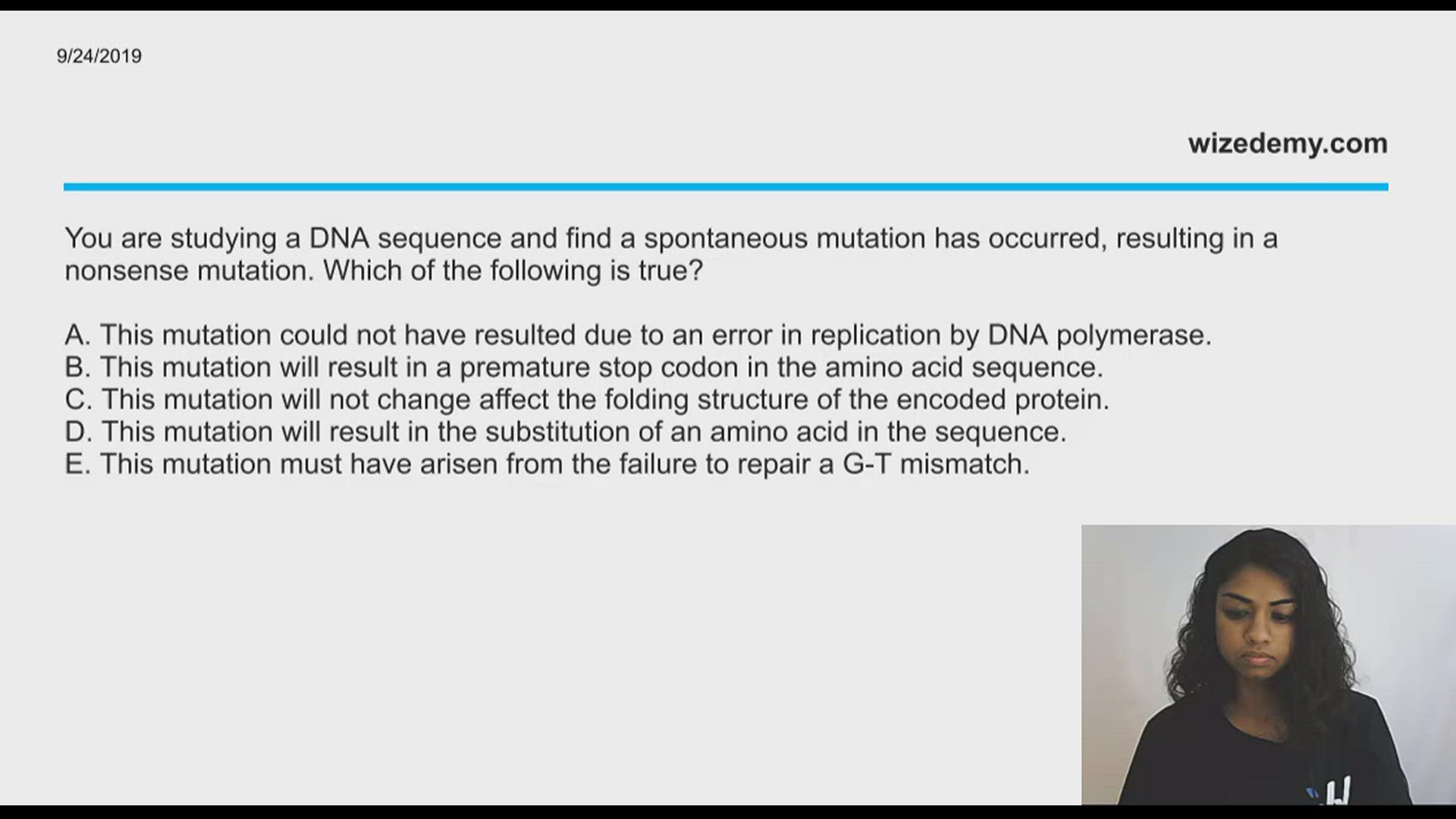
You are studying a DNA sequence and find a spontaneous mutation that has occurred, resulting in a nonsense mutation. Which of the following is true?
A. This mutation could not have resulted due to an error in replication by DNA polymerase.
B. This mutation will result in a premature stop codon in the amino acid sequence.
C. This mutation will not change affect the folding structure of the encoded protein.
D. This mutation will result in the substitution of an amino acid in the sequence.
E. This mutation must have arisen from the failure to repair a G-T mismatch.
B is the correct answer.
A. False- With the given information, it is unknown how the mutation arose. It could have been an error in replication, exposure to environmental chemicals/toxins, a spontaneous mutation, etc.
B. True- A nonsense mutation results in a premature stop codon in the amino acid sequence.
C. False- a nonsense mutation will almost certainly affect protein folding structure, possibly resulting in a non-functional, truncated protein.
D. False- A missense mutation results in the substitution of an amino acid
E. False- As stated in (A), there is not enough information to say that this mutation MUST have arisen from a G-T mismatch.
0:00 / 0:00
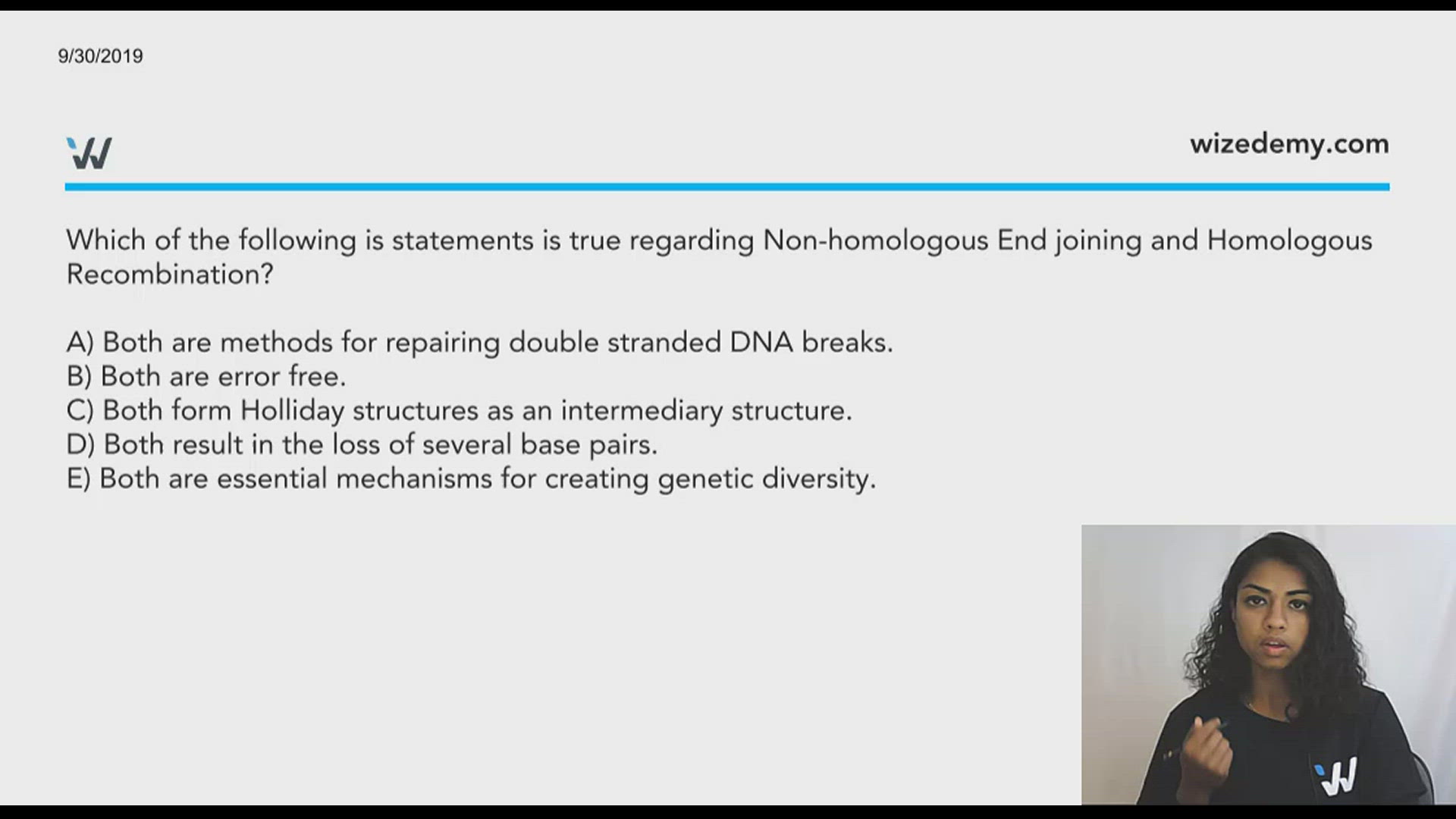
Which of the following statements is true regarding Non-homologous End Joining and Homologous Recombination?
A) Both are methods for repairing double-stranded DNA breaks.
B) Both are error-free.
C) Both form Holliday structures as an intermediary structure.
D) Both result in the loss of several base pairs.
E) Both are essential mechanisms for creating genetic diversity.
A is the correct answer. Both NHEJ and HR are methods for repairing double-stranded DNA breaks
A) True
B) False- Only HR is error-free. NHEJ results in minor deletions
C) False- Holliday structures only appear in HR
D) False- Base pairs are only lost in NHEJ
E) False- Only HR is essential for creating genetic diversity. NHEJ can actually lead to detrimental chimeric genes.
What is the primary method by which DNA polymerase fixes errors while it is actively replicating the DNA?